

AAPC CPC Questions and Answers Guarantee you Oass the Test Easily
Share Latest CPC DUMP with 451 Questions and Answers
NEW QUESTION # 235
A patient arrives with stridor and in respiratory distress. The provider performs a micro laryngoscopy using a Parson's laryngoscope and magnifying telescope. A bronchoscopy was also performed using a 2.5 Stortz bronchoscope. The findings include subglottic web and stenosis with laryngeal edema suggestive of reflux. There was also significant collapse of the trachea at the carina and into the main bronchi bilaterally.
What CPT coding is reported?
- A. 31622, 69990
- B. 31622, 31526-51, 69990
- C. 31629, 31526-51
- D. 31622, 31526-51
Answer: D
Explanation:
1. Procedure and CPT Code Selection:
The provider performed both a bronchoscopy and a microlaryngoscopy to evaluate the patient's airway due to respiratory distress and stridor.
Code 31622 is used for a diagnostic bronchoscopy, which includes the inspection of the trachea, carina, and bronchial structures. Since the bronchoscopy was diagnostic and no additional therapeutic procedures were performed, this is the appropriate code.
Code 31526 is for direct laryngoscopy with the use of an operating microscope or telescope (microlaryngoscopy). This code is appropriate given the use of a Parson's laryngoscope and magnifying telescope to inspect the larynx.
2. Modifier 51:
Modifier 51 is added to 31526 to indicate that it was performed in conjunction with another procedure (31622, bronchoscopy). Modifier 51 denotes multiple procedures without the necessity of a separate incision.
3. Exclusion of Code 69990:
Code 69990 is used for the use of an operating microscope in microsurgery but is not coded separately when the procedure (such as microlaryngoscopy) already includes visualization with a microscope or telescope as part of the CPT descriptor. Thus, 69990 is not separately reported in this scenario, per CPT guidelines.
4. AAPC and CPT Coding Guidelines:
The guidelines specify that when visualization or microlaryngoscopy is inherently part of the procedure (as in 31526), 69990 should not be billed separately. Also, the use of Modifier 51 for multiple procedures in the same session is appropriate.
Therefore, the verified answer, following the CPT and AAPC coding rules, is A. 31622, 31526-51.
NEW QUESTION # 236
(A 14-month-old male with a unilateral complete cleft lip and alveolar cleft palate had prior repair of the cleft lip. He now presents forreconstruction of the palatewith closing the fissure in the soft tissue of thealveolar ridge with bone graft. What CPT coding is reported?)
- A. 0
- B. 42210, 20900
- C. 42200, 20900
- D. 1
Answer: D
Explanation:
This scenario describes apalatoplasty(repair of cleft palate) withclosure of the alveolar ridgeusing abone graft.
CPT code42210is the code that captures palatoplasty withclosure of the alveolar ridgeand associated bone grafting work as part of the reconstructive procedure described. Because the bone graft is part of the defined palatoplasty service in this code concept, you donotseparately report a generic bone graft harvesting code such as20900in the way the answer options suggest. The distractor42200is associated with a more limited palate repair (not matching the alveolar ridge closure with graft detail), and42205does not reflect the specific alveolar ridge closure with bone grafting described in the question stem. CPC exam strategy: identify the mostcomprehensive cleft palate repairthat matches the documentation; when a CPT code description includes the specific additional work (like alveolar ridge closure with graft), code that single comprehensive service.
NEW QUESTION # 237
(A provider documents "pericarditis with effusion" in the assessment. Based on medical terminology, which structure is inflamed?)
- A. The blood vessels supplying the heart
- B. The sac surrounding the heart
- C. The inner lining of the heart chambers
- D. The heart muscle
Answer: B
Explanation:
Medical terms here are very literal.Peri-meansaround,cardirefers to theheart, and-itismeansinflammation.
Sopericarditisis inflammation of thepericardium, thefibrous sac surrounding the heart. "With effusion" indicatesfluid accumulationin that pericardial space (pericardial effusion), which can be clinically important because significant effusion may impair heart filling (tamponade risk), but the question is strictly asking which structure is inflamed. Distractors map to other "card-" terms:myocardium(heart muscle) would be
"myocarditis,"endocardium(inner lining of chambers/valves) would be "endocarditis," and blood vessels supplying the heart arecoronary arteries(inflammation would not be termed pericarditis). On CPC exams, identifyingprefix + root + suffixis the fastest method: peri (around) + cardi (heart) + itis (inflammation) # pericardium inflamed.
NEW QUESTION # 238
Preoperative diagnosis: Right thigh benign congenital hairy nevus. *1
Postoperative diagnosis: Right thigh benign congenital hairy 0 nevus.
Operation performed: Excision of right thigh benign congenital>1
nevus, excision size with margins 4.5 cm and closure size 5 cm.
Anesthesia: General.0
Intraoperative antibiotics: Ancef.0
Indications: The patient is a 5-year-old girl who presented with her parents for evaluation of her right thigh congenital nevus. It has been followed by pediatrics and thought to have changed over the past year. Family requested excision. They understood the risks involved, which included but were not limited to risks of general anesthesia, infection, bleeding, wound dehiscence, and poor scar formation. They understood the scar would likely widen as the child grows because of the location of it and because of the age of the patient. They consented to proceed.
Description of procedure: The patient was seen preoperatively in > I the holding area, identified, and then brought to the operating room. Once adequate general anesthesia had been induced, the patient's right thigh was prepped and draped in standard surgical fashion. An elliptical excision measuring 6 x 1.8 cm had been marked. This was injected with Lidocaine with epinephrine, total of 6 cc of 1% with 1:100,000. After an adequate amount of time, a #15 blade was used to sharply excise this full thickness.
This was passed to pathology for review. The wound required # limited undermining in the deep subcutaneous plane on both sides for approximately 1.5 cm in order to allow mobilization of the skin for closure. The skin was then closed in a layered fashion using 3-0 Vicryl on the dermis and then 4-0 Monocryl running subcuticular in the skin, the wound was cleaned and dressed with Dermabond and Steri-Strips.
The patient was then cleaned and turned over to anesthesia for S extubation.
She was extubated successfully in the operating room and taken S to the recovery room in stable condition.
There were no complications.
What is the radiology coding for this encounter?
- A. 73560-LT
- B. 73560-26-LT
- C. 0
- D. 73562-26
Answer: D
Explanation:
73562 = Knee X-ray, 3 views
-26 = Professional component only
NEW QUESTION # 239
Patient has a 5 cm tumor in the left lower quadrant abdominal wall. A horizontal skin incision is made directly over the tumor in the patient's left lower quadrant and dissection was carried down through the dermis and subcutaneous tissue. The tumor is located and completely excised using electrocautery. The specimen is sent immediately to pathology to rule out cancer. What CPTand ICD-10-CM codes are reported?
- A. 22901, C76.2
- B. 22901, D49.2
- C. 22903, R19.04
- D. 22903, D49.2
Answer: D
Explanation:
1. Procedure and CPTCode Selection:
The scenario describes the excision of a 5 cm tumor located in the left lower quadrant of the abdominal wall.
The tumor was excised down to the dermis and subcutaneous layers and removed using electrocautery.
Code 22903 is appropriate for the excision of a soft tissue tumor in the abdominal wall greater than 5 cm, making it the correct CPTcode.
Code 22901 applies to the excision of a soft tissue tumor in the abdominal wall but only for tumors 5 cm or less. Given that the tumor in this case is exactly 5 cm, it meets the threshold for 22903, which is more appropriate here.
2. Diagnosis and ICD-10-CM Code Selection:
ICD-10-CM Code D49.2 is used for a neoplasm of unspecified behavior in the abdominal area, reflecting the fact that the pathology report is pending to determine if the tumor is malignant.
Code C76.2 would be incorrect because it is for malignant neoplasms of unspecified abdominal areas, which we cannot confirm based on the initial excision. Similarly, R19.04 (indicating a mass in the abdominal region) is a symptom code and is not appropriate for a definitive diagnosis when a neoplasm code (D49.2) exists.
3. AAPC and CPTCoding Guidelines:
Per AAPC coding guidelines, the size of the tumor is critical in selecting the correct excision code for abdominal wall neoplasms. Additionally, if the tumor's pathology is not confirmed as malignant, it is coded as a neoplasm of unspecified behavior until further details are known.
Therefore, based on CPTand ICD-10-CM coding guidelines, the verified answer is B. 22903, D49.2.
NEW QUESTION # 240
A 20-year-old female is being seen for the first time by a primary care physician to have a yearly physical. During the examination for the physical, the provider discovers non-inflammed lesions on her legs and arms. The physician performs a complete physical and additional separate documentation for the treatment of the lesions on the bilateral upper and lower extremities. The provider has the patient buy an over-the-counter ointment and will continue to watch them.
What CPT coding is reported for this visit?
- A. 0
- B. 1
- C. 99385-25, 99203
- D. 99385, 99203-25
Answer: C
NEW QUESTION # 241
Patient has cervical spondylosis with myelopathy. The surgeon performed a bilateral posterior laminectomy with facetectomies at each level and foraminotomies performed between interspaces C5-C6 and C6-C7.
Bilateral decompression of the nerve roots is achieved.
What CPT coding is reported?
- A. 63040-50, 63043, 63043
- B. 63050-50
- C. 63045, 63048
- D. 0
Answer: C
Explanation:
* Cervical spondylosis with myelopathy: Condition requiring decompressive surgery.
* Bilateral posterior laminectomy, facetectomies, foraminotomies: Procedures performed to decompress nerve roots.
* Interspaces C5-C6 and C6-C7: Specific levels where the procedures were performed.
CPT code 63045 is used for the initial cervical laminectomy, and 63048 is for each additional segment. The combination covers the decompression across two interspaces.
References: AMA's CPT Professional Edition (current year)
NEW QUESTION # 242
(Which one of the following is an anesthesiaphysical status modifier?)
- A. P1
- B. 2P
- C. AA
- D. QS
Answer: A
Explanation:
Anesthesiaphysical status modifiersare the ASA modifiersP1-P6, which describe the patient's overall systemic health (e.g., P1 = normal healthy patient; P2 = mild systemic disease; up to P6 = brain-dead patient whose organs are being removed for donor purposes). Among the choices,P1is the only ASA physical status modifier.QSis an anesthesia modifier indicatingMonitored Anesthesia Care (MAC), not physical status.
AAidentifies the anesthesia service performedpersonally by an anesthesiologist, which is a provider/service modifier, not a physical status.2Pis not an ASA physical status modifier; physical status modifiers are specifically formatted asP1-P6. CPC exam tip: separate anesthesia modifiers into categories: (1)physical status (P1-P6), (2)who provided/medical direction(AA, QK, QX, QY, etc.), and (3)service circumstancemodifiers (like QS for MAC when applicable). Here, the question explicitly asks for physical status-soP1is correct.
NEW QUESTION # 243
(What is the ICD-10-CM code for amedial meniscus tearof theleft kneedue to arecent football injury?)
- A. S83.242A
- B. M23.202
- C. M23.204
- D. S83.232A
Answer: D
Explanation:
A "recent football injury" indicates anacute traumaticinjury rather than a chronic/old derangement. Acute meniscus tears are coded from theS83.2-category (tear of meniscus, current injury), not theM23.-category (derangement of meniscus due to old tear or injury). The question specifiesmedial meniscus,left knee, and implies aninitial encounterfor the acute injury, so the correct code must include laterality and the 7th characterAfor initial encounter.S83.232Acorresponds to acurrent tear of the medial meniscus, left knee, initial encounter.S83.242Ais a different meniscus specification (not medial).M23.202/M23.204are derangement codes typically used forold tearsor chronic conditions, not an acute recent sports injury. CPC exam tip:
"recent injury" #S-codes, "old tear/derangement" #M23. Mnemonic:S = Sudden (acute),M = Mature (old
/chronic).
NEW QUESTION # 244
A surgeon removes the right and left fallopian tubes and the left ovary via an abdominal incision. How is this reported?
- A. 58720-50
- B. 58700-50
- C. 0
- D. 1
Answer: C
Explanation:
* Bilateral salpingo-oophorectomy: This involves the removal of both fallopian tubes and ovaries.
* Right and left fallopian tubes: Both fallopian tubes are removed.
* Left ovary: Only the left ovary is removed.
* Abdominal incision: The procedure is performed via an abdominal approach.
* 58720: Salpingo-oophorectomy, complete or partial, unilateral or bilateral (separate procedure).
The procedure involves the removal of both fallopian tubes and one ovary, making 58720 the appropriate code.
References:
* AMA's CPT Professional Edition (current year)
* ICD-10-CM (current year), HCPCS Level II (current year)
NEW QUESTION # 245 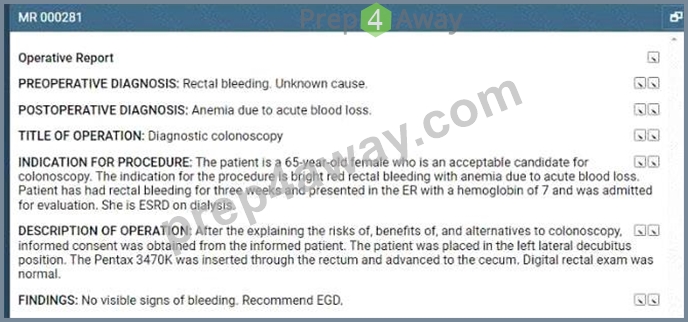
Refer to the supplemental information when answering this question:
View MR 000281
What anesthesia and diagnosis codes are reported for this case?
- A. 00811, D62, N18.6, Z99.2
- B. 00812, D64.9, K62.5, N18.6, Z99.2
- C. 00811, D64.9, K62.5, N18.6, Z99.2
- D. 00812, D62, N18.6, Z99.2
Answer: A
Explanation:
* CPT Code 00811: Anesthesia for lower intestinal endoscopic procedures, endoscope introduced distal to the splenic flexure; diagnostic, with or without collection of specimen(s) by brushing or washing
* This code is reported for anesthesia services provided during a colonoscopy that is diagnostic in nature.
* ICD-10-CM Code D62: Acute posthemorrhagic anemia
* This is the most accurate postoperative diagnosis. The operative report states "Anemia due to acute blood loss."
* ICD-10-CM Code N18.6: End stage renal disease
* This code captures the patient's documented history of ESRD.
* ICD-10-CM Code Z99.2: Dependence on renal dialysis
* This code is necessary to report the patient's dialysis status, as it affects the overall risk of the procedure.
Why other options are incorrect:
* 00812: This code is for therapeutic colonoscopies, not diagnostic.
* D64.9: This code is for anemia, unspecified. D62 is more specific to the patient's condition.
* K62.5: This code is for lower gastrointestinal bleeding, but the anemia is the primary diagnosis in this case.
References:
* CPT Code 00811: Anesthesia for lower intestinal endoscopic procedures, endoscope introduced distal to the splenic flexure; diagnostic, with or without collection of specimen(s) by brushing or washing
* ICD-10-CM Code D62: Acute posthemorrhagic anemia
* ICD-10-CM Code N18.6: End stage renal disease
* ICD-10-CM Code Z99.2: Dependence on renal dialysis
* AAPC Coder's Desk Reference: This resource provides detailed information on coding guidelines and procedures.
NEW QUESTION # 246
A woman who is 19 weeks pregnant is taken to the hospital from her doctor's office due to the detection of no fetal heartbeat and the death of the fetus. Due to the stage of pregnancy, labor is initiated, and the fetus is delivered.
What CPT and ICD-10-CM codes are reported for the delivery of the fetus on the maternal record?
- A. 59821,002.1
- B. 59820, O36.4XX0
- C. 59820, 002.1. Z3A.19
- D. 59821, O36.4XX0, Z3A.19
Answer: D
Explanation:
Procedure Coding (CPT):
59821 - Induced abortion, by vaginal suppository, amniotic fluid injection, or other medical means Used for fetal demise at #14 weeks gestation Labor was medically induced and fetus delivered Diagnosis Coding (ICD-10-CM):
O36.4XX0 - Maternal care for intrauterine death, not applicable or unspecified Correct maternal record diagnosis Z3A.19 - 19 weeks gestation Required per ICD-10-CM guidelines for obstetric encounters Why Other Options Are Incorrect:
A / D - ICD-9 code (002.1) is invalid
C - Missing required gestational age code
NEW QUESTION # 247
A 67-year-old patient has osteomyelitis of the shoulder blade and is in surgery to remove the sequestered section of dead infected fragment bone from surrounding bone.
What CPT code is reported?
- A. 0
- B. 1
- C. 2
- D. 3
Answer: B
Explanation:
The key phrase is "remove the sequestered section of dead infected fragment bone", which is a sequestrectomy performed for osteomyelitis.
23172 describes sequestrectomy of the scapula (shoulder blade).Therefore, C is correct.
NEW QUESTION # 248
A woman who is 19 weeks pregnant is taken to the hospital from her doctor's office due to the detection of no fetal heartbeat and the death of the fetus. Due to the stage of pregnancy, labor is initiated, and the fetus is delivered.
What CPT and ICD-10-CM codes are reported for the delivery of the fetus on the maternal record?
- A. 59821,002.1
- B. 59820, O36.4XX0
- C. 59820, 002.1. Z3A.19
- D. 59821, O36.4XX0, Z3A.19
Answer: D
Explanation:
Procedure Coding (CPT):
59821 - Induced abortion, by vaginal suppository, amniotic fluid injection, or other medical means Used for fetal demise at ≥14 weeks gestation Labor was medically induced and fetus delivered Diagnosis Coding (ICD-10-CM):
O36.4XX0 - Maternal care for intrauterine death, not applicable or unspecified Correct maternal record diagnosis Z3A.19 - 19 weeks gestation Required per ICD-10-CM guidelines for obstetric encounters Why Other Options Are Incorrect:
A / D - ICD-9 code (002.1) is invalid
C - Missing required gestational age code
NEW QUESTION # 249
A 13-year-old established patient is seen for an annual preventive exam. Last visit was two years ago.
What CPT code is reported?
- A. 0
- B. 1
- C. 2
- D. 3
Answer: A
Explanation:
99393 = Preventive visit, established patient, age 5-11
Preventive codes are based on age and patient status, not time since last visit
NEW QUESTION # 250
(A 28-year-old woman who is 36 weeks pregnant withdichorionic/diamniotic twinsdeliveredboth babies vaginally. The same OB provider who delivered the babies provided theantepartum careand will provide thepostpartum care. What CPT and ICD-10-CM codes are reported on the maternal record?)
- A. 59400, 59409-51, O80, O60.14X0, O60.14X1, O30.043, Z37.2, Z3A.36
- B. 59400, 59409-51, O60.14X1, O60.14X2, O30.043, Z37.2, Z3A.36
- C. 59400 × 2, O60.14X1, O60.14X2, O30.043, Z37.2, Z3A.36
- D. 59400 × 2, O80, O60.14X0, O60.14X1, O30.043, Z37.2, Z3A.36
Answer: B
Explanation:
Formultiple gestation vaginal deliveries, CPT global obstetric care is generally reported as the global code for thefirst fetus(here59400: antepartum + vaginal delivery + postpartum), and an additionaldelivery-onlycode for each additional fetus (here59409) with an appropriate modifier (commonly-51in exam-style choices). You donotreport59400 twicebecause the global package is not duplicated for each baby; only the additional delivery service is added for the additional fetus. Diagnosis coding: this is atwin pregnancy, dichorionic
/diamniotic, third trimester#O30.043. Delivery outcome for twins #Z37.2, and weeks of gestation #Z3A.36.
Because delivery occurred at36 weeks(preterm threshold is <37 weeks), and the options use thepreterm labor with preterm deliverycategory with fetus identifiers, the correct pairing shown isO60.14X1 and O60.14X2 (fetus 1 and fetus 2). Option D is the only one matching correct CPT multiple-delivery structure and appropriate diagnosis set.
NEW QUESTION # 251
A patient with empyema requires a Schede thoracoplasty.
What CPT code is reported for this procedure?
- A. 0
- B. 1
- C. 2
- D. 3
Answer: D
Explanation:
The Schede thoracoplasty for empyema is accurately described by CPT code 32905, which covers the radical procedure involving the resection of multiple ribs and often the obliteration of the pleural cavity to treat chronic empyema.
References:
* AMA's CPT Professional Edition (current year)
NEW QUESTION # 252
......
Dumps for Free CPC Practice Exam Questions: https://www.prep4away.com/AAPC-certification/braindumps.CPC.ete.file.html
PDF Dumps 2026 Exam Questions with Practice Test: https://drive.google.com/open?id=1jOMuEEQMkv9vwOUlLAq4FyT8zbmjoTT4