

Free The Open Group (OGBA-101) Certification Sample Questions with Online Practice Test
OGBA-101 Certification Study Guide Pass OGBA-101 Fast
The Open Group OGBA-101 Exam Syllabus Topics:
| Topic | Details |
|---|---|
| Topic 1 |
|
| Topic 2 |
|
| Topic 3 |
|
| Topic 4 |
|
| Topic 5 |
|
NEW QUESTION # 25
Which of the following is a benefit of developing a TOGAF business scenario?
- A. It can be an important aid to vendors in delivering appropriate solutions.
- B. It provides general rules and guidelines to support planning at the enterprise level.
- C. It provides an organizing framework for the change activity in a project.
- D. It provides a versatile approach to business planning.
Answer: A
Explanation:
Developing a TOGAF business scenario provides several benefits, particularly in aiding vendors to deliver appropriate solutions.
TOGAF Business Scenarios:
Business scenarios are used to capture and describe business requirements, helping to identify and understand business needs and challenges.
Role in Vendor Engagement:
Clarity of Requirements: Business scenarios provide clear and detailed descriptions of the business context, needs, and requirements. This helps vendors understand what solutions are necessary to address specific business challenges.
Alignment of Solutions: By providing a comprehensive view of the business environment and requirements, business scenarios ensure that the solutions proposed by vendors are aligned with the actual business needs and strategic goals.
NEW QUESTION # 26
Which of the following is a benefit of value streams and value stream mapping?
- A. Value streams help to ensure that investments and project initiatives are prioritized and funded at an appropriate level commensurate with their value.
- B. Value streams help to identify value, duplication, and redundancy across the enterprise.
- C. Value streams highlight the value of individual work packages needed to develop the business architecture.
- D. Value streams provide a framework for more effective business requirements analysis, case management, and solution design.
Answer: D
Explanation:
According to the TOGAF Business Architecture Guide, value streams play a key role in providing a structured framework that supports more effective analysis of business requirements, case management, and solution design. Value streams offer a high-level, customer-centric view of how value flows through the organization, which helps in aligning business requirements and ensuring solutions are well-targeted to meet those requirements. Role of Value Streams in Business Requirements AnalysisValue streams help stakeholders understand the key stages and outcomes that deliver value to customers or stakeholders. This framework facilitates a clear alignment between business requirements and the value outcomes each requirement supports.
By mapping requirements to specific value stream stages, architects can ensure that requirements are directly tied to business outcomes. Supporting Case ManagementValue streams also provide a structured approach for managing various business cases. By identifying key stages in the value creation process, value streams help in evaluating and prioritizing cases based on their impact on value delivery. This structured approach enhances case management by focusing on value, efficiency, and alignment with organizational goals.
Enhancing Solution DesignSolution design is more effective when informed by a value stream view, as it allows architects to focus on delivering value at each stage of the process. By understanding the flow of value, architects and solution designers can ensure that technology, processes, and capabilities are aligned to support the most critical aspects of the value stream.
This alignment optimizes solution design to meet specific business needs more effectively. Why Option B is CorrectThe TOGAF Business Architecture Guide explicitly states that value streams provide a framework for business requirements analysis, case management, and solution design.
This insight indicates that value streams are instrumental in ensuring that these elements are aligned with how value is delivered within the organization.
NEW QUESTION # 27
Complete the sentence. The architecture domains that are considered by the TOGAF standard as subsets of an overall enterprise architecture are Business, Technology,
- A. Logical and Physical
- B. Application and Data
- C. Information and Data
- D. Capability and Segment
Answer: B
Explanation:
In the TOGAF framework, the architecture domains considered as subsets of an overall enterprise architecture are Business, Technology, Application, and Data. Here's a detailed explanation:
TOGAF Architecture Domains:
Business Architecture: Describes the business strategy, governance, organization, and key business processes.
Data Architecture: Defines the structure of an organization's logical and physical data assets and data management resources.
Application Architecture: Provides a blueprint for the individual applications to be deployed, their interactions, and their relationships to the core business processes of the organization.
Technology Architecture: Describes the logical software and hardware capabilities that are required to support the deployment of business, data, and application services.
Importance of Each Domain:
Business Architecture: Aligns the architecture with the business strategy and goals.
Data Architecture: Ensures that data is structured and managed to support business processes and decisions.
Application Architecture: Ensures that applications are designed and integrated to support business processes.
Technology Architecture: Provides the technology infrastructure needed to support applications and data management.
TOGAF Reference:
Phase B: Business Architecture: Focuses on developing the Business Architecture.
Phase C: Information Systems Architectures: This phase includes both Data Architecture and Application Architecture.
Phase D: Technology Architecture: Focuses on developing the Technology Architecture.
In summary, the TOGAF standard considers Business, Technology, Application, and Data as the architecture domains that are subsets of an overall enterprise architecture.
NEW QUESTION # 28
Consider the following:
You need to analyze a new value stream within the scope of a project.
Which of the following would you use?
- A. Combining information mapping with a business process model.
- B. Converting the value stream stages to entities and then building a logical data model
- C. Heat mapping by value stream stages.
- D. An organization chart showing the business units that work with the enterprise and their value.
Answer: C
Explanation:
In TOGAF and other enterprise architecture practices, analyzing a value stream often involves understanding the various stages of the value stream and assessing how each stage contributes to business value. Heat mapping is a commonly used technique to visualize and analyze these stages, making it the most appropriate choice in this context.
* Understanding Value Streams in TOGAFA value stream represents a high-level view of how value is delivered to customers or stakeholders. It encompasses all the activities necessary to achieve a specific outcome, often broken down into stages. In TOGAF's Business Architecture, value stream mapping is a key activity for analyzing and understanding these value stages, enabling architects to identify areas for improvement.
* Heat Mapping as an Analysis TechniqueHeat mapping by value stream stages is a visualization technique that highlights the effectiveness or performance of each stage in the value stream. By applying a heat map, architects can easily see which stages are performing well (often marked in "cool" colors) and which stages may need improvement (often marked in "hot" colors). This is particularly useful for identifying bottlenecks, redundancies, or inefficiencies within the value stream, which is essential for project analysis.
* Why Other Options are Incorrect:
* Option A (Converting value stream stages to entities and building a logical data model):Building a logical data model involves defining data entities and their relationships, which is more relevant for data architecture. It does not directly contribute to analyzing a value stream's stages or performance within a project scope.
* Option C (An organization chart showing business units and their value):An organization chart shows hierarchical relationships and roles within the enterprise, which does not specifically address value stream stages. While it may help understand which units are responsible for different parts of the value stream, it doesn't provide insight into the performance or effectiveness of each stage.
* Option D (Combining information mapping with a business process model):Information mapping with a business process model is more suited for detailed process analysis. It involves mapping information flows within processes but doesn't directly address analyzing value stream stages.
Value streams are typically at a higher level than detailed business processes, focusing more on outcomes than specific activities.
* Conclusion: Heat mapping by value stream stages (Option B) is the most effective tool for analyzing a new value stream within the project scope, as it provides a visual assessment of each stage's performance and identifies areas for improvement.
References:
TOGAF Standard, Version 9.2, Value Stream Mapping Techniques
NEW QUESTION # 29
Which of the following is a benefit of organization mapping?
- A. An organization map improves the ability to consume, process, and deliver information.
- B. An organization map can be reused for training and employee development.
- C. An organization map highlights inefficiencies and reduces operational costs.
- D. An organization map improves strategic planning.
Answer: D
Explanation:
One of the benefits of organization mapping is that it improves strategic planning2. Organization mapping is a technique that can be used to document and visualize the organizational structure and relationships of an enterprise or a part of it2. Organization mapping can help to align the organizational design with the business strategy, goals, and objectives2. Organization mapping can also help to identify the roles, responsibilities, authorities, accountabilities, and dependencies of different organizational entities2. By providing a clear and consistent view of the organizational landscape, organization mapping can enable better informed and more effective decisions for strategic planning.
NEW QUESTION # 30
Which of the following is a benefit of Value Stream Mapping?
- A. It helps to ensure that investments and project initiatives are prioritized and funded at a level matching with their value.
- B. It helps to identify value, duplication, and redundancy across the enterprise.
- C. It helps to assess an organization's effectiveness at creating, capturing, and delivering value for different stakeholders.
- D. It highlights the value of individual work packages needed to develop the business architecture.
Answer: C
Explanation:
One of the benefits of Value Stream Mapping is that it helps to assess an organization's effectiveness at creating, capturing, and delivering value for different stakeholders2. Value Stream Mapping is a technique that can be used to represent a sequence of activities that create an overall result for a customer, stakeholder, or end user2. Value Stream Mapping can help to identify the value proposition, outcomes, measures, enablers, and dependencies of each activity in the value stream, as well as the overall value flow and performance2. By analyzing the value stream map, the organization can evaluate how well it is meeting the stakeholder needs and expectations, as well as identify opportunities for improvement or innovation.
NEW QUESTION # 31
Refer to the table below: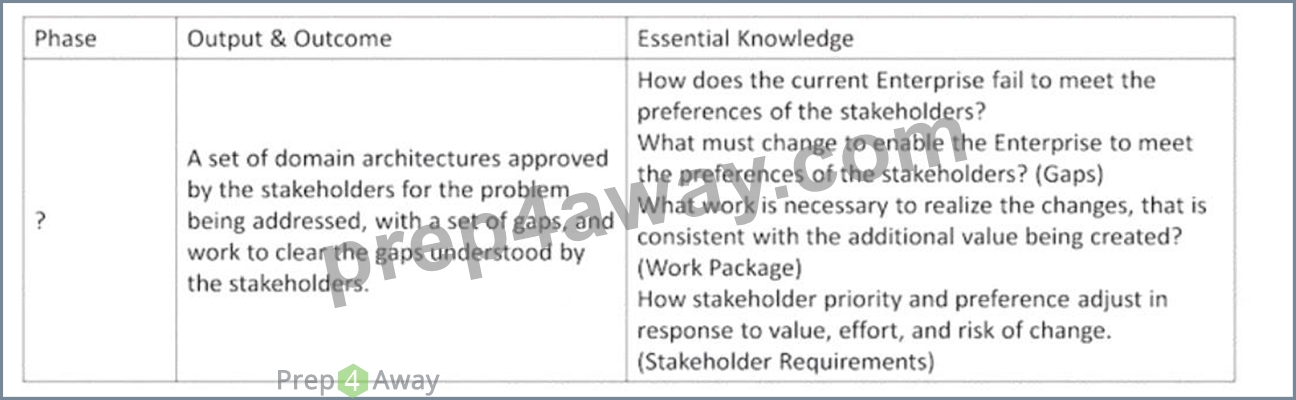
Which ADM Phase(s) does this describe?
- A. Phase E
- B. Preliminary Phase
- C. Phase B
- D. Phase B. C and D
Answer: D
Explanation:
The table describes the steps involved in Phase B (Business Architecture), Phase C (Information Systems Architectures), and Phase D (Technology Architecture) of the TOGAF ADM5. These phases are responsible for developing the target architectures for each domain and identifying the gaps between the baseline and target architectures. The table shows the outputs and outcomes of each phase, as well as the essential knowledge required for each phase.
The table describes the iterative cycle of defining requirements, identifying gaps, and creating solutions that occurs throughout thearchitecture development phasesof the TOGAF ADM. This cycle is most prominent in:
* Phase B (Business Architecture):
* Develop the Business Architecture, identifying gaps between the baseline and desired business capabilities, processes, and information flows.
* Define work packages to address these gaps and realize the target business architecture.
* Phase C (Information Systems Architectures):
* Develop the Data and Application Architectures to support the Business Architecture.
* Identify gaps between the baseline and target information systems architectures.
* Define work packages to address these gaps and realize the target data and application architectures.
* Phase D (Technology Architecture):
* Develop the Technology Architecture to support the Data and Application Architectures.
* Identify gaps between the baseline and target technology architectures.
* Define work packages to address these gaps and realize the target technology architecture.
NEW QUESTION # 32
A Business Model explains how an organization creates, delivers, and captures:
- A. Information
- B. Governance
- C. Technology
- D. Value
Answer: D
Explanation:
A Business Model describes how an organization creates value for customers, delivers that value efficiently, and captures benefits such as revenue or strategic advantage. It explains the organization's overall approach to value creation.
NEW QUESTION # 33
Which ADM Phases match the following purpose descriptions?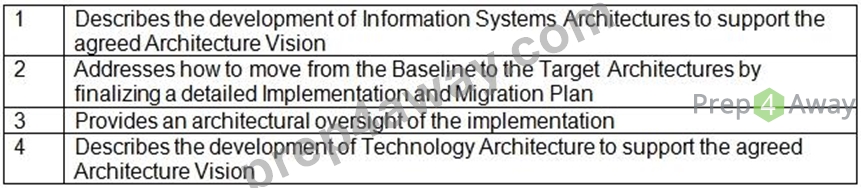
- A. 1 Phase C - 2 Phase F - 3 Phase G- 4 Phase D
- B. 1 Phase D - 2 Phase B - 3 Phase G - 4 Phase A
- C. 1 Phase C - 2 Phase F - 3 Phase H - 4 Phase B
- D. 1 Phase C - 2 Phase E - 1 Phase H - 4 Phase C
Answer: A
Explanation:
The ADM Phases that match the purpose descriptions provided are: Phase C for the development of Information Systems Architectures to support the agreed Architecture Vision, Phase F for addressing the move from the Baseline to the Target Architectures by finalizing a detailed Implementation and Migration Plan, Phase G for providing architectural oversight of the implementation, and Phase D for describing the development of the Technology Architecture to support the agreed Architecture Vision.
NEW QUESTION # 34
Complete the sentence A business capability is_________________________________.
- A. an ability that a business possesses to achieve a specific outcome
- B. a description of the architectural approach to realize a particular business solution
- C. a representation of an end-to-end collection of business activities
- D. a qualitative statement of intent that should be met by the business architecture
Answer: A
Explanation:
A business capability is a conceptual representation that reflects the core abilities or capacities of a business. It is defined as an intrinsic ability that an organization possesses or can develop to consistently deliver a specific outcome or set of outcomes. Business capabilities abstract away from the organizational structure, processes, and technology to focus on the 'what' the business can do, rather than the 'how' it does it. This concept is fundamental in business architecture as it helps in aligning strategic objectives with operational efficiency.
NEW QUESTION # 35
Consider the diagram of an architecture development cycle.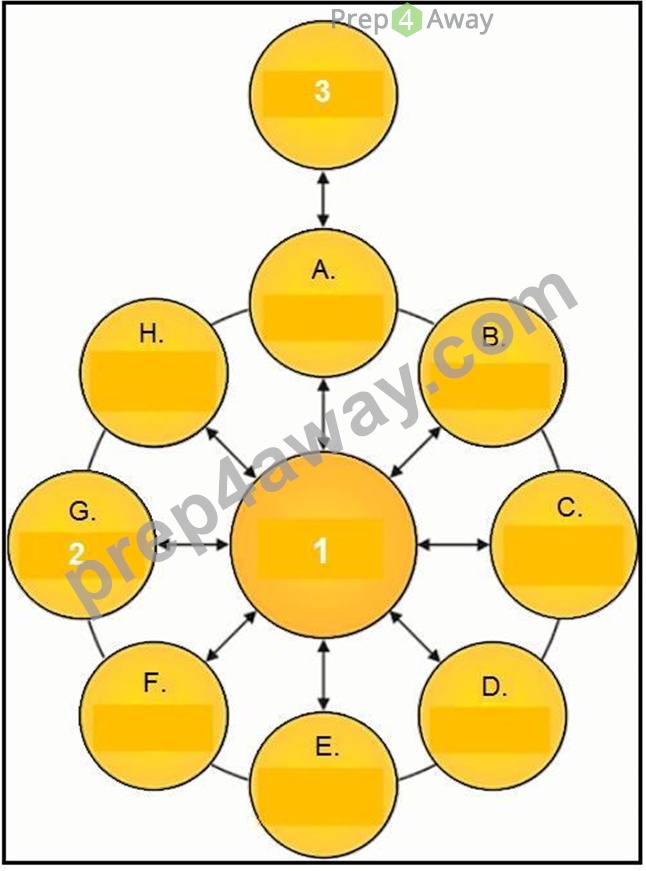
Select the correct phase names corresponding to the labels 1, 2 and 3?
- A. 1 Architecture Governance - 2 Implementation Governance - 3 Preliminary
- B. 1 Requirements Management - 2 Implementation Governance - 3 Preliminary
- C. 1 Requirements Management - 2 Change Management - 3 Strategy
- D. 1 Continuous Improvement - 2 Migration Planning - 3 Architecture Vision
Answer: B
Explanation:
The diagram of an architecture development cycle shows three phases of the TOGAF ADM. The correct phase names corresponding to the labels 1, 2 and 3 are Requirements Management, Implementation Governance, and Preliminary respectively. These phases are described as follows:
Requirements Management (label 1): This phase provides a process for managing architecture requirements throughout the ADM cycle. It ensures that requirements are captured, stored, prioritized, and addressed by relevant ADM phases. It also ensures that requirements are validated and updated as necessary.
Implementation Governance (label 2): This phase provides a process for ensuring that the implementation projects conform to the defined architecture. It involves establishing an implementation governance model, defining architecture contracts and compliance reviews, and monitoring and supporting the implementation projects.
Preliminary (label 3): This phase provides a process for preparing and planning the architecture project. It involves defining the scope and vision of the project, customizing the ADM process and content framework, defining principles and governance structures, and evaluating the enterprise architecture maturity and readiness.
NEW QUESTION # 36
Complete the sentence. The purpose of the Preliminary Phase is to:
- A. Describe the target architecture.
- B. Define the enterprise strategy.
- C. Identify the stakeholders and their requirements.
- D. Architect an Enterprise Architecture Capability.
Answer: D
Explanation:
In the TOGAF ADM, the Preliminary Phase sets up the architecture capability within the organization, establishing architecture governance, defining architecture principles, and setting up necessary processes and tools. This phase is crucial for laying the foundation before formal architecture development begins.
Reference:
The Preliminary Phase is the first phase in the TOGAF Architecture Development Method (ADM). It sets the foundation for successful architecture development within an organization. The primary purpose of this phase is to:
Establish an Enterprise Architecture practice: This involves defining the organizational structure, processes, and resources needed to support architecture activities.
Tailor TOGAF to the organization's needs: TOGAF is a flexible framework. The Preliminary Phase allows for adapting the ADM and other TOGAF components to fit the specific context and requirements of the organization.
Secure senior management commitment: Gaining support from leadership is crucial for the success of any enterprise architecture initiative. This phase helps to ensure that key stakeholders understand and endorse the architecture development process.
Define the scope and approach: This includes determining the initial scope of the architecture work, identifying relevant architecture domains, and selecting appropriate methods and tools
NEW QUESTION # 37
What component of the Architecture Repository is an architectural representation of SBBs supporting the Architecture Landscape?
- A. Solutions Repository
- B. Solutions Landscape
- C. Solutions Continuum
- D. Solutions Library
Answer: B
Explanation:
The component of the Architecture Repository that is an architectural representation of SBBs supporting the Architecture Landscape is the Solutions Landscape3. The Solutions Landscape presents an architectural representation of the Solution Building Blocks (SBBs) that support the Architecture Landscape and have been planned or deployed by the enterprise3. The Solutions Landscape shows how SBBs are mapped to Architecture Building Blocks (ABBs) in different architecture domains and levels3. The Solutions Landscape can help to ensure consistency and alignment between the Architecture Landscape and the solutions that implement it.
NEW QUESTION # 38
Consider the following business capability map. where cells of a model are given different colors to represent desired maturity levels (Green (G) = level achieved, yellow (Y) = one level away, red (R) =two or more levels away, purple (P) = missing capability):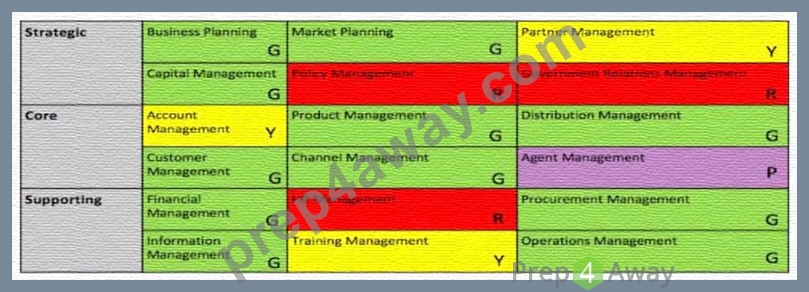
Which of the following best describes what this shows?
- A. Agent Management needs immediate attention. Market Planning. HR Management and Government Relations Management need attention. Customer Management. Training Management and Partner Management need attention but are of lower priority.
- B. Policy Management. Government Relations Management, and HR Management need immediate attention. Partner Management. Account Management, and Training Management have issues but are of lower priority Agent Management Is a new business capability that does not exist
- C. Agent Management needs immediate attention. Market Planning. Government Relations Management, and HR Management have Issues but are of lower priority Partner Management. Customer Management, and Training Management are new business capabilities that do not exist.
- D. The Strategic capabilities need more attention in two areas. Policy Management, and Government Relations Management. Agent Management is missing as a Core capability Information Management needs attention as a Supporting Capability.
Answer: B
Explanation:
The business capability map provided uses color coding to represent the maturity levels of various business capabilities in strategic, core, and supporting functions. The colors indicate the current state or priority for development, with red indicating capabilities that are significantly below desired maturity levels and thus require immediate attention. In this case, Policy Management, Government Relations Management, and HR Management are marked as red, signaling the need for urgent improvement. Yellow indicates capabilities that are closer to the desired state but still need attention, while green shows capabilities that have achieved the desired maturity level. Purple indicates a missing capability that does not currently exist in the enterprise, which is the case for Agent Management.
NEW QUESTION # 39
Which of the following lists the components of a business capability?
- A. Name, Statement, Rationale, Implications
- B. Vision, Rating, Risks, Actions
- C. Measure, Process, Service, Capability
- D. Roles, Processes, Information, Resources
Answer: D
Explanation:
Business capabilities in TOGAF are defined as the ability of an organization to achieve a specific purpose or outcome. The components that make up a business capability typically include:
Roles: The responsibilities and positions within the organization that support the capability.
Processes: The activities and workflows that are essential to the functioning of the capability.
Information: The data and knowledge necessary for the capability to operate effectively.
Resources: The assets, such as people, technology, and materials, required to support the capability. This comprehensive definition ensures that each capability is fully understood in terms of the resources and activities required to deliver its intended outcomes.
NEW QUESTION # 40
Which Business Architecture artifact best supports impact analysis when business strategy changes?
- A. Platform Matrix
- B. Server Inventory
- C. Technology Standards Catalog
- D. Capability Map
Answer: D
Explanation:
A Capability Map enables architects to assess how strategic changes affect business abilities. By mapping capabilities to strategic objectives, organizations can prioritize transformation initiatives and evaluate potential impacts across the enterprise.
NEW QUESTION # 41
When developing a Business Architecture, which of the following best describes the approach to take If no Architecture Descriptions exist?
- A. Validate the business principles and update the Statement of Architecture Work.
- B. Identify the business goals, business objectives, and drivers for the enterprise
- C. Review the contents of the Architecture Repository.
- D. Information should be gathered, and Business Architecture models developed.
Answer: D
Explanation:
In the absence of existing Architecture Descriptions, the development of a Business Architecture would begin with the gathering of relevant information about the business. This information can come from strategic documents, business plans, process documents, and stakeholder interviews, among other sources. Once gathered, this information would be used to create Business Architecture models that articulate the business vision, strategy, governance, organization, and key business processes. These models provide a blueprint that captures the essence of the business and guides subsequent architecture work.
NEW QUESTION # 42
Consider the following output from Phase A:
What is this an example of?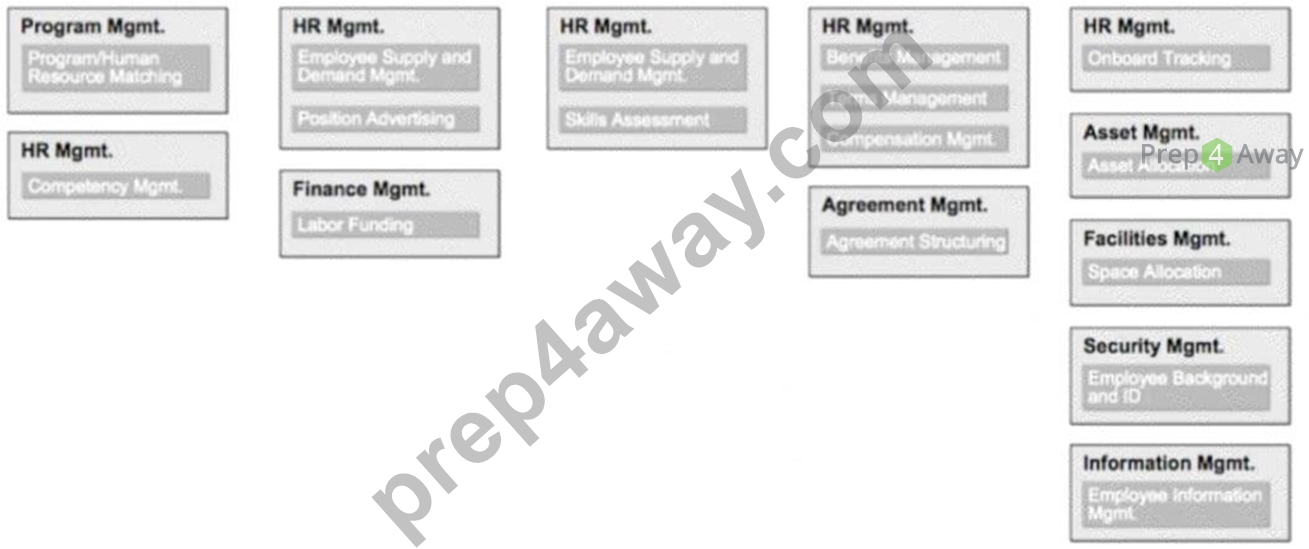
- A. Process Map
- B. Organization Map
- C. Value Stream Map
- D. Capability Map
Answer: D
Explanation:
The diagram provided illustrates aCapability Map. Here's why:
* Focus on "what" the organization does:The diagram depicts various functions and activities that the organization performs, such as "Program/Human Resource Matching," "EmployeeSupply and Demand Mgmt," "Benefits Management," etc. These represent the capabilities of the organization, or what it is able to do.
* Hierarchical structure:The capabilities are organized hierarchically, with broader functions like "HR Mgmt." encompassing more specific capabilities like "Position Advertising" and "Skills Assessment." This shows how different capabilities relate to each other and contribute to higher-level functions.
* No specific process flow:Unlike a process map or value stream map, this diagram doesn't show a sequence of steps or flow of activities. It focuses on the capabilities themselves, not how they are executed
NEW QUESTION # 43
Consider the following business capability map. where cells of a model are given different colors to represent desired maturity levels (Green (G) = level achieved, yellow (Y) = one level away, red (R) =two or more levels away, purple (P) = missing capability):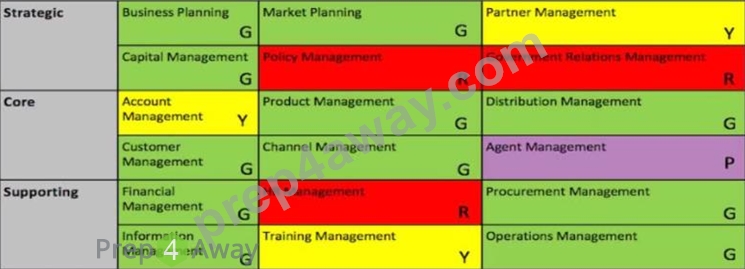
Which of the following best describes what this shows?
- A. Agent Management needs immediate attention. Market Planning. HR Management and Government Relations Management need attention. Customer Management. Training Management and Partner Management need attention but are of lower priority.
- B. Policy Management. Government Relations Management, and HR Management need immediate attention. Partner Management. Account Management, and Training Management have issues but are of lower priority Agent Management Is a new business capability that does not exist
- C. Agent Management needs immediate attention. Market Planning. Government Relations Management, and HR Management have Issues but are of lower priority Partner Management. Customer Management, and Training Management are new business capabilities that do not exist.
- D. The Strategic capabilities need more attention in two areas. Policy Management, and Government Relations Management. Agent Management is missing as a Core capability Information Management needs attention as a Supporting Capability.
Answer: B
Explanation:
The business capability map provided uses color coding to represent the maturity levels of various business capabilities in strategic, core, and supporting functions. The colors indicate the current state or priority for development, with red indicating capabilities that are significantly below desired maturity levels and thus require immediate attention. In this case, Policy Management, Government Relations Management, and HR Management are marked as red, signaling the need for urgent improvement. Yellow indicates capabilities that are closer to the desired state but still need attention, while green shows capabilities that have achieved the desired maturity level. Purple indicates a missing capability that does not currently exist in the enterprise, which is the case for Agent Management.
NEW QUESTION # 44
Refer to Exhibit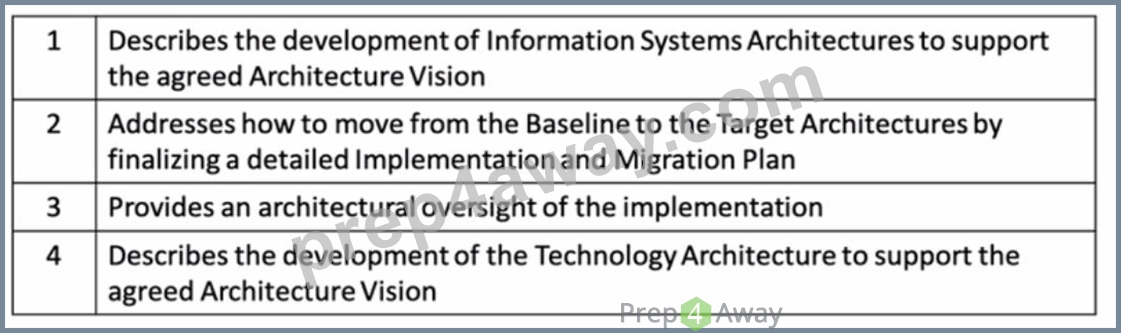
- A. 1 Phase C - 2 Phase F - 3 Phase G- 4 Phase D
- B. 1 Phase D - 2 Phase B - 3 Phase G - 4 Phase A
- C. 1 Phase C - 2 Phase F - 3 Phase H - 4 Phase B
- D. 1 Phase C - 2 Phase E - 1 Phase H - 4 Phase C
Answer: B
Explanation:
The diagram of the ADM phases matches the following purpose descriptions:
1 Phase D: This phase is responsible for developing the Technology Architecture that defines the logical software and hardware capabilities that are required to support the deployment of business, data, and application services1. This includes defining the technology platforms, principles, standards, and policies that will enable and govern the implementation of the Target Architecture1.
2 Phase B: This phase is responsible for developing the Business Architecture that describes how the enterprise needs to operate to achieve the business goals, and respond to the strategic drivers set out in the Architecture Vision1. This includes defining the business strategy, governance, organization, and key business processes1.
3 Phase G: This phase is responsible for implementing governance and management frameworks over architecture contracting, monitoring, and compliance1. This includes establishing an implementation governance model, defining architecture contracts and compliance reviews, and monitoring and supporting the implementation projects1.
4 Phase A: This phase is responsible for developing the Architecture Vision that describes the scope and approach for the overall architecture project1. This includes defining the problem statement, objective, scope, stakeholders, business requirements, and high-level architecture vision1.
NEW QUESTION # 45
Where are business scenarios used most prominently in the TOGAF ADM?
- A. They are used in the Phase A to discover and document business requirements.
- B. They are used as part of the lessons learned activity at the end of Phase F.
- C. They are used to resolve impacts across the Architecture Landscape in Phases B, C, and D.
- D. They are used as part of a business transformation readiness assessment in Phase E.
Answer: A
Explanation:
Business scenarios are most prominently used in Phase A (Architecture Vision) of the TOGAF ADM. In this phase, they help in discovering and documenting business requirements by providing detailed and realistic descriptions of business situations. Business scenarios help in identifying the key business drivers, goals, and challenges, ensuring that the architecture development is aligned with the actual needs of the business.
NEW QUESTION # 46
......
Get Perfect Results with Premium OGBA-101 Dumps Updated 153 Questions: https://www.prep4away.com/TheOpenGroup-certification/braindumps.OGBA-101.ete.file.html
OGBA-101 Dumps PDF 2026 Program Your Preparation EXAM SUCCESS: https://drive.google.com/open?id=1zMX4EAuQy8nu4fJ4tFLpmcQzqD8Fn6cF