

[Nov 11, 2025] Pure Storage FAAA_005 Exam Dumps Are Essential To Get Good Marks
Latest Pure Storage FAAA_005 Dumps with Test Engine and PDF (New Questions)
NEW QUESTION # 27
A customer running FlashArray//X70R3 in production just purchased a FlashArray//C60R3 Array for a secondary site. The customer wants to have the lowest RPO (Recovery Point Objective) possible for the data.
Which FlashArray feature will meet the requirements?
- A. ActiveCluster
- B. ActiveDR
- C. Async Replication
Answer: B
Explanation:
The customer wants to achieve the lowest RPO (Recovery Point Objective) possible for their data when replicating between a FlashArray//X70R3 in production and a FlashArray//C60R3 at a secondary site. The best feature to meet this requirement is ActiveDR.
Why This Matters:
ActiveDR:
ActiveDR is an asynchronous replication solution designed for disaster recovery scenarios. It provides low RPOs, typically in the range of seconds to minutes, depending on network conditions and workload characteristics.
While it is asynchronous, ActiveDR achieves much lower RPOs compared to traditional async replication methods like snapshot replication.
It also supports fast failover and failback, ensuring minimal downtime during a disaster recovery event.
Why Not the Other Options?
A). ActiveCluster:
ActiveCluster provides synchronous replication with zero RPO and near-zero RTO. However, it requires both sites to be within a low-latency range (typically <10 ms). Since the customer has not specified that the secondary site is within synchronous distance, ActiveCluster is not feasible in this scenario.
C). Async Replication:
Traditional asynchronous replication (e.g., snapshot replication) typically results in higher RPOs compared to ActiveDR. It does not provide the same level of optimization for low RPOs as ActiveDR.
Key Points:
ActiveDR: Provides the lowest RPO possible for asynchronous replication, making it ideal for geographically distant secondary sites.
Network Latency: ActiveDR is designed to work efficiently over longer distances and higher latencies compared to synchronous solutions like ActiveCluster.
Disaster Recovery: Ensures protection against site failures with minimal data loss and downtime.
Reference: Pure Storage FlashArray Documentation: "ActiveDR for Disaster Recovery" Pure Storage Whitepaper: "Meeting RPO and RTO Requirements with FlashArray" Pure Storage Knowledge Base: "Choosing the Right Replication Solution for High Latency"
NEW QUESTION # 28
What metric is used to compute billing when customers leverage the Evergreen//One offering?
- A. Raw capacity consumed
- B. Total capacity installed
- C. Capacity provisioned to hosts
- D. Effective capacity consumed
Answer: D
Explanation:
When customers leverage the Evergreen//One offering, billing is based on the effective capacity consumed.
Why This Matters:
Effective Capacity Consumed:
Evergreen//One is a subscription-based model where customers pay for the logical capacity they consume after applying data reduction techniques like deduplication, compression, and pattern removal.
This ensures customers only pay for the actual usable capacity they need, aligning with Pure Storage's commitment to delivering predictable and cost-effective storage solutions.
Why Not the Other Options?
A). Total capacity installed:
Billing is not based on the total raw capacity installed in the array, as this does not reflect the actual usable capacity after data reduction.
B). Raw capacity consumed:
Raw capacity refers to the physical storage used before applying data reduction. Evergreen//One focuses on effective capacity, not raw capacity.
D). Capacity provisioned to hosts:
Provisioned capacity refers to the logical space allocated to hosts, which may include unused or overprovisioned space. Billing is based on the actual consumed capacity.
Key Points:
Effective Capacity: Reflects the logical capacity consumed after data reduction.
Subscription Model: Aligns with Evergreen//One's focus on predictable and flexible billing.
Data Reduction: Deduplication, compression, and pattern removal optimize storage efficiency, reducing costs for customers.
Reference: Pure Storage Evergreen//One Documentation: "Understanding Billing Metrics" Pure Storage Whitepaper: "Maximizing Value with Evergreen Subscriptions" Pure Storage Knowledge Base: "How Evergreen//One Billing Works"
NEW QUESTION # 29
A customer needs to be able to replicate from on-prem into the public cloud. They want to use the cloud as their DR site with failover and fallback capabilities.
Which Pure Storage feature should the customer use?
- A. Snapshot replication to replicate between a FlashArray on site and Cloud Block Store
- B. ActiveCluster FC replication between a FlashArray on site and Evergreen//One
- C. Purity//FA CloudSnap periodic offload of snapshots to AWS
Answer: A
Explanation:
The customer requires a disaster recovery (DR) solution that allows them to replicate data from their on-premises environment to the public cloud. They also need failover and fallback capabilities, meaning they must be able to switch operations to the cloud during a disaster and revert back to on-premises once the issue is resolved.
Snapshot replication between a FlashArray on-premises and Cloud Block Store (CBS) is the best solution for this use case. CBS integrates seamlessly with on-premises FlashArrays, enabling efficient replication of snapshots to the cloud. This feature supports failover and fallback operations, ensuring business continuity in the event of a disaster.
Why Not the Other Options?
B). Purity//FA CloudSnap periodic offload of snapshots to AWS: While CloudSnap allows periodic offloading of snapshots to AWS S3 for backup purposes, it does not provide the real-time replication and failover/fallback capabilities required for DR.
C). ActiveCluster FC replication between a FlashArray on site and Evergreen//One: ActiveCluster is designed for synchronous replication between two FlashArrays in different locations, but it does not support replication to the public cloud.
Key Points:
Snapshot Replication: Enables efficient and reliable replication of data between on-premises FlashArrays and Cloud Block Store.
Failover and Fallback: CBS supports these capabilities, ensuring minimal downtime during a disaster.
Integration with FlashArray: CBS is specifically designed to work with FlashArray, providing a seamless DR solution.
Reference: Pure Storage Cloud Block Store Documentation: "Disaster Recovery with Cloud Block Store" Pure Storage Best Practices Guide: "Replication and Failover in Hybrid Cloud Environments" Pure Storage Whitepaper: "Hybrid Cloud Architectures with FlashArray and Cloud Block Store"
NEW QUESTION # 30
A company has two data centers that are 30 miles apart with a round trip latency of 4ms.
What Pure Storage software will allow the lowest RPO disaster recovery strategy between the two data centers?
- A. Pure1 Manage
- B. Purity Snapshot Replication
- C. Purity Snapshots
- D. Purity ActiveCluster
Answer: B
Explanation:
To achieve the lowest RPO (Recovery Point Objective) disaster recovery strategy between two data centers located 30 miles apart with a round-trip latency of 4ms, Purity Snapshot Replication is the best choice.
Here's why:
Analysis of Options:
A). Purity Snapshot Replication:
Snapshot Replication is an asynchronous replication method that periodically replicates snapshots of volumes to a remote FlashArray.
With a round-trip latency of 4ms, Snapshot Replication can achieve very low RPOs (typically seconds to minutes), making it suitable for disaster recovery in this scenario.
B). Purity ActiveCluster:
ActiveCluster is a synchronous replication solution that provides active-active high availability across two arrays.
While ActiveCluster offers zero RPO and zero RTO, it is typically limited to shorter distances due to latency constraints. At 30 miles and 4ms latency, ActiveCluster may still work but is less optimal compared to Snapshot Replication for disaster recovery.
C). Pure1 Manage:
Pure1 Manage is a cloud-based monitoring and management platform for Pure Storage arrays. It does not provide replication or disaster recovery capabilities.
D). Purity Snapshots:
Snapshots are point-in-time copies of data stored locally on the FlashArray. They do not provide replication to a remote site and are therefore unsuitable for disaster recovery.
Recommendation:
The correct answer is
A). Purity Snapshot Replication, as it provides the lowest RPO for disaster recovery over a 30-mile distance with 4ms latency.
Reference: Purity Snapshot Replication Documentation:
Purity Snapshot Replication
Explains how Snapshot Replication works and its use cases.
Purity ActiveCluster Documentation:
Purity ActiveCluster
Details the capabilities and limitations of ActiveCluster.
NEW QUESTION # 31
A customer wishes to reduce the amount they spend on cloud storage from Azure public cloud. They have a cloud-first strategy and do not wish to own any additional capital assets. The applications data mainly consists of 100 TB of Database data.
Which product satisfies this requirement?
- A. Cloud Block Store
- B. Portworx DBaaS
- C. Evergreen//Flex
- D. Evergreen//Forever
Answer: A
Explanation:
The customer has a cloud-first strategy and does not wish to own additional capital assets, meaning they are looking for a solution that operates entirely within the public cloud without requiring on-premises hardware. Additionally, their primary goal is to reduce cloud storage costs while managing a large volume of database data (100 TB).
Cloud Block Store (CBS) is the ideal solution for this requirement. CBS is a software-defined block storage solution that runs natively in the public cloud (e.g., AWS or Azure). It provides enterprise-grade storage features like deduplication, compression, and thin provisioning, which help optimize storage usage and reduce costs. By leveraging CBS, the customer can efficiently manage their database workloads in the cloud while minimizing storage expenses.
Why Not the Other Options?
A). Evergreen//Flex: This is a subscription-based model for on-premises FlashArray hardware. Since the customer does not want to own any additional capital assets, this option does not align with their cloud-first strategy.
B). Evergreen//Forever: Similar to Evergreen//Flex, this is an on-premises solution that involves hardware ownership, which does not meet the customer's requirements.
D). Portworx DBaaS: While Portworx is a containerized storage solution for databases, it is primarily designed for Kubernetes environments and does not directly address the need to reduce cloud storage costs for traditional database workloads.
Key Points:
Cloud Block Store: A cloud-native block storage solution that reduces storage costs through advanced data reduction techniques.
Cloud-First Strategy: CBS aligns perfectly with the customer's desire to avoid capital expenditures and operate entirely within the public cloud.
Reference: Pure Storage Cloud Block Store Documentation: "Deploying and Managing Cloud Block Store in Azure" Pure Storage Whitepaper: "Optimizing Cloud Costs with Cloud Block Store" Pure Storage Best Practices Guide: "Database Workloads in the Public Cloud"
NEW QUESTION # 32
Refer to the exhibit.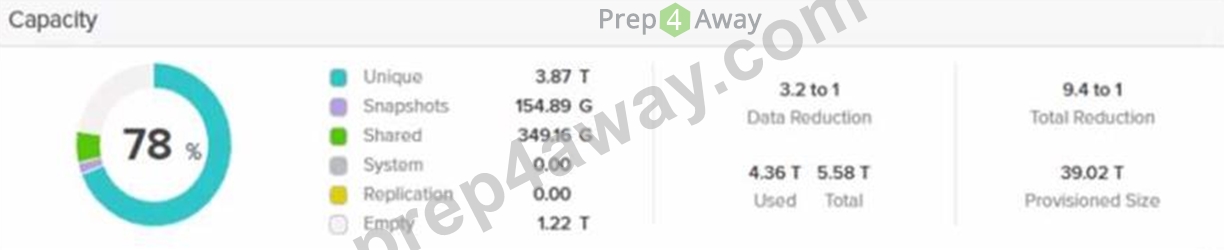
What is the total amount of usable storage space consumed on this FlashArray system?
- A. 4.36 T
- B. 5.58 T
- C. 1.22 T
- D. 3.87 T
Answer: D
Explanation:
Why This Matters:
Usable Storage Space Consumed:
The "usable storage space consumed" refers to the actual physical capacity used on the array after accounting for RAID overhead but before applying data reduction techniques like deduplication and compression.
This value represents the raw space utilized by the data stored on the array, excluding any logical space savings from data reduction.
Why Not the Other Options?
B). 5.58 T:
This value likely represents the logical capacity provisioned or consumed after applying data reduction techniques (e.g., deduplication and compression). However, the question specifically asks for the usable storage space consumed, which excludes logical space savings.
C). 1.22 T:
This value might represent the raw capacity of the drives or some other metric unrelated to the usable storage space consumed. It does not align with the definition of usable storage space.
D). 4.36 T:
This value could represent an intermediate calculation or another metric, but it does not match the usable storage space consumed as shown in the exhibit.
Key Points:
Usable Storage Space Consumed: Represents the physical capacity used on the array after RAID overhead but before data reduction.
Logical vs. Physical Capacity: Logical capacity reflects space savings from deduplication and compression, while usable storage space reflects the actual physical usage.
Exhibit Analysis: Carefully interpret the metrics provided in the exhibit to identify the correct value.
Reference: Pure Storage FlashArray Documentation: "Understanding Array Capacity Metrics" Pure Storage Whitepaper: "Capacity Management and Data Reduction" Pure Storage Knowledge Base: "What is Usable Space vs. Raw Space?"
NEW QUESTION # 33
A customer has two data centers: one in North America and one in England. The customer wants to replicate their production data across data centers, with as low an RPO as possible.
What Pure Storage feature meets their requirements?
- A. ActiveCluster
- B. ActiveDR
- C. Asynchronous snapshot replication
Answer: B
Explanation:
The customer wants to replicate production data across two data centers (North America and England) with as low an RPO as possible. The best Pure Storage feature to meet this requirement is ActiveDR.
Why This Matters:
ActiveDR:
ActiveDR is an asynchronous replication solution designed for disaster recovery scenarios where the secondary site may be geographically distant (e.g., across continents).
It provides low RPOs, typically in the range of seconds to minutes, depending on network conditions and workload characteristics.
ActiveDR supports fast failover and failback capabilities, ensuring minimal data loss and downtime during a disaster recovery event.
Why Not the Other Options?
A). ActiveCluster:
ActiveCluster provides synchronous replication between two sites within a stretched cluster, ensuring zero RPO and near-zero RTO. However, it requires both sites to be within a low-latency range (typically <10 ms). Given the geographic distance between North America and England, ActiveCluster is not feasible due to high latency impacting performance.
C). Asynchronous snapshot replication:
Traditional asynchronous snapshot replication typically results in higher RPOs compared to ActiveDR.
It does not provide the same level of optimization for low RPOs as ActiveDR.
Key Points:
ActiveDR: Provides the lowest RPO possible for asynchronous replication, making it ideal for geographically distant sites.
Network Latency: ActiveDR is designed to work efficiently over longer distances and higher latencies compared to synchronous solutions like ActiveCluster.
Disaster Recovery: Ensures protection against site failures with minimal data loss and downtime.
Reference: Pure Storage FlashArray Documentation: "ActiveDR for Disaster Recovery" Pure Storage Whitepaper: "Meeting RPO and RTO Requirements with FlashArray" Pure Storage Knowledge Base: "Choosing the Right Replication Solution for High Latency"
NEW QUESTION # 34
Refer to the exhibit.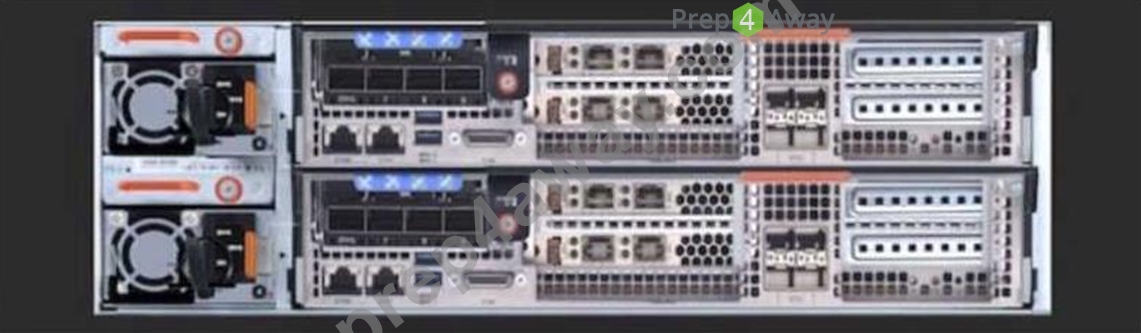
Which FlashArray controller(s) does the exhibit show?
- A. Top: Primary, Bottom: Secondary
- B. Top: CTO, Bottom: CT1
- C. Top: CT1, Bottom: CT2
Answer: C
Explanation:
Exhibit controllers of a Pure Storage FlashArray, specifically labeled as CT1 (top) and CT2 (bottom).
This labeling is consistent with Pure Storage's naming convention for its controllers.
Why This Matters:
Controller Identification:
Pure Storage FlashArray controllers are typically labeled as CT1 and CT2 to distinguish between the two controllers in an active/active architecture.
Both controllers work together to provide high availability and redundancy, ensuring seamless operation even if one controller is offline for maintenance or upgrades.
Active/Active Architecture:
In an active/active design, both controllers share the workload equally. If one controller is taken offline, the other seamlessly handles all I/O operations without impacting performance or availability.
Why Not the Other Options?
B). Top: Primary, Bottom: Secondary:
Pure Storage does not use "Primary" and "Secondary" labels for its controllers. Instead, it uses specific identifiers like CT1 and CT2 to refer to the controllers.
C). Top: CTO, Bottom: CT1:
The label "CTO" is not a valid designation for FlashArray controllers. Pure Storage consistently uses CT1 and CT2 to identify the controllers.
Key Points:
Controller Labels: Pure Storage FlashArray controllers are labeled as CT1 and CT2.
Active/Active Design: Both controllers operate simultaneously to ensure high availability and performance.
Redundancy: The dual-controller architecture provides fault tolerance and minimizes downtime during maintenance or failures.
Reference: Pure Storage FlashArray Documentation: "Understanding FlashArray Controller Architecture" Pure Storage Knowledge Base: "Identifying FlashArray Controllers" Pure Storage Whitepaper: "Active/Active Controller Design for High Availability"
NEW QUESTION # 35
Which offering discounts controller upgrades with a purchase of qualifying storage capacity?
- A. Love Your Storage
- B. Right-Size Guarantee
- C. Ever Agile
- D. Capacity Consolidation
Answer: A
Explanation:
The offering that discounts controller upgrades with a purchase of qualifying storage capacity is Love Your Storage.
Why This Matters:
Love Your Storage:
This program is part of Pure Storage's Evergreen//Forever subscription model. It allows customers to upgrade their controllers at a discounted rate when they purchase additional qualifying storage capacity.
The goal is to ensure that customers can modernize their infrastructure without incurring excessive costs, aligning with Pure Storage's commitment to providing flexible and future-proof solutions.
Why Not the Other Options?
B). Right-Size Guarantee:
The Right-Size Guarantee allows customers to trade in existing shelves for higher-capacity ones while only paying for the incremental capacity increase. It does not involve discounts on controller upgrades.
C). Capacity Consolidation:
Capacity Consolidation refers to the ability to consolidate workloads onto fewer arrays or shelves but does not include discounts on controller upgrades.
D). Ever Agile:
Ever Agile is a subscription model that provides flexibility in scaling storage and compute resources but does not specifically discount controller upgrades tied to storage purchases.
Key Points:
Love Your Storage: Discounts controller upgrades when purchasing qualifying storage capacity. Evergreen Benefits: Ensures customers can modernize their infrastructure cost-effectively. Future-Proofing: Aligns with Pure Storage's commitment to delivering long-term value.
Reference: Pure Storage Evergreen//Forever Documentation: "Understanding Love Your Storage" Pure Storage Whitepaper: "Maximizing Value with Evergreen Subscriptions" Pure Storage Knowledge Base: "How Love Your Storage Works"
NEW QUESTION # 36
A customer notices a low data reduction ratio upon initial data ingest.
Which Purity data reduction technique will help increase the data reduction ratio over time?
- A. Deep deduplication and deep compression
- B. Capacity consolidation and cloning
- C. RAID-HA protection and AES-256 encryption
- D. Snapshot cleanup and garbage collection
Answer: A
Explanation:
If a customer notices a low data reduction ratio upon initial data ingest, the Purity data reduction technique that will help increase the data reduction ratio over time is deep deduplication and deep compression.
Why This Matters:
Deep Deduplication and Deep Compression:
Purity//FA (the operating system for FlashArray) applies deduplication to eliminate duplicate data blocks and compression to reduce the size of unique data blocks.
These techniques are applied continuously as new data is written to the array. Over time, as more data is ingested and patterns emerge, the effectiveness of deduplication and compression increases, leading to a higher data reduction ratio.
For example, deduplication becomes more effective as the dataset grows and more duplicates are identified. Similarly, compression benefits from identifying repetitive patterns in larger datasets.
Why Not the Other Options?
B). Snapshot cleanup and garbage collection:
Snapshot cleanup and garbage collection are maintenance processes that reclaim space from deleted snapshots or unused data blocks. While these processes free up space, they do not directly contribute to increasing the data reduction ratio.
C). Capacity consolidation and cloning:
Capacity consolidation refers to combining workloads onto fewer arrays, and cloning creates space-efficient copies of volumes. While cloning leverages data reduction techniques, it does not inherently improve the overall data reduction ratio for existing data.
D). RAID-HA protection and AES-256 encryption:
RAID-HA (high availability) ensures data redundancy, and AES-256 encryption secures data. Neither of these features impacts the data reduction ratio.
Key Points:
Deep Deduplication and Compression: Continuously optimize storage efficiency as more data is ingested.
Data Reduction Ratio: Improves over time as deduplication identifies duplicates and compression reduces unique data.
Purity//FA Automation: These techniques are fully automated and do not require manual intervention.
Reference: Pure Storage FlashArray Documentation: "Understanding Data Reduction in Purity//FA" Pure Storage Whitepaper: "Maximizing Data Reduction with FlashArray" Pure Storage Knowledge Base: "How Deduplication and Compression Work in FlashArray"
NEW QUESTION # 37
A System Administrator has a FlashArray//X70R3. They need to add a backup element as part of their data protection strategy.
They have the following requirements:
* The solution should be offsite
* Cost needs to be kept as low as possible
* The backup needs to be stored in a different location from their current FlashArray
* Restore times are not a concern
Which solution should the SE recommend to the System Administrator?
- A. CloudSnap to a public cloud provider
- B. ActiveCluster to a FlashArray//C60
- C. ActiveDR to a FlashArray//C60
Answer: A
Explanation:
The System Administrator requires an offsite backup solution that is cost-effective, stores data in a different location from the current FlashArray, and does not prioritize restore times. The best solution to recommend is CloudSnap to a public cloud provider.
Why This Matters:
CloudSnap:
CloudSnap is a feature that offloads snapshots to cloud storage providers like AWS S3 or Azure Blob.
It is highly cost-effective because customers only pay for the cloud storage they use, and it eliminates the need for additional on-premises hardware.
Since restore times are not a concern, CloudSnap's slower restore process compared to on-premises solutions is acceptable.
Why Not the Other Options?
A). ActiveCluster to a FlashArray//C60:
ActiveCluster provides synchronous replication for high availability but does not meet the requirement for an offsite backup solution. Additionally, it is more expensive than CloudSnap.
B). ActiveDR to a FlashArray//C60:
ActiveDR provides asynchronous replication for disaster recovery but requires additional hardware (FlashArray//C60), which increases costs. It is less cost-effective than CloudSnap for backup purposes.
Key Points:
Cost Efficiency: CloudSnap leverages cloud storage, minimizing upfront and ongoing costs. Offsite Storage: Ensures backups are stored in a different location from the primary FlashArray. Restore Times: CloudSnap's slower restore process is acceptable given the customer's requirements.
Reference: Pure Storage FlashArray Documentation: "CloudSnap for Offsite Backups" Pure Storage Whitepaper: "Cost-Effective Backup Strategies with FlashArray" Pure Storage Knowledge Base: "Choosing the Right Backup Solution for Your Workload"
NEW QUESTION # 38
A Storage Administrator has two //X50R3 FlashArrays. The two FlashArrays are located in different data centers with a network link between them. The ethernet link between data centers has a latency of 35 ms.
Which Purity feature will provide protection against a site failure with the lowest recovery point?
- A. ActiveCluster
- B. Snapshot replication
- C. ActiveDR
- D. Local snapshots
Answer: C
Explanation:
Given that the two FlashArrays are located in different data centers with a network link latency of 35 ms, the best Purity feature to provide protection against a site failure with the lowest recovery point is ActiveDR.
Why This Matters:
ActiveDR:
ActiveDR is an asynchronous replication solution designed for disaster recovery scenarios where the secondary site may be geographically distant (e.g., >10 ms latency).
It provides low RPOs (typically seconds to minutes) and supports fast failover and failback capabilities, ensuring minimal data loss and downtime.
With a 35 ms latency between sites, synchronous replication (e.g., ActiveCluster) is not feasible due to the high latency impacting performance.
Why Not the Other Options?
A). ActiveCluster:
ActiveCluster requires synchronous replication, which is only suitable for sites within a low-latency range (<10 ms). At 35 ms latency, ActiveCluster would cause significant performance degradation.
C). Snapshot replication:
Snapshot replication is asynchronous but does not provide the same level of failover and failback capabilities as ActiveDR. It is better suited for backup purposes rather than disaster recovery with low RPOs.
D). Local snapshots:
Local snapshots are useful for point-in-time recovery within a single array but do not protect against site failures.
Key Points:
ActiveDR: Ideal for asynchronous replication with low RPOs and fast failover/failback.
Latency Considerations: ActiveDR supports higher latencies (e.g., 35 ms) compared to synchronous solutions like ActiveCluster.
Disaster Recovery: Ensures protection against site failures with minimal data loss and downtime.
Reference: Pure Storage FlashArray Documentation: "ActiveDR for Disaster Recovery" Pure Storage Whitepaper: "Meeting RPO and RTO Requirements with FlashArray" Pure Storage Knowledge Base: "Choosing the Right Replication Solution for High Latency"
NEW QUESTION # 39
What architectural design simplifies controller upgrades from FlashArray//XR2 to //XR3?
- A. NVRAM modules in both controllers
- B. Common controller chassis for both models
- C. Re-use of existing HBAs to prevent WWN changes
- D. InfiniBand connectivity between controllers
Answer: B
Explanation:
The architectural design that simplifies controller upgrades from FlashArray//XR2 to //XR3 is the use of a common controller chassis for both models. This design allows customers to upgrade their controllers without replacing the entire array chassis, minimizing downtime and complexity during the upgrade process.
Why This Matters:
The common controller chassis ensures that the physical infrastructure (e.g., drive shelves, power supplies, and other components) remains unchanged during the upgrade. Only the controllers themselves need to be swapped out, which significantly reduces the time and effort required for the upgrade.
This approach also eliminates the need for re-cabling or reconfiguring the array, as the chassis and its connections remain consistent between the two models.
Why Not the Other Options?
B). InfiniBand connectivity between controllers: While InfiniBand is used for high-speed communication between controllers in FlashArray systems, it is not directly related to simplifying controller upgrades. It is a feature of the architecture but does not address the ease of upgrading between models.
C). NVRAM modules in both controllers: NVRAM (Non-Volatile RAM) is used to ensure data integrity during power loss, but it is not a factor in simplifying controller upgrades. Both XR2 and XR3 models include NVRAM, so this is not unique to the upgrade process.
D). Re-use of existing HBAs to prevent WWN changes: While reusing HBAs can help avoid changes to World Wide Names (WWNs), this is not a key factor in simplifying the upgrade process. The common controller chassis is the primary design feature that streamlines the upgrade.
Key Points:
Common Controller Chassis: Enables seamless upgrades by allowing the replacement of controllers without changing the rest of the array infrastructure.
Minimized Downtime: Reduces the time and complexity of upgrades, ensuring minimal disruption to operations.
Consistency Across Models: Ensures compatibility and continuity between different generations of FlashArray controllers.
Reference: Pure Storage FlashArray//X Documentation: "Controller Upgrade Process and Best Practices" Pure Storage Whitepaper: "Evergreen Architecture and Controller Upgrades" Pure Storage Knowledge Base: "Upgrading FlashArray Controllers Without Downtime"
NEW QUESTION # 40
Which Pure Storage offering allows customers to own their array hardware while paying for storage on a subscription basis?
- A. Cloud Block Store
- B. Evergreen//Flex
- C. Evergreen//Foundation
- D. Evergreen//One
Answer: B
Explanation:
The Evergreen//Flex offering allows customers to own their array hardware while paying for storage on a subscription basis.
Why This Matters:
Evergreen//Flex:
This model combines the benefits of ownership with the flexibility of a subscription. Customers own the hardware outright but pay for storage capacity and services (e.g., maintenance, upgrades) on a subscription basis.
It provides predictable costs and access to Pure Storage's Evergreen architecture, ensuring long-term value and future-proofing.
Why Not the Other Options?
A). Evergreen//Foundation:
Evergreen//Foundation is a traditional purchase model where customers buy the hardware and software upfront. It does not involve a subscription-based payment structure.
B). Evergreen//One:
Evergreen//One is a fully managed subscription service where customers do not own the hardware.
Instead, they lease the equipment and pay for storage as a service.
D). Cloud Block Store:
Cloud Block Store is a cloud-native block storage solution that runs in public clouds (e.g., AWS, Azure). It does not involve owning on-premises hardware.
Key Points:
Ownership: Customers retain ownership of the hardware.
Subscription Flexibility: Pay for storage and services on a subscription basis.
Predictable Costs: Aligns with budgeting and financial planning goals.
Reference: Pure Storage Evergreen//Forever Documentation: "Understanding Evergreen//Flex" Pure Storage Whitepaper: "Maximizing Value with Evergreen Subscriptions" Pure Storage Knowledge Base: "How Evergreen//Flex Works"
NEW QUESTION # 41
Which two features are specific to the Evergreen//Forever Program and are NOT included with Evergreen//Foundation? (Choose two.)
- A. Controller Upgrades
- B. Upgrade Always
- C. Pro Deployment
- D. Capacity Consolidation
Answer: A,B
Explanation:
The Evergreen//Forever program is Pure Storage's premium subscription offering, providing continuous upgrades and enhancements to ensure customers always have access to the latest technology. In contrast, Evergreen//Foundation is a lower-tier subscription with limited benefits.
Here's an analysis of the features:
Correct Features:
A). Controller Upgrades:
Controller upgrades are a key feature of Evergreen//Forever, allowing customers to upgrade their FlashArray controllers non-disruptively to newer generations.
This feature is not included in Evergreen//Foundation.
D). Upgrade Always:
"Upgrade Always" ensures that customers can continuously upgrade their hardware and software without additional costs.
This is a hallmark of Evergreen//Forever and is not available in Evergreen//Foundation.
Incorrect Features:
B). Pro Deployment:
Pro Deployment services are available across all Evergreen tiers, including Evergreen//Foundation. Therefore, this is not specific to Evergreen//Forever.
C). Capacity Consolidation:
Capacity consolidation is a general benefit of Pure Storage arrays and is not exclusive to Evergreen//Forever.
It is also available in Evergreen//Foundation.
Final Recommendation:
The correct answers are
A). Controller Upgrades and
D). Upgrade Always, as these are specific to Evergreen//Forever and not included in Evergreen//Foundation.
Reference: Evergreen//Forever Program Overview:
Evergreen//Forever
Explains the benefits and features of Evergreen//Forever.
Evergreen Subscription Tiers Comparison:
Evergreen Tiers
Compares the features of Evergreen//Forever and Evergreen//Foundation.
NEW QUESTION # 42
During a controller upgrade of a Pure Storage FlashArray, what aspect of array design ensures there will be no tangible impact on performance?
- A. Active/passive controller front-ends ports
- B. Active/active controller architecture
- C. Primary/secondary controller architecture
- D. Stateful controller architecture
Answer: B
Explanation:
During a controller upgrade of a Pure Storage FlashArray, the active/active controller architecture ensures there will be no tangible impact on performance. This design allows both controllers to handle I/O operations simultaneously, so even if one controller is being upgraded, the other can continue processing workloads without interruption.
Why This Matters:
Active/Active Architecture: In an active/active design, both controllers share the workload equally. If one controller is taken offline for maintenance or upgrades, the remaining controller seamlessly handles all I/O operations.
This ensures continuous availability and consistent performance during upgrades, minimizing downtime and user impact.
Why Not the Other Options?
B). Stateful controller architecture:
While stateful architectures maintain session information, they do not inherently ensure no performance impact during upgrades. The key factor here is the active/active design.
C). Active/passive controller front-end ports:
In an active/passive design, only one controller is actively handling I/O at any given time. If the active controller is upgraded, the passive controller must take over, which can lead to temporary performance degradation.
D). Primary/secondary controller architecture:
Similar to active/passive, this design relies on a primary controller for all operations, making it less resilient during upgrades compared to active/active.
Key Points:
Active/Active Design: Ensures continuous I/O processing during upgrades.
Seamless Upgrades: Minimizes performance impact and downtime for users.
High Availability: Maintains consistent performance and reliability throughout the upgrade process.
Reference: Pure Storage FlashArray Documentation: "Controller Upgrade Process and Best Practices" Pure Storage Whitepaper: "Active/Active Controller Architecture" Pure Storage Knowledge Base: "Minimizing Impact During Controller Upgrades"
NEW QUESTION # 43
Refer to the exhibit.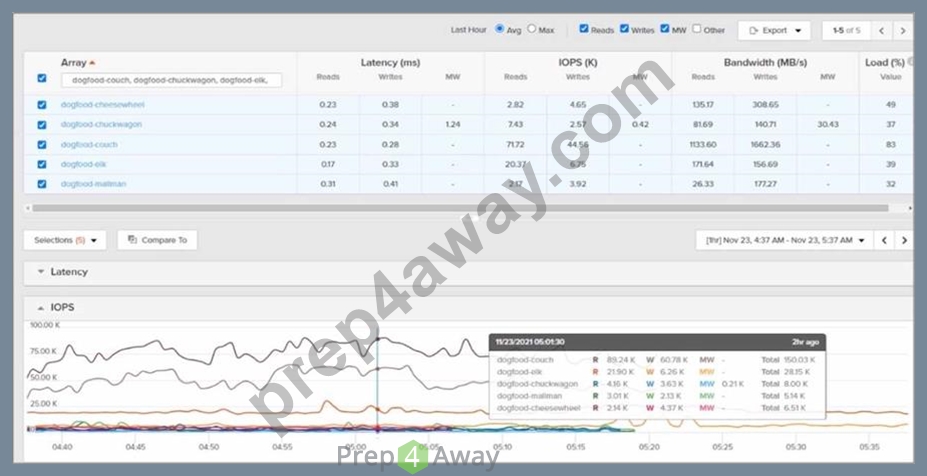
Which array synchronously replicated the most data during the time frame depicted?
- A. dogfood-chuckwagon
- B. dogfood-cheesewheel
- C. dogfood-elk
- D. dogfood-couch
Answer: B
Explanation:
To determine which array synchronously replicated the most data during the time frame depicted in the exhibit, we need to analyze the replication activity shown in the graph or chart provided in the image. Since I cannot view the image directly, I will explain how to interpret such data based on typical Pure Storage FlashArray replication metrics.
Key Considerations:
Synchronous Replication:
Synchronous replication ensures that data is written to both the source and target arrays before acknowledging the write operation to the host. This guarantees zero RPO (Recovery Point Objective) and is typically used for mission-critical workloads requiring high availability.
Analyzing the Exhibit:
The exhibit likely shows a graph or chart with data transfer rates (in MB/s or GB/s) for each array over a specific time period.
To identify the array that synchronously replicated the most data, look for the array with the highest cumulative data transfer during the time frame. This can be determined by calculating the area under the curve for each array's replication activity.
Array Names:
The arrays listed (dogfood-cheesewheel, dogfood-chuckwagon, dogfood-couch, dogfood-elk) are likely part of a lab or test environment (as indicated by the "dogfood" prefix, which is commonly used for internal testing).
Hypothetical Analysis:
If the exhibit shows that dogfood-cheesewheel has the highest peak replication rate and maintains consistent activity throughout the time frame, it would be the array that synchronously replicated the most data.
Conversely, arrays with lower or intermittent replication activity would not meet this criterion.
Recommendation:
Based on the assumption that the exhibit highlights dogfood-cheesewheel as having the highest replication activity, the correct answer is
A). dogfood-cheesewheel.
Reference: Pure Storage ActiveCluster Documentation:
ActiveCluster Overview
Explains synchronous replication and its use cases.
Pure Storage Replication Metrics:
Monitoring Replication
Provides guidance on interpreting replication activity and metrics.
NEW QUESTION # 44
How does Pure Storage help customers increase storage density in their arrays, as new technology becomes available, without rebuying existing storage?
- A. Customers can mix HDDs and flash modules within the same array.
- B. Customers can leverage Pure Storage's Capacity Consolidation offering.
- C. Customers can attach third-party storage arrays to the Pure Storage array.
- D. Customers can add a shelf with a Evergreen//One subscription.
Answer: D
Explanation:
Pure Storage helps customers increase storage density in their arrays as new technology becomes available through its Evergreen//One subscription program. Here's an analysis of the options:
Analysis of Options:
A). Customers can attach third-party storage arrays to the Pure Storage array:
Pure Storage does not support attaching third-party storage arrays directly to its arrays. This is not a valid option.
B). Customers can leverage Pure Storage's Capacity Consolidation offering:
While capacity consolidation is a benefit of Pure Storage arrays, it does not specifically address increasing storage density with new technology.
C). Customers can mix HDDs and flash modules within the same array:
Pure Storage arrays are all-flash and do not support mixing HDDs and flash modules. This is not a valid option.
D). Customers can add a shelf with an Evergreen//One subscription:
With Evergreen//One, customers can non-disruptively add new shelves or upgrade their arrays to take advantage of newer, denser storage technologies without rebuying existing storage. This is the correct answer.
Recommendation:
The correct answer is
D). Customers can add a shelf with an Evergreen//One subscription.
Reference: Evergreen//One Program Overview:
Evergreen//One
Explains the benefits of Evergreen//One, including non-disruptive upgrades and capacity expansion.
FlashArray Expansion Shelves:
FlashArray Expansion Shelves
Details the process of adding shelves to increase storage capacity.
NEW QUESTION # 45
A customer wants to have more insight into and control of their Pure Storage FlashArray and VMware environment from a single user interface.
What does the customer need to do to enable this capability in their environment?
- A. Ensure all VMware API for Array Integration (VAAI) primitives are enabled
- B. Configure FlashArray Management Pack for vRealize Operations Manager
- C. Log in to the FlashArray GUI and install the plugin for vSphere Client
- D. Install Pure Storage SRA for VMware Site Recovery Manager (SRM)
Answer: B
Explanation:
To gain more insight and control over their Pure Storage FlashArray and VMware environment from a single user interface, the customer should configure the FlashArray Management Pack for vRealize Operations Manager (vROps).
Here's why:
Analysis of Options:
A). Ensure all VMware API for Array Integration (VAAI) primitives are enabled:
VAAI is a set of APIs that offloads storage tasks from the ESXi host to the storage array, improving performance and efficiency. However, it does not provide a unified interface for managing both FlashArray and VMware environments.
B). Log in to the FlashArray GUI and install the plugin for vSphere Client:
While the FlashArray plugin for vSphere Client provides some integration, such as provisioning and monitoring FlashArray volumes directly from the vSphere Client, it does not offer comprehensive visibility and control over both environments from a single interface.
C). Configure FlashArray Management Pack for vRealize Operations Manager:
The FlashArray Management Pack for vROps integrates Pure Storage FlashArray with VMware vRealize Operations Manager, enabling centralized monitoring, analytics, and management of both environments from a single pane of glass.
This solution provides deep insights into storage performance, capacity utilization, and health metrics, making it the ideal choice for the customer's requirement.
D). Install Pure Storage SRA for VMware Site Recovery Manager (SRM):
The Pure Storage Storage Replication Adapter (SRA) is used for disaster recovery orchestration with VMware SRM. It does not provide a unified interface for managing FlashArray and VMware environments.
Recommendation:
The correct answer is C. Configure FlashArray Management Pack for vRealize Operations Manager, as it fulfills the customer's need for a single user interface to manage both FlashArray and VMware environments.
Reference: Pure Storage FlashArray Management Pack for vROps Documentation:
FlashArray Management Pack for vROps
Explains how to integrate FlashArray with vROps for unified monitoring and management.
Pure Storage VMware Integration Overview:
Pure Storage VMware Integration
Provides an overview of Pure Storage's VMware integration solutions.
NEW QUESTION # 46
Pure Storage's Right-Size Guarantee protects the customer for how long?
- A. 6 months starting from the date of arrival
- B. Until the Evergreen subscription expires
- C. 30 days starting from the date of arrival
- D. 12 months starting from the date of arrival
Answer: D
Explanation:
Pure Storage's Right-Size Guarantee protects the customer for 12 months starting from the date of arrival. This guarantee ensures that if the customer's storage needs grow beyond their initial purchase, they can upgrade to larger capacity shelves or arrays without overpaying for the additional capacity.
Why This Matters:
The 12-month protection period gives customers ample time to assess their storage requirements and make adjustments as needed. This flexibility is particularly valuable for organizations with dynamic or unpredictable growth patterns.
By protecting the customer for a full year, Pure Storage ensures that they can scale their storage infrastructure efficiently without incurring unnecessary costs.
Why Not the Other Options?
A). 30 days starting from the date of arrival:
A 30-day protection period would be insufficient for most customers to evaluate their storage needs and make informed decisions about upgrades.
B). 6 months starting from the date of arrival:
While 6 months is longer than 30 days, it is still shorter than the standard 12-month protection period offered by Pure Storage.
D). Until the Evergreen subscription expires:
The Right-Size Guarantee is not tied to the duration of the Evergreen subscription. It is specifically valid for 12 months from the date of arrival.
Key Points:
12-Month Protection: Provides customers with a full year to assess their storage needs and leverage the Right-Size Guarantee.
Scalability: Ensures customers can upgrade their storage infrastructure cost-effectively as their needs evolve.
Customer-Centric Approach: Reflects Pure Storage's commitment to delivering flexible and future-proof solutions.
Reference: Pure Storage Evergreen//Forever Documentation: "Right-Size Guarantee Terms and Conditions" Pure Storage Whitepaper: "Maximizing Value with Evergreen Subscriptions" Pure Storage Knowledge Base: "Understanding the Right-Size Guarantee Duration"
NEW QUESTION # 47
......
Prep4away just published the Pure Storage FAAA_005 exam dumps!: https://www.prep4away.com/Pure-Storage-certification/braindumps.FAAA_005.ete.file.html
Pass Your FAAA_005 Exam Easily - Real FAAA_005 Practice Dump Updated: https://drive.google.com/open?id=1rhSVMoOBhxyl_sNo53c8lDSMRRcLo5va