

[Oct-2024] Use Real NS0-521 Dumps Free Sample Questions and Practice Test Engine
Pass Network Appliance NS0-521 exam - questions - convert Tets Engine to PDF
NEW QUESTION # 32
What configuration must be applied for NVMe/FC?
- A. Create multiple initiator zones and multiple target zones.
- B. Enable NPIV on all fabric switches.
- C. Configure igroup and IQN mapping.
- D. Enable NPV on all fabric switches.
Answer: B
Explanation:
When configuring NVMe/FC (NVMe over Fibre Channel), it is necessary to enable N_Port ID Virtualization (NPIV) on all fabric switches. NPIV allows multiple Fibre Channel initiators to share a single physical Fibre Channel port, which is crucial for NVMe/FC environments where efficient utilization of available ports is needed.
NPIV support enables the creation of virtual ports, which can significantly optimize the configuration and management of Fibre Channel fabrics, thus supporting NVMe/FC operations.
For further details, you can refer to:
* NetApp Community - NVMe/FC Configuration (NetApp Community).
* NetApp Documentation - NVMe Overview (NetApp).
NEW QUESTION # 33
A storage administrator has a NetApp AFF SAN cluster in a multitenant environment. Another user has requested access to perform only replication within a specific SVM to another cluster.
Which default role would be used in this scenario?
- A. backup
- B. vsadmin-backup
- C. vsadmin-protocol
- D. readonly
Answer: B
Explanation:
In a multitenant environment where a user needs access only to perform replication within a specific SVM to another cluster, the default rolevsadmin-backupis appropriate. This role provides thenecessary permissions to manage backup and replication tasks without granting broader administrative rights.
For more details, see:
* NetApp Documentation on User Roles
* NetApp Community Discussion on Roles
NEW QUESTION # 34
An administrator is configuring ISCSI on an SVM and requires that all network traffic Is encrypted. What must be done to satisfy this requirement?
- A. Use CHAP for iSCSI.
- B. Configure aggregate encryption.
- C. Enable FIPS mode.
- D. Configure IPsec.
Answer: D
Explanation:
To ensure that all network traffic is encrypted for iSCSI on an SVM, configuring IPsec is required. IPsec (Internet Protocol Security) provides end-to-end encryption for IP traffic, ensuring that data transmitted over the network is secure.
For more details, refer to:
* NetApp Documentation on Configuring IPsec
NEW QUESTION # 35
An administrator needs to ensure that Snapshot copies of database files across multiple FCP LUNs are taken at the same point in time.
Which two configurations enable the administrator to achieve this? (Choose two.)
- A. Create each LUN within the same FlexGroup volume.
- B. Create a consistency group that uses FlexGroup volumes.
- C. Create a consistency group that uses FlexVol volumes.
- D. Create each LUN within the same FlexVol volume.
Answer: A,C
Explanation:
To ensure that Snapshot copies of database files across multiple FCP LUNs are taken at the same point in time, the following configurations can be used:
* Create a consistency group that uses FlexVol volumes: This setup ensures that snapshots of all volumes in the consistency group are taken simultaneously.
* Create each LUN within the same FlexGroup volume: This configuration allows for a unified snapshot across multiple LUNs within the FlexGroup, ensuring data consistency.
For more details, see:
* NetApp Documentation on Consistency Groups
* NetApp FlexGroup Overview
NEW QUESTION # 36
Which two steps must be taken first to restore a LUN from a SnapMirror Synchronous destination? (Choose two.)
- A. Release the relationship.
- B. Delete the relationship.
- C. Initialize the relationship.
- D. Resync the relationship.
Answer: A,B
Explanation:
To restore a LUN from a SnapMirror Synchronous destination, the following steps must be taken:
* Release the relationship: This step is necessary to break the SnapMirror relationship, allowing the LUN to be restored independently.
* Delete the relationship: After releasing the relationship, deleting it ensures that there are no residual dependencies or configurations that might interfere with the restore process.
For more information, refer to:
* NetApp Documentation on SnapMirror Synchronous (NetApp) (NetApp).
NEW QUESTION # 37
When using tagged VLANs on Cisco Nexus switches for NVMe over TCP, which two changes must be made to enable jumbo frames? (Choose two.)
- A. Modify the Cisco Nexus switches to use an MTU of 9216.
- B. Modify the appropriate broadcast domain in NetApp ONTAP software to use an MTU of 9216.
- C. Modify the appropriate broadcast domain in NetApp ONTAP software to use an MTU of 9000.
- D. Modify the Cisco Nexus switches to use an MTU of 9000.
Answer: A,B
Explanation:
For enabling jumbo frames on Cisco Nexus switches for NVMe over TCP with tagged VLANs, the following changes are required:
* Modify the Cisco Nexus switches to use an MTU of 9216: Setting the MTU to 9216 ensures that the network can handle jumbo frames, reducing the number of packets needed for large data transfers and thus improving performance.
* Modify the appropriate broadcast domain in NetApp ONTAP software to use an MTU of 9216:
This setting must match the network configuration to ensure end-to-end support for jumbo frames, which is essential for optimizing performance in NVMe over TCP environments.
For additional information, refer to:
* NetApp Documentation on NVMe over TCP
* Cisco Documentation on Jumbo Frames
NEW QUESTION # 38
What is the minimum number of rack units that are required on each site for a NetApp AFF All San Array (ASA) A800 MetroCluster IP configuration with 72 disks per site and Cisco N9K-C9336C-FX2 backend switches?
- A. 16 RU
- B. 12 RU
- C. 4 RU
- D. 8 RU
Answer: A
Explanation:
For a NetApp AFF All SAN Array (ASA) A800 MetroCluster IP configuration with 72 disks per site and Cisco N9K-C9336C-FX2 backend switches, the minimum number of rack units required on each site is 16 RU. This includes space for the controllers, disk shelves, and the necessary network switches. This configuration ensures that all components are properly accommodated and operational within the specified rack space.
For detailed information on the rack unit requirements and MetroCluster IP configurations, refer to:
* NetApp Documentation on MetroCluster IP
* MetroCluster IP Solution Architecture
NEW QUESTION # 39
An administrator installs a new NetApp ONTAP system in a customer's SAN environment. The customer wants to confirm that ALUA correctly changes the path states between Active/Optimized and Active/Nonoptimized.
Which event causes ALUA to change the path states?
- A. Shut down one FC LIF.
- B. Shut down all FC LIFs on the HA partner node.
- C. Disconnect one FC cable on the node hosting the LUN.
- D. Move the containing volume to the HA partner node.
Answer: B
Explanation:
ALUA (Asymmetric Logical Unit Access) is a protocol used in SAN environments to manage paths between a host and its storage. It enables the host to recognize and manage paths to the LUNs more efficiently by designating paths as either "Active/Optimized" or "Active/Nonoptimized". A significant event, such as shutting down all FC LIFs on the HA partner node, will trigger ALUA to change the pathstates. This action effectively causes the storage paths to transition from the HA partner node to the local node, switching the path states from Active/Nonoptimized to Active/Optimized on the paths that remain active.
For more information, you can refer to:
* NetApp Community Discussion on ALUA
* NetApp Documentation on ALUA
NEW QUESTION # 40
A customer has created an SVM for their SAN workloads. They now want to configure the SVM to use NVMe/FC. Which two steps are needed to accomplish this task? (Choose two.)
- A. Create the NVMe service.
- B. Add the FC protocol.
- C. Create the FC service.
- D. Create an NVMe/FC LIF.
Answer: B,D
Explanation:
To configure an SVM to use NVMe/FC, the following steps are necessary:
* Add the FC protocol: This step involves enabling the Fibre Channel protocol on the SVM, which is required to support NVMe over Fibre Channel.
* Create an NVMe/FC LIF: Logical Interfaces (LIFs) must be created to handle NVMe traffic over the Fibre Channel network. These LIFs enable the NVMe namespace access to the host systems.
These steps ensure that the SVM is correctly set up to use NVMe/FC, allowing for efficient and high-performance access to NVMe storage.
For more information, refer to:
* NetApp NVMe/FC Configuration
NEW QUESTION # 41
An administrator runs the vserver nvme namespace convert-from-iun command on a NetApp ASA cluster to increase host performance.
What is modified by the convert command?
- A. Metadata
- B. FlexVol
- C. LUN clone
- D. FlexClone
Answer: A
Explanation:
The vserver nvme namespace convert-from-lun command in a NetApp ASA cluster is used to convert a LUN to an NVMe namespace to increase host performance. This process involves modifying themetadataof the storage object to make it compatible with the NVMe protocol, allowing for faster access and reduced latency
NEW QUESTION # 42
A customer requires multiple SAN and NAS protocols on a NetApp AFF cluster. The cluster must concurrently serve a namespace over NVMe/FC, a LUN over FCP, a LUN over iSCSI, and an NFS export.
Based on these requirements, what is the minimum data SVM count that is required?
- A. 0
- B. 1
- C. 2
- D. 3
Answer: B
Explanation:
To concurrently serve a namespace over NVMe/FC, a LUN over FCP, a LUN over iSCSI, and an NFS export, only one data SVM (Storage Virtual Machine) is required. NetApp ONTAP allows a single SVM to supportmultiple SAN and NAS protocols simultaneously, enabling efficient and consolidated management of storage resources.
For more information, refer to:
* NetApp Documentation on SVM Configuration
* NetApp SVM Best Practices
NEW QUESTION # 43
An SVM is created for FCP traffic. LUNs must be created to share with ESXi hosts for datastores. Which two items must be configured after the LUN is created, for this to happen? (Choose two.)
- A. Configure CHAP authentication.
- B. Map the LUNs to the igroup.
- C. Create an igroup with the ESXi hosts' WWNNs.
- D. Create an igroup with the ESXi hosts' WWPNs.
Answer: B,D
Explanation:
For configuring LUNs to share with ESXi hosts for datastores in an SVM created for FCP traffic, the following steps are necessary after creating the LUN:
* Create an igroup with the ESXi hosts' WWPNs: This step involves defining an initiator group that includes the WWPNs of the ESXi hosts that need access to the LUN.
* Map the LUNs to the igroup: This step assigns the LUN to the created igroup, allowing the ESXi hosts to access the LUN.
For further details, refer to:
* NetApp Documentation on LUN and igroup Configuration
NEW QUESTION # 44
During maintenance of A NetApp AFF ONTAP cluster, which two steps are needed to move the SAN UFs to new nodes that are members of a portset? (Choose two.)
- A. Take the SAN LIF offline.
- B. Remove the LIF from the portset.
- C. Disable the SLM feature for the node that hosts the LIF.
- D. Disable the zoning of the LIF WWPN.
Answer: A,B
Explanation:
To move SAN LIFs to new nodes that are members of a portset during maintenance of a NetApp AFF ONTAP cluster, you should take the following steps:
* Remove the LIF from the portset: This ensures that the LIF is no longer associated with the current node, preparing it for the move to the new node.
* Take the SAN LIF offline: This step is necessary to make configuration changes without causing disruption to the SAN hosts. Once offline, the LIF can be moved to the new node and reconfigured as needed.
These actions help maintain the integrity and performance of the SAN environment during the migration of LIFs.
For more details, see:
* NetApp Documentation on Moving SAN LIFs
* NetApp Community on Moving LIFs
NEW QUESTION # 45
A storage engineer in SAN environment needs to Identify FC ports using the company-wide naming policy.
Which command will accomplish this task?
- A. TCP portname set
- B. network interface modify
- C. ucadmin modify
- D. vserver fcp wwpn-alias set
Answer: D
Explanation:
The vserver fcp wwpn-alias set command is used to set or modify the World Wide Port Name (WWPN) aliases for Fibre Channel (FC) ports in a NetApp ONTAP environment. This command allows you to apply a company-wide naming policy to FC ports, ensuring consistent and easily identifiable naming conventions across your storage infrastructure.
For further details, you can refer to:
* NetApp Documentation on FC Management
* NetApp Community Discussion on WWPN Aliases
NEW QUESTION # 46
An administrator finishes an installation of a new NetApp ASA system at the customer site and creates a new LUN. The customer wants to restrict the access of the LUN to specific UFs.
Where would the administrator configure this?
- A. Portset
- B. Selective LUN Map
- C. Zoning
- D. igroup
Answer: D
Explanation:
To restrict access to a newly created LUN to specific hosts, the administrator should configure theigroup (initiator group). An igroup is used to control which initiators (hosts) are allowed to access specific LUNs.
This ensures that only authorized hosts can access the storage, enhancing security and access control.
For more details, refer to:
* NetApp Documentation on iGroups (NetApp).
NEW QUESTION # 47
An engineer Is implementing a data migration scenario for a customer who has multiple FC LUNs across multiple third-party SAN arrays. The engineer wants to use Foreign LUN Import (FLI) for the migration.
What is a requirement on the destination NetApp ONTAP cluster for FLI?
- A. At least one FC port in target mode
- B. A valid SnapMirror license
- C. A valid NetApp XCP license
- D. At least one FC port in initiator mode
Answer: A
Explanation:
When using Foreign LUN Import (FLI) for migrating LUNs from third-party SAN arrays to a NetApp ONTAP system, one of the requirements is to have at least one Fibre Channel (FC) port configured in target mode on the destination NetApp ONTAP cluster. This configuration is necessary to facilitate the migration process as the target mode port will accept and manage incoming data from the source SAN arrays.
For additional details, refer to:
* NetApp Documentation on FLI
NEW QUESTION # 48
Click the Exhibit button.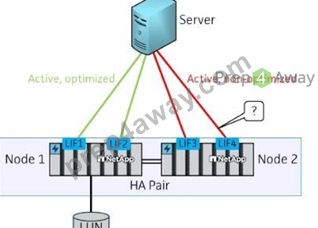
A customer is testing a newly installed NetApp AFF A400 all-flash HA storage system. An SVM for FCP with a LUN on Node 1 has been configured, and a server has been connected as shown in the exhibit. For testing, the engineer plans to do a storage failover of Node 1.
After the failover, what is the expected status of the marked path?
- A. Offline
- B. Active/Nonoptimized
- C. Unavailable
- D. Active/Optimized
Answer: B
Explanation:
In the scenario where a storage failover is performed on Node 1 in an HA pair, the path marked in the exhibit would becomeActive/Nonoptimized. After the failover, the LIFs from Node 1 that were activeand optimized will switch to Node 2. Paths that were previously optimized will become nonoptimized because they are now served through the partner node.
For more details, see:
* NetApp Documentation on ALUA
NEW QUESTION # 49
A customer wants to enable CHAP authentication on their iSCSI sessions.
Which command should be used to set up the appropriate security policies and passwords?
- A. security login create
- B. igroup initiator modify
- C. security certificate create
- D. vserver iscsi security create
Answer: D
Explanation:
To enable CHAP (Challenge-Handshake Authentication Protocol) authentication on iSCSI sessions, the command vserver iscsi security create should be used. This command sets up the necessary security policies and passwords required for CHAP authentication, ensuring secure access to iSCSI targets.
For more details, refer to:
* NetApp Documentation on iSCSI Configuration (NetApp).
NEW QUESTION # 50
During expansion planning for a 10-node cluster running NetApp ONTAP 9.14.1 software, which uses SAN and NAS, how many additional nodes can be added to this cluster?
- A. 0
- B. 1
- C. 2
- D. 3
Answer: A
Explanation:
NetApp ONTAP 9.14.1 supports up to a 16-node cluster for SAN and NAS configurations. Given a current
10-node cluster, you can add up to 6 additional nodes to reach the maximum supported node count. This expansion capability ensures scalability for growing storage needs while maintaining high availability and performance.
For more information, refer to:
* NetApp Storage Limits Documentation (NetApp)
NEW QUESTION # 51
A storage administrator wants to increase security and optimize performance in a recently implemented SAN deployment.
What should the storage administrator configure to ensure initiator restriction to certain LIFs?
- A. Network route
- B. Access list
- C. Broadcast domain.
- D. Subnets
Answer: B
Explanation:
To increase security and optimize performance in a SAN deployment, configuring an access list is essential.
Access lists restrict initiator access to specific LIFs, ensuring that only authorized hosts can connect to the storage system. This helps in enhancing security by preventing unauthorized access and optimizes performance by controlling and managing the paths used for storage access.
For additional details, you can refer to:
* NetApp SAN Administration Guide
NEW QUESTION # 52
A customer needs to verify if jumbo frames have been configured correctly for an ISCSI workload. Which command should be used?
- A. pig "lif <LIF> -vserver <svm> -destination <ip> -disallow-fragmentation true -packet-size 8900
- B. pig -lif <-F> -vserver <SVM> -destination <IP> -disallow-fragmentation true -packet-size 9000
- C. pig -lif <1IF> -vserver <SVM> -destination <IP> -disallow-fragmentation false -packet-size 1500
- D. ping -lif <LIF> -vserver <SVM> -destination <IP> -disallow-fragmentation true -packet-size 1500
Answer: B
Explanation:
To verify if jumbo frames have been configured correctly for an iSCSI workload, the command ping -lif
<LIF> -vserver <SVM> -destination <IP> -disallow-fragmentation true -packet-size 9000 should be used. This command tests the network path with the jumbo frame size (9000 bytes) and ensures that the packets are not fragmented, confirming that jumbo frames are supported end-to-end.
For more details, you can check:
* NetApp Documentation on iSCSI Configuration
* NetApp Community Discussions on Jumbo Frames
NEW QUESTION # 53
What is the maximum size for a LUN in NetApp ONTAP 9.14.1 software?
- A. 128TiB
- B. 16TiB
- C. 300TiB
- D. 64TiB
Answer: A
Explanation:
In NetApp ONTAP 9.14.1 software, the maximum size for a LUN is128TiB. This limit ensures that large datasets can be stored and managed efficiently within a single LUN, catering to the needs of high-capacity SAN environments
NEW QUESTION # 54
An administrator is setting up a NetApp ONTAP AFF system for both NVMe/TCP and iSCSI. Which task is required for SAN configuration?
- A. Configure CHAP authentication.
- B. Configure IPsec.
- C. Configure DH-HMAC-CHAP authentication.
- D. Configure LIFs.
Answer: D
Explanation:
When setting up a NetApp ONTAP AFF system for both NVMe/TCP and iSCSI, a critical task required for SAN configuration is to configure Logical Interfaces (LIFs). LIFs are necessary for network connectivity and are used by both NVMe/TCP and iSCSI protocols to communicate between the storage system and the host.
The configuration of LIFs involves creating and managing these interfaces to ensure they are correctly mapped and available for use by the respective protocols. This step is essential for the SAN setup to function properly.
For more detailed steps on configuring LIFs, you can refer to NetApp's documentation:
* How to Configure NVMe/TCP with ONTAP (NetApp Community).
* SAN Configuration with ONTAP (NetApp).
NEW QUESTION # 55
......
Network Appliance NS0-521 Exam Syllabus Topics:
| Topic | Details |
|---|---|
| Topic 1 |
|
| Topic 2 |
|
| Topic 3 |
|
| Topic 4 |
|
| Topic 5 |
|
| Topic 6 |
|
| Topic 7 |
|
Pass Your NS0-521 Exam Easily - Real NS0-521 Practice Dump Updated Oct 30, 2024: https://www.prep4away.com/NetworkAppliance-certification/braindumps.NS0-521.ete.file.html
2024 Realistic Verified Free Network Appliance NS0-521 Exam Questions: https://drive.google.com/open?id=1rhB-40XmGlDi1Ydy7nXWOTS3_OqD-HOw