

OGBA-101 Tested & Approved TOGAF Business Architecture Foundation Study Materials
Validate your Skills with Updated TOGAF Business Architecture Foundation Exam Questions & Answers and Test Engine
NEW QUESTION # 44
Which of the following best describes a benefit of business models?
- A. They provide a different viewpoint to cross-check assumptions.
- B. They can be used to calculate detailed cost estimates.
- C. They can be used to resolve conflicts amongst different stakeholders.
- D. They highlight what the business does without the need to explain why.
Answer: A
Explanation:
Business models are essential tools within TOGAF for providing different perspectives on the business operations, strategies, and value propositions. Here's a detailed explanation:
* Purpose of Business Models:
* Business models are designed to represent various aspects of the business, such as value creation, delivery, and capture mechanisms. They provide a structured way to analyze and understand the business.
* Different Viewpoint:
* Cross-Check Assumptions: Business models offer a different viewpoint that helps in validating and cross-checking assumptions made about the business. By presenting a visual and structured representation of the business, these models enable stakeholders to identify gaps, inconsistencies, and areas that need further analysis.
* Holistic Understanding: They help in gaining a holistic understanding of how different components of the business interact, which is crucial for ensuring that the enterprise architecture aligns with the business strategy and goals.
* TOGAF References:
* Phase A: Architecture Vision: During this phase, business models are used to articulate the vision and scope of the architecture effort. They help in ensuring that all assumptions are validated and that the architecture aligns with business objectives.
* Phase B: Business Architecture: Business models are also utilized in this phase to analyze business capabilities, processes, and value streams. They provide a different viewpoint that aids in identifying areas for improvement and ensuring alignment with the strategic intent.
In summary, business models provide a different viewpoint that helps cross-check assumptions, ensuring that the enterprise architecture is aligned with the business strategy and objectives.
NEW QUESTION # 45
Complete the sentence. The TOGAF standard covers the development of four architecture domains. Business. Dat a. Technology and___________.
- A. Transition
- B. Capability
- C. Segment
- D. Application
Answer: D
Explanation:
The TOGAF standard covers the development of four architecture domains: Business, Data, Technology, and Application. The Application Architecture domain defines the applications required to process the data and support the business functions.
NEW QUESTION # 46
Which of the following best describes where business scenarios are used in the TOGAF ADM?
- A. They are used as part of the lessons learned activity at the end of Phase F.
- B. They are used to resolve impacts across the Architecture Landscape in Phases B, C, and D.
- C. They are used as part of a business transformation readiness assessment in Phase E.
- D. They are used in the Preliminary Phase, Phase A, and Phase B.
Answer: D
Explanation:
According to the TOGAF Standard, business scenarios are an important technique that may be used at various stages of the enterprise architecture, principally the Architecture Vision and the Business Architecture, but in other architecture domains as well, if required, to derive the characteristics of the architecture directly from the high-level requirements of the business1. The Architecture Vision is developed in Phase A, and the Business Architecture is developed in Phase B. The Preliminary Phase is also a stage where business scenarios can be used to help identify and understand business needs2.
NEW QUESTION # 47
Which of the following is a purpose of mapping capabilities to value stream stages?
- A. To classify, group, and align capabilities into categories for a deeper understanding.
- B. To describe the business in terms of services provided and consumed.
- C. To identify and eliminate business capabilities that do not contribute to the business.
- D. To provide a self-contained business description that is independent of the organizational structure.
Answer: A
Explanation:
One of the purposes of mapping capabilities to value stream stages is to classify, group, and align capabilities into categories for a deeper understanding of how they support value creation and delivery2. By mapping capabilities to value stream stages, the architect can identify which capabilities are required for each stage of the value stream, how they relate to each other, and how they contribute to the overall value proposition. This can help to assess the maturity, effectiveness, performance, and value or cost contribution of each capability.
NEW QUESTION # 48
Complete the sentence An information map is a_______________________________________.
- A. description of the business units that use capabilities and participate in value streams
- B. representation of where the business information is held within the enterprise
- C. collection of information concepts and their relationships to one another
- D. target description of information assets needed to support the business
Answer: C
Explanation:
An information map is essentially a collection of information concepts along with their relationships. It's a visual representation that shows how various types of information are related and used throughout the organization. This can include data entities, their attributes, and the flow of data between different business processes or systems. Information mapping helps in understanding the structure of an organization's data and is a key part of the information system architecture within TOGAF's content framework.
NEW QUESTION # 49
Consider the following business capability map. where cells of a model are given different colors to represent desired maturity levels (Green (G) = level achieved, yellow (Y) = one level away, red (R) =two or more levels away, purple (P) = missing capability):
Which of the following best describes what this shows?
- A. The Strategic capabilities need more attention in two areas. Policy Management, and Government Relations Management. Agent Management is missing as a Core capability Information Management needs attention as a Supporting Capability.
- B. Agent Management needs immediate attention. Market Planning. Government Relations Management, and HR Management have Issues but are of lower priority Partner Management. Customer Management, and Training Management are new business capabilities that do not exist.
- C. Agent Management needs immediate attention. Market Planning. HR Management and Government Relations Management need attention. Customer Management. Training Management and Partner Management need attention but are of lower priority.
- D. Policy Management. Government Relations Management, and HR Management need immediate attention. Partner Management. Account Management, and Training Management have issues but are of lower priority Agent Management Is a new business capability that does not exist
Answer: D
Explanation:
The business capability map provided uses color coding to represent the maturity levels of various business capabilities in strategic, core, and supporting functions. The colors indicate the current state or priority for development, with red indicating capabilities that are significantly below desired maturity levels and thus require immediate attention. In this case, Policy Management, Government Relations Management, and HR Management are marked as red, signaling the need for urgent improvement. Yellow indicates capabilities that are closer to the desired state but still need attention, while green shows capabilities that have achieved the desired maturity level. Purple indicates a missing capability that does not currently exist in the enterprise, which is the case for Agent Management.
NEW QUESTION # 50
In which part of a business scenario are business capabilities and value streams modeled?
- A. When identifying the human actors
- B. When identifying, documenting and ranking the problem
- C. When identifying the business and technology environment
- D. When identifying and documenting desired outcomes
Answer: C
Explanation:
In a business scenario, business capabilities and value streams are modeled when identifying the business and technology environment. Here's a detailed explanation:
* Business Scenarios in TOGAF:
* Business scenarios are used to capture and describe the business requirements, providing a context for the architecture development. They help in understanding the business environment, identifying problems, and defining desired outcomes.
* Identifying the Business and Technology Environment:
* Business Capabilities: During this phase, the architect identifies the key business capabilities required to achieve the business objectives. These capabilities represent what the organization
* needs to be able to do.
* Value Streams: Value streams are also identified and modeled to understand how value is delivered to customers and stakeholders. They provide a high-level view of the end-to-end processes that create value.
* TOGAF ADM References:
* Phase A: Architecture Vision: In this phase, understanding the business and technology environment is crucial for defining the architecture vision. Modeling business capabilities and value streams provides a foundation for this understanding.
* Phase B: Business Architecture: This phase involves a detailed analysis of business capabilities and value streams to ensure that the architecture supports the business strategy and objectives.
* Importance:
* Contextual Understanding: By modeling business capabilities and value streams, architects gain a comprehensive understanding of the business and technology environment. This helps in aligning the architecture with business needs and ensuring that it supports value creation.
* Strategic Alignment: Identifying and modeling these elements ensures that the architecture is aligned with the strategic goals of the organization and supports its key business activities.
In summary, business capabilities and value streams are modeled when identifying the business and technology environment, providing a comprehensive understanding of how the organization operates and how the architecture can support its objectives.
NEW QUESTION # 51
What process is used to decompose a set of business capabilities to communicate more detail?
- A. Leveling
- B. Layering
- C. Mapping
- D. Sorting
Answer: A
Explanation:
The process used to decompose a set of business capabilities to communicate more detail is leveling6. Leveling is a technique that can be used to break down a business capability into sub-capabilities at lower levels of granularity6. Leveling can help to provide more clarity and specificity about what a business capability entails and how it supports the business goals and objectives6. Leveling can also help to identify dependencies, gaps, overlaps, or redundancies among business capabilities6.
NEW QUESTION # 52
Which of the following is a difference between an organization map and an organization chart?
- A. An organization map improves the ability to deliver information within the organization by highlighting the consumers.
- B. An organization map reduces the time, cost, and risk of business operations.
- C. An organization map highlights where in the organization that stakeholder concerns are not being addressed by a business architecture.
- D. An organization map describes the complex interactions and relationship within an organization.
Answer: D
Explanation:
An organization map provides a detailed representation of the complex interactions and relationships within an organization, going beyond the hierarchical structure shown in an organization chart. It includes the connections and dependencies between different business units, teams, and roles, offering a more comprehensive view of how the organization operates and collaborates to achieve its objectives.
NEW QUESTION # 53
Which of the following best describes a business capability?
- A. It is an articulation of the relationships between business entities that make up the enterprise.
- B. It is a qualitative statement of intent that should be met by the enterprise architecture capability developing the business architecture.
- C. It delineates what a business does without an explanation of how, why, or where the capability is used.
- D. It is a detailed description of the architectural approach to realize a particular solution.
Answer: C
Explanation:
According to the TOGAF Series Guide to Business Capabilities (Version 2), a business capability is defined as "a particular ability or capacity that a business may possess or exchange to achieve a specific purpose or outcome" 4. A business capability delineates what a business does without an explanation of how, why, or where the capability is used4. A business capability can be expressed as a verb phrase that indicates what function or service the capability provides4. For example, some possible business capabilities are "Manage Customer Relationships", "Deliver Products", or "Perform Financial Analysis".
NEW QUESTION # 54
Which of the following is a derived relationship in an organization map?
- A. Location
- B. Scope of enterprise
- C. Value flow
- D. Capability
Answer: C
Explanation:
According to the TOGAF Series Guide: Organization Mapping, one of the derived relationships in an organization map is value flow1. A value flow is a relationship that shows how value is exchanged between business units or other entities in an organization map1. A value flow can be expressed as a verb phrase that indicates what type of value is transferred or shared between entities1. For example, in an organization map for an online retailer, a possible value flow could be "Delivers products" between the Warehouse business unit and the Customer entity.
NEW QUESTION # 55
When developing a Business Architecture, which of the following best describes the approach to take If no Architecture Descriptions exist?
- A. Identify the business goals, business objectives, and drivers for the enterprise
- B. Information should be gathered, and Business Architecture models developed.
- C. Validate the business principles and update the Statement of Architecture Work.
- D. Review the contents of the Architecture Repository.
Answer: B
Explanation:
In the absence of existing Architecture Descriptions, the development of a Business Architecture would begin with the gathering of relevant information about the business. This information can come from strategic documents, business plans, process documents, and stakeholder interviews, among other sources. Once gathered, this information would be used to create Business Architecture models that articulate the business vision, strategy, governance, organization, and key business processes. These models provide a blueprint that captures the essence of the business and guides subsequent architecture work.
NEW QUESTION # 56
What can architects present to stakeholders to extract hidden agendas, principles, and requirements that could impact the final Target Architecture?
- A. Solutions and Applications
- B. Architecture Views and Architecture Viewpoints
- C. Business Scenarios and Business Models
- D. Alternatives and Trade-offs
Answer: C
Explanation:
Business Scenarios and Business Models are tools that architects can present to stakeholders to facilitate discussions that reveal underlying assumptions, agendas, principles, and requirements. They help in understanding the context, extracting and validating requirements, and identifying potential impacts on the target architecture. By discussing scenarios and models, stakeholders can express their vision and concerns, which may include unspoken or implicit needs that are crucial for the architecture's success.
NEW QUESTION # 57
In the diagram, what are the items labelled A, B, and C?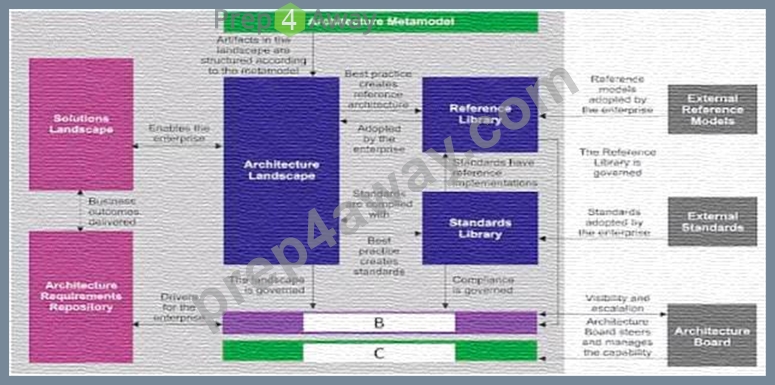
- A. Enterprise Repository, B-Board repository, C-Enterprise Capability
- B. A-Architecture Repository, B-Governing Board, C-Enterprise Capability
- C. A-Architecture Repository, B-Governance Repository. C-Architecture Capability
- D. A-Enterprise Repository, B-Governance Repository. C-Board Repository
Answer: B
Explanation:
In the provided diagram, item A refers to the Architecture Repository, which is a part of the TOGAF framework where all the architecture assets are stored. This includes the architectural models, patterns, architecture descriptions, and other artifacts relevant to the architecture. Item B is labeled as the Governing Board, which is likely referring to the Architecture Board or a similar governance structure responsible for oversight and decision-making regarding the enterprise architecture. Item C refers to Enterprise Capability, which encompasses the processes, tools, skills, and other capabilities that enable the architecture function within the enterprise.
NEW QUESTION # 58
Which approach to modeling business value is designed to create and end-to-end perspective of value from the customer's perspective?
- A. Value streams
- B. Lean value streams
- C. Value chains
- D. Value networks
Answer: A
Explanation:
A value stream is an approach to modeling business value that focuses on the end-to-end sequence of activities that an organization performs to deliver a product or service to the customer. This perspective is designed to help organizations understand the full lifecycle of value creation, from the initial customer demand to the final delivery of value. It provides a holistic view of the flow of value through the organization and is instrumental in identifying areas of waste and opportunities for improvement to enhance the overall customer experience.
Value streams help in visualizing and optimizing the steps necessary to effect change in the business processes and systems that create value for the customers.
NEW QUESTION # 59
Which of the following best describes a TOGAF business scenario?
- A. A business case.
- B. A technique to elaborate an architecture effort.
- C. A use-case providing detailed descriptions.
- D. A method to develop a business model.
Answer: B
Explanation:
A TOGAF business scenario is a technique that can be used to fully understand the requirements of information technology and align it with business needs1. It is not a business case, which is a document that provides justification for a proposed project or initiative6. It is not a method to develop a business model, which is a description of how an organization creates, delivers, and captures value for its stakeholders7. It is not a use-case, which is a description of how a system interacts with external actors to achieve a specific goal.
NEW QUESTION # 60
Which of the following is a benefit of information mapping?
- A. It enables improved business process integration.
- B. It highlights information requirements not addressed by a business architecture.
- C. It provides a framework for effective business requirements analysis.
- D. It provides a basis to support decision-making throughout the business.
Answer: D
Explanation:
One of the benefits of information mapping is that it provides a basis to support decision-making throughout the business1. Information mapping is a technique that can be used to document and visualize the information concepts and their relationships that are relevant for the business1. Information mapping can help to identify the information needs, sources, flows, quality, and value of the business, as well as the gaps, issues, and opportunities for improvement1. By providing a clear and consistent view of the information landscape, information mapping can enable better informed and more effective decisions at all levels of the business.
NEW QUESTION # 61
Which of the following is an analysis technique which is used to show a range of different perspectives on the same set of business capabilities?
- A. Information mapping
- B. Relationship mapping
- C. Capability decomposition
- D. Heat mapping
Answer: D
Explanation:
Heat mapping is an analysis technique used in TOGAF to show a range of different perspectives on the same set of business capabilities. This technique involves visually representing data to highlight areas of importance or concern, such as performance levels, resource allocation, or risk exposure. Heat maps provide a clear and intuitive way to identify strengths, weaknesses, opportunities, and threats within the business capabilities, facilitating better decision-making and prioritization of improvement efforts.
NEW QUESTION # 62
Which of the following best describes information mapping?
- A. A technique to construct a high level description of the informational requirements of a business.
- B. A technique to create a maturity model for information management.
- C. A technique to represent business information assets in use, or planned by the enterprise.
- D. A technique to construct a baseline description of the structure and interaction of information assets that support key business functions.
Answer: C
Explanation:
Information mapping in TOGAF is a technique used to represent business information assets that are either currently in use or planned for future use by the enterprise. Here's a detailed explanation:
Purpose of Information Mapping:
Information mapping provides a clear visualization of how information flows within the enterprise, highlighting the information assets and their interactions. This is crucial for understanding the current state and planning the future state of information management.
TOGAF Framework:
Phase C: Information Systems Architectures: Within this phase, information mapping is used to develop the Data Architecture, which outlines the structure of an organization's logical and physical data assets and data management resources.
Supporting Analysis: Information mapping supports various analyses, including gap analysis, impact analysis, and the identification of information dependencies and redundancies.
Benefits:
Clear Representation: It provides a clear and structured representation of business information assets, aiding in the understanding and management of information flows.
Alignment with Business Processes: Helps ensure that information assets are aligned with business processes and objectives, enhancing the efficiency and effectiveness of information usage.
Components:
Current Information Assets: Information mapping identifies and catalogs the information assets currently in use within the enterprise.
Planned Information Assets: It also includes planned information assets that will be needed to support future business processes and strategies.
In summary, information mapping is a technique to represent business information assets in use or planned by the enterprise, providing a structured view of information flows and supporting effective information management.
NEW QUESTION # 63
When developing a Business Architecture, which of the following is recommended if an enterprise has existing Architecture Descriptions?
- A. They should be used as the basis for the Baseline Description.
- B. They should be added to the Governance Repository within the Architecture Repository.
- C. They should be used to validate the business principles.
- D. They should be reviewed, and work packages identified for portfolio planning.
Answer: A
Explanation:
When developing a Business Architecture, TOGAF provides guidance on how to leverage existing architecture descriptions to build a comprehensive and accurate Baseline Description. Here's a step-by-step explanation:
* Existing Architecture Descriptions:
* Existing architecture descriptions provide valuable insights into the current state of the enterprise's architecture. These descriptions can include documentation of processes, systems, technologies, and organizational structures.
* Baseline Description:
* The Baseline Description represents the current state of the enterprise architecture. It serves as the starting point for developing the Target Architecture and planning the transition from the current state to the future state.
* Using Existing Descriptions:
* Review and Analyze: Existing architecture descriptions should be reviewed and analyzed to understand the current state accurately. This involves identifying all relevant artifacts, documents, and data.
* Integration into Baseline: The information from the existing descriptions should be integrated into the Baseline Description. This ensures that the Baseline accurately reflects the current state, providing a solid foundation for future planning.
* Gaps and Opportunities: By using existing descriptions, architects can identify gaps in the current architecture and opportunities for improvement. This helps in formulating a more effective Target Architecture.
* TOGAF ADM References:
* Phase A: Architecture Vision: This phase involves establishing the architecture vision, which includes defining the scope and approach for the Baseline Description.
* Phase B: Business Architecture: During this phase, the Baseline Business Architecture is developed using existing architecture descriptions as a key input.
In summary, using existing architecture descriptions as the basis for the Baseline Description ensures that the current state is accurately documented, providing a reliable foundation for developing the Target Architecture and planning the transition.
NEW QUESTION # 64
In business capability mapping, when you have documented all of the business capabilities, what should you do next?
- A. Draw up a business value assessment for each of the business capabilities.
- B. Identify the human and computer actors associated with each business capability.
- C. Organize the business capabilities in a logical manner.
- D. Map the business capabilities to stakeholder concerns.
Answer: C
Explanation:
According to the TOGAF Series Guide: Business Capabilities, after documenting all of the business capabilities, the next step is to organize them in a logical manner1. This can be done by using techniques such as layering, sorting, mapping, and leveling1. These techniques can help to classify, group, and align capabilities into categories for a deeper understanding of how they support the business goals and objectives1. Organizing the business capabilities can also help to identify dependencies, gaps, overlaps, or redundancies among them1.
NEW QUESTION # 65
Which step during development of a business scenario ensures that each iteration is managed as a mini-project?
- A. Planning Step
- B. Documenting Step
- C. Gathering Step
- D. Reviewing Step
Answer: A
Explanation:
The step during development of a business scenario that ensures that each iteration is managed as a mini-project is the Planning Step3. The Planning Step is a preparatory step that defines how to approach each iteration of developing a business scenario3. The Planning Step involves setting up a project team with clear roles and responsibilities, defining a project plan with milestones and deliverables, identifying stakeholders and their concerns, establishing communication channels and feedback mechanisms, and securing resources and budget3. The Planning Step can help to ensure that each iteration is managed as a mini-project with clear objectives, scope, schedule, quality criteria, risks, and issues.
NEW QUESTION # 66
Question: Which ADM Phases match the following purpose descriptions?
- A. 1 Phase D - 2 Phase B - 3 Phase G - 4 Phase A
- B. 1 Phase C - 2 Phase F - 3 Phase H - 4 Phase B
- C. 1 Phase C - 2 Phase E - 1 Phase H - 4 Phase C
- D. 1 Phase C - 2 Phase F - 3 Phase G- 4 Phase D
Answer: D
Explanation:
The ADM Phases that match the purpose descriptions provided are: Phase C for the development of Information Systems Architectures to support the agreed Architecture Vision, Phase F for addressing the move from the Baseline to the Target Architectures by finalizing a detailed Implementation and Migration Plan, Phase G for providing architectural oversight of the implementation, and Phase D for describing the development of the Technology Architecture to support the agreed Architecture Vision.
NEW QUESTION # 67
Which of the following supports the need to govern Enterprise Architecture?
- A. Best practice governance enables the organization to control value realization.
- B. The stakeholder preferences may go beyond the architecture project scope and needs control.
- C. The TOGAF standard cannot be used without executive governance.
- D. The Architecture Project mandates the governance of the target architecture.
Answer: A
Explanation:
The need to govern Enterprise Architecture is supported by the fact that best practice governance enables the organization to control value realization. Here's a detailed explanation:
* Enterprise Architecture Governance:
* Definition: Governance in the context of Enterprise Architecture (EA) involves establishing processes, roles, and responsibilities to ensure that the architecture is developed and maintained in alignment with the business strategy and objectives.
* Importance of Governance:
* Control and Accountability: Effective governance ensures that architecture activities are controlled and aligned with business priorities. It establishes accountability for architectural decisions and outcomes.
* Value Realization: Governance mechanisms ensure that the architecture delivers value to the organization by aligning with strategic goals, optimizing resource usage, and ensuring that architecture initiatives are completed successfully.
* TOGAF References:
* Architecture Governance Framework: TOGAF provides a framework for architecture governance, including guidelines for establishing governance structures, processes, and tools to manage architecture activities effectively.
* ADM Phases: Governance is integrated into all phases of the ADM to ensure that architecture development is controlled and aligned with business needs. This includes monitoring progress, managing risks, and ensuring compliance with architecture principles and standards.
* Best Practices:
* Continuous Improvement: Best practice governance involves continuous monitoring and improvement of the architecture processes to ensure they remain effective and deliver the desired outcomes.
* Stakeholder Engagement: Effective governance ensures ongoing engagement with stakeholders, ensuring their needs and concerns are addressed, and maintaining alignment with business objectives.
In summary, the need to govern Enterprise Architecture is supported by the fact that best practice governance enables the organization to control value realization, ensuring that architecture initiatives are aligned with strategic goals and deliver tangible benefits.
NEW QUESTION # 68
......
OGBA-101 [Dec-2024] Newly Released] OGBA-101 Exam Questions For You To Pass: https://www.prep4away.com/TheOpenGroup-certification/braindumps.OGBA-101.ete.file.html
For your comfort, Prep4away provides you the convenience of free TOGAF Business Architecture Foundation braindumps demo: https://drive.google.com/open?id=1MDdD_oJ6FHzkBwvp-gVndJzQDY9tiRAS