

2026 Reliable Study Materials & Testing Engine for OGBA-101 Exam Success!
Validate your Skills with Updated OGBA-101 Exam Questions & Answers and Test Engine
NEW QUESTION # 91
Which TOGAF ADM phase establishes the Architecture Vision?
- A. Phase C
- B. Phase A
- C. Preliminary
- D. Phase B
Answer: B
Explanation:
Phase A develops the Architecture Vision by defining business objectives, identifying stakeholders, confirming scope, and obtaining approval. It establishes a shared understanding before detailed architecture work begins in subsequent ADM phases.
NEW QUESTION # 92
In which part of a business scenario are business capabilities and value streams modeled?
- A. When identifying and documenting desired outcomes
- B. When identifying the business and technology environment
- C. When identifying, documenting and ranking the problem
- D. When identifying the human actors
Answer: B
Explanation:
In a business scenario, business capabilities and value streams are modeled when identifying the business and technology environment. Here's a detailed explanation:
Business Scenarios in TOGAF:
Business scenarios are used to capture and describe the business requirements, providing a context for the architecture development. They help in understanding the business environment, identifying problems, and defining desired outcomes.
Identifying the Business and Technology Environment:
Business Capabilities: During this phase, the architect identifies the key business capabilities required to achieve the business objectives. These capabilities represent what the organization needs to be able to do.
Value Streams: Value streams are also identified and modeled to understand how value is delivered to customers and stakeholders. They provide a high-level view of the end-to-end processes that create value.
TOGAF ADM Reference:
Phase A: Architecture Vision: In this phase, understanding the business and technology environment is crucial for defining the architecture vision. Modeling business capabilities and value streams provides a foundation for this understanding.
Phase B: Business Architecture: This phase involves a detailed analysis of business capabilities and value streams to ensure that the architecture supports the business strategy and objectives.
Importance:
Contextual Understanding: By modeling business capabilities and value streams, architects gain a comprehensive understanding of the business and technology environment. This helps in aligning the architecture with business needs and ensuring that it supports value creation.
Strategic Alignment: Identifying and modeling these elements ensures that the architecture is aligned with the strategic goals of the organization and supports its key business activities.
In summary, business capabilities and value streams are modeled when identifying the business and technology environment, providing a comprehensive understanding of how the organization operates and how the architecture can support its objectives.
NEW QUESTION # 93
Which of the following is a benefit of value streams and value stream mapping?
- A. Value streams provide a framework for more effective business requirements analysis, case management, and solution design.
- B. Value streams highlight the value of individual work packages needed to develop the business architecture.
- C. Value streams help to identify value, duplication, and redundancy across the enterprise.
- D. Value streams help to ensure that investments and project initiatives are prioritized and funded at an appropriate level commensurate with their value.
Answer: A
Explanation:
According to the TOGAF Business Architecture Guide, value streams play a key role in providing a structured framework that supports more effective analysis of business requirements, case management, and solution design. Value streams offer a high-level, customer-centric view of how value flows through the organization, which helps in aligning business requirements and ensuring solutions are well-targeted to meet those requirements.
* Role of Value Streams in Business Requirements AnalysisValue streams help stakeholders understand the key stages and outcomes that deliver value to customers or stakeholders. This framework facilitates a clear alignment between business requirements and the value outcomes each requirement supports. By mapping requirements to specific value stream stages, architects can ensure that requirements are directly tied to business outcomes.
* Supporting Case ManagementValue streams also provide a structured approach for managing various business cases. By identifying key stages in the value creation process, value streams help in evaluating and prioritizing cases based on their impact on value delivery. This structured approach enhances case management by focusing on value, efficiency, and alignment with organizational goals.
* Enhancing Solution DesignSolution design is more effective when informed by a value stream view, as it allows architects to focus on delivering value at each stage of the process. By understanding the flow of value, architects and solution designers can ensure that technology, processes, and capabilities are aligned to support the most critical aspects of the value stream. This alignment optimizes solution design to meet specific business needs more effectively.
* Why Option B is CorrectThe TOGAF Business Architecture Guide explicitly states that value streams provide a framework for business requirements analysis, case management, and solution design. This insight indicates that value streams are instrumental in ensuring that these elements are aligned with how value is delivered within the organization.
Why Other Options are Incorrect:
* Option A (Identify value, duplication, and redundancy):While value streams can provide insights into operational efficiency, they are not primarily focused on identifying duplication and redundancy across the enterprise. Instead, this aspect is typically covered by detailed process mapping or capability assessments.
* Option C (Highlighting value of individual work packages):Value streams do not emphasize individual work packages but rather focus on the overall flow of value. Work packages are more granular and usually defined during implementation and migration planning.
* Option D (Ensuring investment prioritization):Investment prioritization is more closely associated with portfolio management rather than value stream mapping. Although value streams inform decision- making, they do not directly handle funding prioritization.
Conclusion:
The correct answer is B because value streams provide a framework that directly supports business requirements analysis, case management, and solution design, as outlined in the TOGAF Business Architecture Guide.
Reference:
TOGAF Business Architecture Guide, Value Streams Section
NEW QUESTION # 94
Exhibit.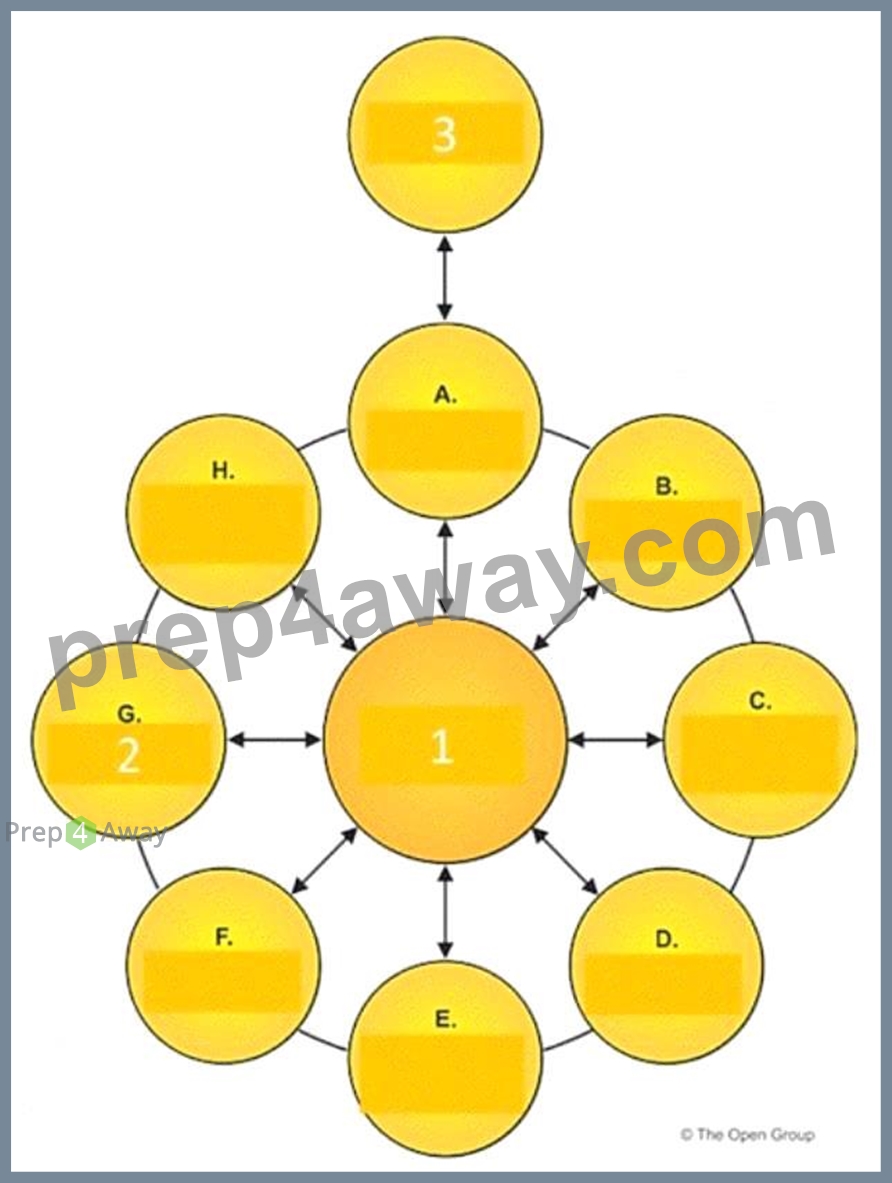
Consider the diagram of an architecture development cycle.
Select the correct phase names corresponding to the labels 1, 2 and 3?
- A. 1 Architecture Governance - 2 Implementation Governance - 3 Preliminary
- B. 1 Requirements Management - 2 Change Management - 3 Strategy
- C. 1 Requirements Management - 2 Implementation Governance - 3 Preliminary
- D. 1 Continuous Improvement - 2 Migration Planning - 3 Architecture Vision
Answer: C
Explanation:
The diagram of an architecture development cycle shows three phases of the TOGAF ADM. The correct phase names corresponding to the labels 1, 2 and 3 are Requirements Management, Implementation Governance, and Preliminary respectively3. These phases are described as follows:
* Requirements Management (label 1): This phase provides a process for managing architecture requirements throughout the ADM cycle3. It ensures that requirements are captured, stored, prioritized, and addressed by relevant ADM phases3. It also ensures that requirements are validated and updated as necessary3.
* Implementation Governance (label 2): This phase provides a process for ensuring that the implementation projects conform to the defined architecture3. It involves establishing an implementation governance model, defining architecture contracts and compliance reviews, and monitoring and supporting the implementation projects3.
* Preliminary (label 3): This phase provides a process for preparing and planning the architecture project3. It involves defining the scope and vision of the project, customizing the ADM process and content framework, defining principles and governance structures, and evaluating the enterprise architecture maturity and readiness3.
NEW QUESTION # 95
Complete the sentence. The classification model of the Architecture Landscape is divided Into levels known as________________
- A. Baseline. Transition, and To Be Architectures
- B. Segment. Strategic, and Capability Architectures
- C. Gaps, Plateaus, and Target Architectures
- D. Transitional. Complete, and Incremental Architectures
Answer: D
NEW QUESTION # 96
Consider the following:
You need to analyze a new value stream within the scope of a project.
Which of the following would you use?
- A. Heat mapping by value stream stages.
- B. Converting the value stream stages to entities and then building a logical data model
- C. Combining information mapping with a business process model.
- D. An organization chart showing the business units that work with the enterprise and their value.
Answer: A
Explanation:
In TOGAF and other enterprise architecture practices, analyzing a value stream often involves understanding the various stages of the value stream and assessing how each stage contributes to business value. Heat mapping is a commonly used technique to visualize and analyze these stages, making it the most appropriate choice in this context.
Understanding Value Streams in TOGAF
A value stream represents a high-level view of how value is delivered to customers or stakeholders. It encompasses all the activities necessary to achieve a specific outcome, often broken down into stages. In TOGAF's Business Architecture, value stream mapping is a key activity for analyzing and understanding these value stages, enabling architects to identify areas for improvement.
Heat Mapping as an Analysis Technique
Heat mapping by value stream stages is a visualization technique that highlights the effectiveness or performance of each stage in the value stream. By applying a heat map, architects can easily see which stages are performing well (often marked in "cool" colors) and which stages may need improvement (often marked in "hot" colors). This is particularly useful for identifying bottlenecks, redundancies, or inefficiencies within the value stream, which is essential for project analysis.
Why Other Options are Incorrect:
Option A (Converting value stream stages to entities and building a logical data model):
Building a logical data model involves defining data entities and their relationships, which is more relevant for data architecture. It does not directly contribute to analyzing a value stream's stages or performance within a project scope.
Option C (An organization chart showing business units and their value):
An organization chart shows hierarchical relationships and roles within the enterprise, which does not specifically address value stream stages. While it may help understand which units are responsible for different parts of the value stream, it doesn't provide insight into the performance or effectiveness of each stage.
Option D (Combining information mapping with a business process model):
Information mapping with a business process model is more suited for detailed process analysis. It involves mapping information flows within processes but doesn't directly address analyzing value stream stages. Value streams are typically at a higher level than detailed business processes, focusing more on outcomes than specific activities.
Conclusion: Heat mapping by value stream stages (Option B) is the most effective tool for analyzing a new value stream within the project scope, as it provides a visual assessment of each stage's performance and identifies areas for improvement.
Reference:
TOGAF Standard, Version 9.2, Value Stream Mapping Techniques
NEW QUESTION # 97
Which of the following is a benefit of information mapping?
- A. It enables improved business process integration.
- B. It provides a framework for effective business requirements analysis.
- C. It provides a basis to support decision-making throughout the business.
- D. It highlights information requirements not addressed by a business architecture.
Answer: C
Explanation:
In TOGAF and business architecture practices,information mappingis a technique used to organize, visualize, and analyze key information assets within an organization. One of the primary benefits of information mapping is that it provides a structured view of information flows, dependencies, and requirements across various parts of the organization, supporting decision-making at multiple levels. By clearly mapping how information is generated, used, and shared, decision-makers can make more informed choices, ensuring alignment with strategic goals and effective use of resources.
Each option can contribute to the business architecture, butOption Dis the most accurate for the benefit of information mapping:
* Option A(Improved business process integration) describes a benefit of process mapping rather than information mapping, although structured information can support process integration indirectly.
* Option B(Framework for effective business requirements analysis) is not the primary benefit of information mapping. While information mapping helps clarify information needs, the analysis of business requirements is more focused on requirements engineering practices.
* Option C(Highlights information requirements not addressed) is incorrect because while information mapping can reveal gaps in information needs, its primary function is not to identify gaps but to provide a clear view of information assets and flows.
Therefore,Option Daccurately reflects the main benefit of information mapping: supporting effective, informed decision-making across the business.
NEW QUESTION # 98
Which ADM phase is primarily responsible for developing the Business Architecture?
- A. Phase C
- B. Phase D
- C. Phase A
- D. Phase B
Answer: D
Explanation:
Phase B focuses on developing the Business Architecture by defining baseline and target business architectures, analyzing gaps, and identifying opportunities to support the organization's strategic objectives and transformation initiatives.
NEW QUESTION # 99
Consider the diagram.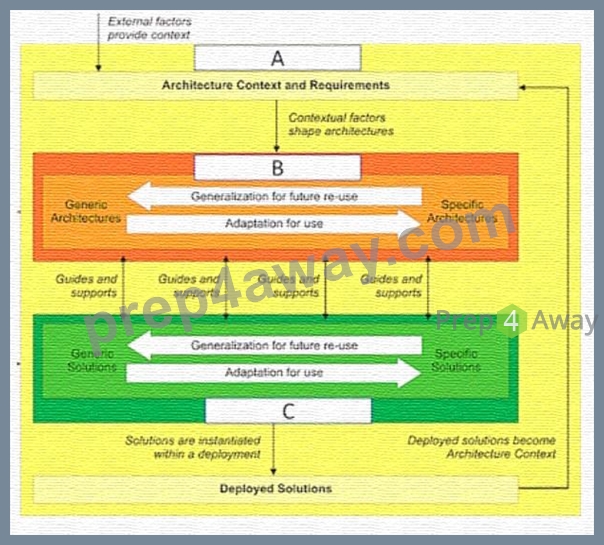
What are the items labelled A, B and C?
- A. A-Enterprise Strategic Architecture, B-Segment Architecture, C-Solutions Architecture
- B. A-Enterprise Architecture, B-Architecture Building Blocks, C-Solutions Building Blocks
- C. A-Enterprise Continuum, B-Architecture Continuum. C-Solutions Continuum
- D. A-Architecture Vision, B-Business Architecture. C-lnformation Systems Architecture
Answer: C
Explanation:
The diagram shows the Enterprise Continuum, which is a view of the Architecture Repository that provides methods for classifying architecture and solution artifacts as they evolve from generic Foundation Architectures to Organization-Specific Architectures4. The Enterprise Continuum comprises two complementary concepts: the Architecture Continuum and the Solutions Continuum. The Architecture Continuum shows the relationships among foundational frameworks, common system architectures, industry architectures, and enterprisearchitectures4. The Solutions Continuum shows the relationships among foundational solutions, common system solutions, industry solutions, and enterprise solutions4.
NEW QUESTION # 100
What is the role of an Architecture Board?
- A. It oversees implementation of the Architecture Governance strategy for the enterprise.
- B. It creates the Statement of Architecture Work for an Enterprise Architecture project.
- C. It conducts the assessments of the maturity level of architecture discipline within the organization.
- D. It determines the scope of an architecture compliance review.
Answer: A
NEW QUESTION # 101
When considering the scope of an architecture, the architect considers the level of detail for the architecting effort. What is this dimension of the scope called?
- A. The project
- B. The depth
- C. The extent
- D. The breadth
Answer: B
NEW QUESTION # 102 
Which of the following best describes this diagram?
- A. Business Capabilities Layer diagram
- B. Business Capability/Value Stream Mapping
- C. Business Capability Map
- D. Business Relationships diagram
Answer: C
Explanation:
The diagram presented is best described as a Business Capability Map. Here's a detailed explanation:
* Business Capability Map:
* Definition: A Business Capability Map represents the various capabilities an organization requires to deliver its products and services and achieve its strategic objectives. It typically categorizes capabilities into different levels or tiers, such as strategic, core, and supporting capabilities.
* Diagram Analysis:
* Layers and Groupings: The diagram shows capabilities grouped into three categories: Strategic, Core, and Supporting. Each group lists specific business capabilities necessary for the organization's functioning.
* Color Coding: The use of different colors (green, red, yellow, purple) may indicate various aspects such as priority, status, or different business units. However, the primary purpose is to visually represent and categorize capabilities.
* TOGAF References:
* Phase B: Business Architecture: In this phase, creating a Business Capability Map is a crucial activity. It helps in understanding the business functions and aligning them with strategic goals.
* Capability-Based Planning: TOGAF promotes capability-based planning, which involves identifying, mapping, and analyzing business capabilities to ensure they support the overall strategy and objectives.
* Purpose and Benefits:
* Strategic Alignment: The Business Capability Map helps in aligning business capabilities with the strategic objectives of the organization. It provides a clear view of what the organization needs to do to achieve its goals.
* Gap Analysis: It is useful for conducting gap analysis by comparing current capabilities with the desired state, helping to identify areas for improvement.
* Resource Allocation: By understanding the different capabilities, organizations can allocate resources more effectively to areas that need development or enhancement.
In summary, the diagram is best described as a Business Capability Map because it visually represents and categorizes the various capabilities needed by the organization into strategic, core, and supporting layers, aligning them with the business strategy and objectives.
NEW QUESTION # 103
Refer to the table below: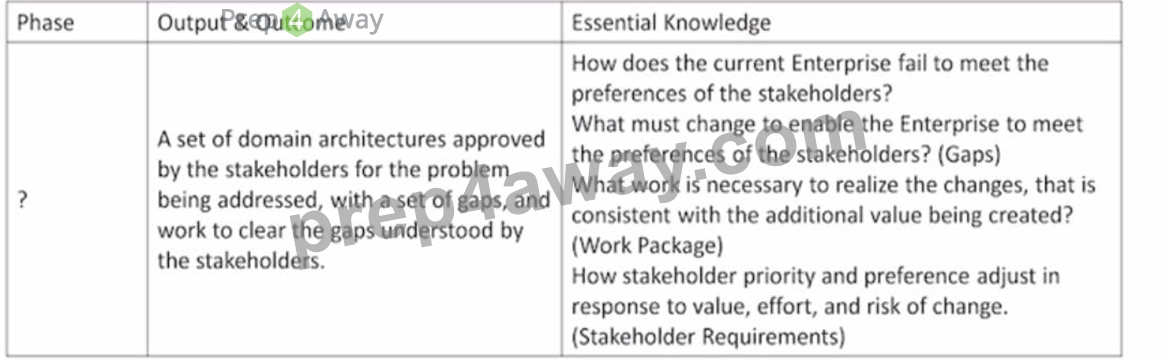
Which ADM Phase(s) does this describe?
- A. Preliminary Phase
- B. Phase E
- C. Phase B. C and D
- D. Phase B
Answer: C
Explanation:
The table describes the steps involved in Phase B (Business Architecture), Phase C (Information Systems Architectures), and Phase D (Technology Architecture) of the TOGAF ADM5. These phases are responsible for developing the target architectures for each domain and identifying the gaps between the baseline and target architectures. The table shows the outputs and outcomes of each phase, as well as the essential knowledge required for each phase.
The table describes the iterative cycle of defining requirements, identifying gaps, and creating solutions that occurs throughout the architecture development phases of the TOGAF ADM. This cycle is most prominent in:
Phase B (Business Architecture):
Develop the Business Architecture, identifying gaps between the baseline and desired business capabilities, processes, and information flows.
Define work packages to address these gaps and realize the target business architecture.
Phase C (Information Systems Architectures):
Develop the Data and Application Architectures to support the Business Architecture.
Identify gaps between the baseline and target information systems architectures.
Define work packages to address these gaps and realize the target data and application architectures.
Phase D (Technology Architecture):
Develop the Technology Architecture to support the Data and Application Architectures.
Identify gaps between the baseline and target technology architectures.
Define work packages to address these gaps and realize the target technology architecture.
NEW QUESTION # 104
Consider the diagram.
What are the items labelled A, B and C?
- A. A-Enterprise Strategic Architecture, B-Segment Architecture, C-Solutions Architecture
- B. A-Enterprise Architecture, B-Architecture Building Blocks, C-Solutions Building Blocks
- C. A-Enterprise Continuum, B-Architecture Continuum. C-Solutions Continuum
- D. A-Architecture Vision, B-Business Architecture. C-lnformation Systems Architecture
Answer: C
Explanation:
The diagram shows the Enterprise Continuum, which is a view of the Architecture Repository that provides methods for classifying architecture and solution artifacts as they evolve from generic Foundation Architectures to Organization-Specific Architectures4. The Enterprise Continuum comprises two complementary concepts: the Architecture Continuum and the Solutions Continuum. The Architecture Continuum shows the relationships among foundational frameworks, common system architectures, industry architectures, and enterprise architectures4. The Solutions Continuum shows the relationships among foundational solutions, common system solutions, industry solutions, and enterprise solutions4.
NEW QUESTION # 105
Complete the sentence. The TOGAF standard covers the development of four architecture domains. Business.
Data. Technology and___________.
- A. Transition
- B. Capability
- C. Application
- D. Segment
Answer: C
Explanation:
The TOGAF standard covers the development of four architecture domains: Business, Data, Technology, and Application. The Application Architecture domain defines the applications required to process the data and support the business functions.
The TOGAF standard describes the development of four architecture domains, which are considered its pillars. These are Business, Data, Technology, and Application. The Application Architecture domain provides a blueprint for the individual application systems to be deployed, their interactions, and their relationships to the core business processes of the organization.
NEW QUESTION # 106
......
The Open Group OGBA-101 Exam Syllabus Topics:
| Topic | Details |
|---|---|
| Topic 1 |
|
| Topic 2 |
|
| Topic 3 |
|
| Topic 4 |
|
| Topic 5 |
|
| Topic 6 |
|
| Topic 7 |
|
Regular Free Updates OGBA-101 Dumps Real Exam Questions Test Engine: https://www.prep4away.com/TheOpenGroup-certification/braindumps.OGBA-101.ete.file.html
Tested & Approved OGBA-101 Study Materials Download: https://drive.google.com/open?id=1-9o5Am8IRSomSWhrJ19Y_ScmZ-Q6onG_