

Updated Jul-2026 Exam Engine for JN0-649 Exam Free Demo & 365 Day Updates
Exam Passing Guarantee JN0-649 Exam with Accurate Quastions!
The Juniper JN0-649 exam consists of 65 multiple-choice questions that must be completed within a time limit of 120 minutes. JN0-649 exam is available in English and Japanese language versions. To pass the exam, candidates must achieve a minimum score of 65%. JN0-649 exam can be taken at any authorized Pearson VUE testing center worldwide. Upon passing the exam, candidates will receive a Juniper Networks Certified Professional Enterprise Routing and Switching (JNCIP-ENT) certification, which is recognized worldwide as a sign of expertise in enterprise networking and routing technologies.
NEW QUESTION # 13
You are asked to establish interface level authentication for users connecting to your network.
You must ensure that only corporate devices, identified by MAC addresses, are allowed to connect and authenticate. Authentication must be handled by a centralized server to increase scalability. Which authentication method would satisfy this requirement?
- A. 802.1X with single-secure supplicant mode
- B. MAC RADIUS
- C. captive portal
- D. 802.1X with multiple supplicant mode
Answer: B
NEW QUESTION # 14
Referring to the exhibit, ServerA sends a single IP packet destined to 10.0.0.127.
Which two statements correctly describe the behavior of the resulting outbound VXLAN packets that contain the original packet destined to 10.0.0.127? (Choose two.)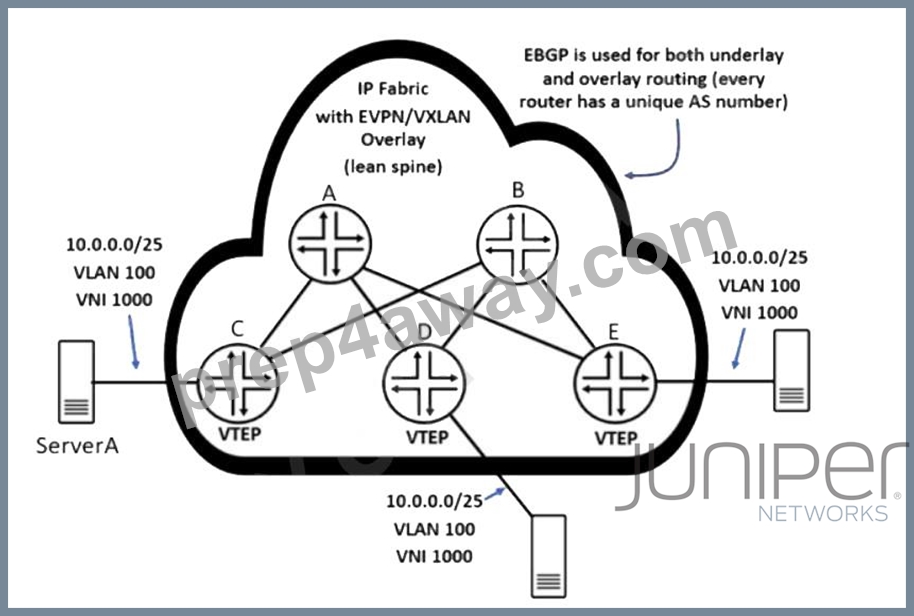
- A. Router E will replicate and send a copy of the received VXLAN packet to router D.
- B. Router D will not replicate and send a copy of the received VXLAN packet to router E.
- C. Router C will send a single VXLAN packet to one remote VTEP.
- D. Router C will send a VXLAN packet destined only to router D and router E.
Answer: A,C
NEW QUESTION # 15
Click the Exhibit button.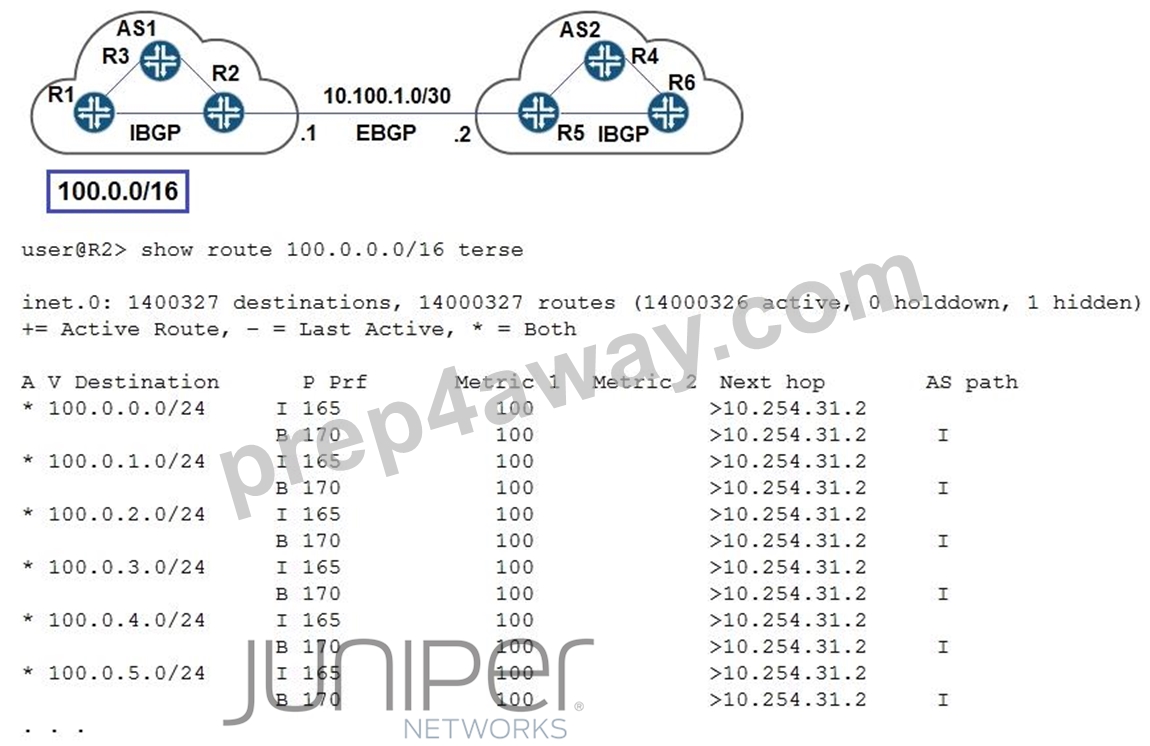
Referring to the exhibit, you must advertise the 100.0.0.0/16 routes from AS1 to AS2, but R2 is not advertising any BGP routes to R5.
Why is this happening in this scenario?
- A. The IBGP routes are not active and EBGP will advertise only active routes.
- B. The IBGP routes are not active because the next hop is not reachable.
- C. The IBGP routes will not be advertised because the AS path shows as incomplete.
- D. The IBGP routes will not be advertised because you must use a policy to advertise IBGP routes.
Answer: A
Explanation:
https://www.juniper.net/documentation/en_US/junos/topics/concept/policy-routing-policies- actions-defaults.html Default BGP Export Policy:
Readvertise all active BGP routes to all BGP speakers, while following protocol-specific rules that prohibit one IBGP speaker from readvertising routes learned from another IBGP speaker, unless it is functioning as a route reflector.
ed@vMX-PE1# show protocols bgp group eBGP | display set set protocols bgp group eBGP type external set protocols bgp group eBGP family inet unicast rib-group inet0-to-test set protocols bgp group eBGP peer-as 3 set protocols bgp group eBGP neighbor 10.0.13.3
[edit]
ed@vMX-PE1#
NEW QUESTION # 16
You are configuring an EVPN overlay to allow VLANs to be stretched between two campus sites, but EVPN routes are not being exchanged. Referring to the exhibit, which configuration statement would solve this problem?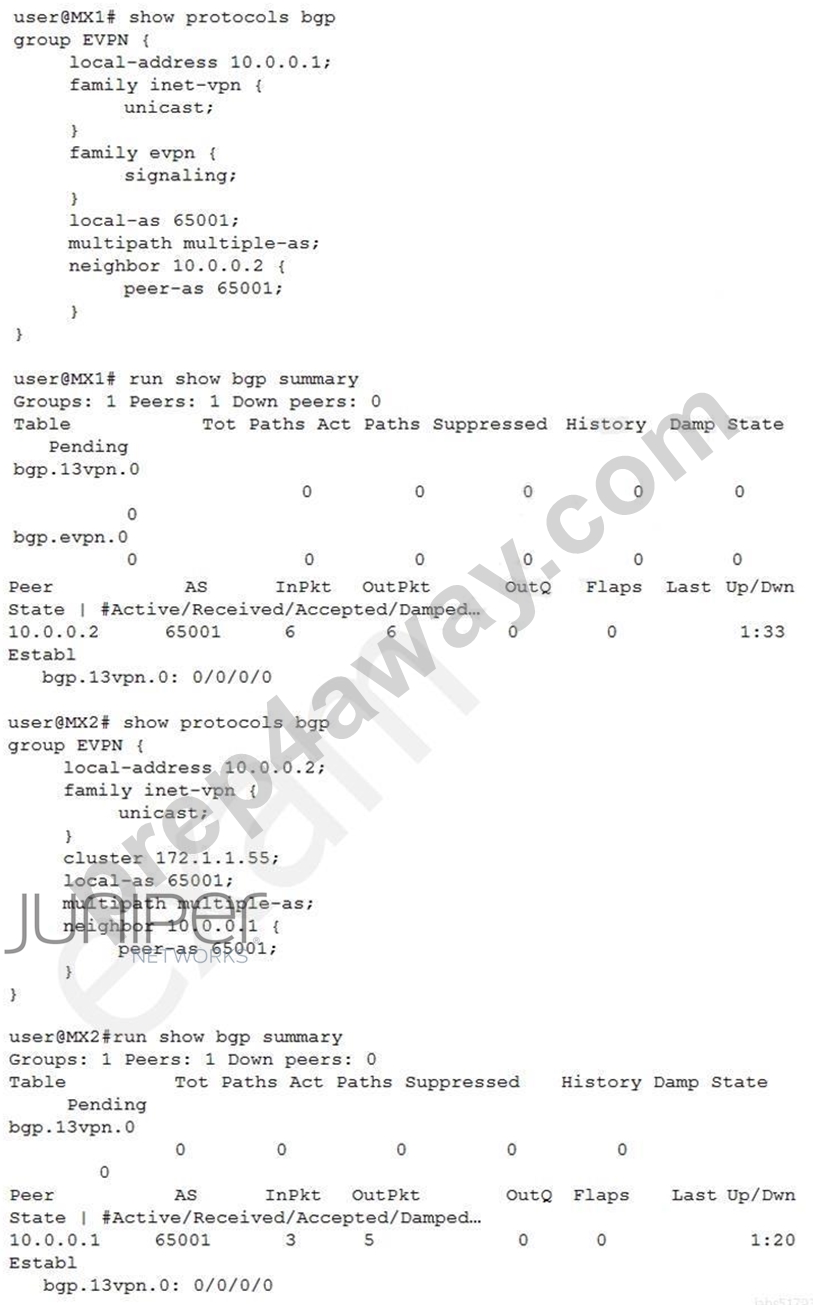
- A. Apply the delete protocols bgp group EVPN multipath multiple-an configuration on MX1 and MX2
- B. Apply the set protocols bgp group EVPN family inet-vpn any configuration on MX1 and MX?
- C. Apply the set protocols bgp group EVPN family EVPN signaling configuration on MX2.
- D. Apply the delete protocols bgp group EVPN cluster 172 .1.1. 53 configuration on MX2
Answer: C
NEW QUESTION # 17
There are two BGP routes to 10.200.200.0/24 received from two external peers. Route 1 comes from a neighbor with a router ID of 10.10.100.1 and a peer IP address of 10.10.30.1, and route 2 comes from a neighbor with a router ID of 10.10.200.1 and a peer IP address of 10.10.50.1. Both routes have the same MED value, origin value, AS path length, and local preference number.
In this scenario, which statement is correct about the active route?
- A. Route 2 will be active because of the peer IP address.
- B. Route 2 will be active because of the router ID.
- C. Route 1 will be active because of the peer IP address.
- D. Route 1 will be active because of the router ID.
Answer: B
Explanation:
When two BGP routes have identical attributes (MED, origin, AS path length, local preference), BGP uses the router ID as a tie-breaker. In this case, route 2 has a higher router ID (10.10.200.1 vs. 10.10.100.1). BGP will select the route with the higher router ID as the active route.
References:
* Useful Juniper Commands.txt
* Tech Ops Managed Router Juniper Install Guide
NEW QUESTION # 18
Referring to the exhibit, you have placed the cos multifield classifier on all edge interfaces and configured the relevant CoS parameters.
In this scenario, which two statements are correct? (Choose two.)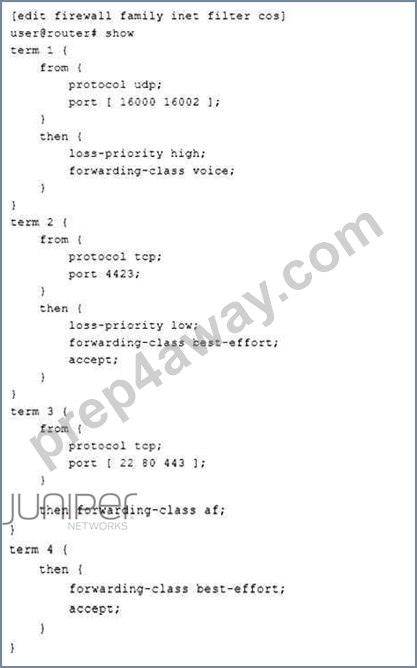
- A. SSH traffic using the default port will be placed in the best-effort forwarding class and accepted.
- B. UDP traffic using the 16000 port will be placed in the voice forwarding class and accepted.
- C. SSH traffic using the default port will be placed in the af forwarding class and accepted.
- D. UDP traffic using the 16000 port will be placed in the best-effort forwarding class and accepted.
Answer: B,C
NEW QUESTION # 19
You are using 802.1X in your access network consisting of EX Series switches. You recently had a failure with your RADIUS server which resulted in authenticating client devices being denied access to the network. You want to change this behavior so that authenticating clients are directed to a remediation VLAN. Which RADIUS server failback setting satisfies this requirement?
- A. sustain
- B. permit
- C. deny
- D. move
Answer: D
Explanation:
https://www.juniper.net/documentation/en_US/junos/topics/topic-map/radius-server-configuration- ex-series-cli.html#id-configuring-radius-server-fail-fallback-cli-procedure Permit authentication, allowing traffic to flow from the end device through the interface as if the end device were successfully authenticated by the RADIUS server.
Deny authentication, preventing traffic from flowing from the end device through the interface.
This is the default.
Move the end device to a specified VLAN if the switch receives a RADIUS access-reject message. The configured VLAN name overrides any attributes sent by the server. (The VLAN must already exist on the switch.) Sustain authenticated end devices that already have LAN access and deny unauthenticated end devices. If the RADIUS servers time out during reauthentication, previously authenticated end devices are reauthenticated and new users are denied LAN access.
NEW QUESTION # 20
Which two multicast listener registration protocols are supported in the Junos operating system?
(Choose two.)
- A. IGMP
- B. PIM
- C. MLD
- D. DVMRP
Answer: A,C
NEW QUESTION # 21
You are using 802.1X authentication in your network to secure all ports. You have a printer that does not support 802.1X and you must ensure that traffic is allowed to and from this printer without authentication.
In this scenario, what will satisfy the requirement?
- A. static MAC bypass
- B. MAC RADIUS
- C. MAC filtering
- D. MACsec
Answer: A
NEW QUESTION # 22
Referring to the exhibit, how will router E quickly learn that the remote MAC addresses are no longer reachable through the router attached to the failed link?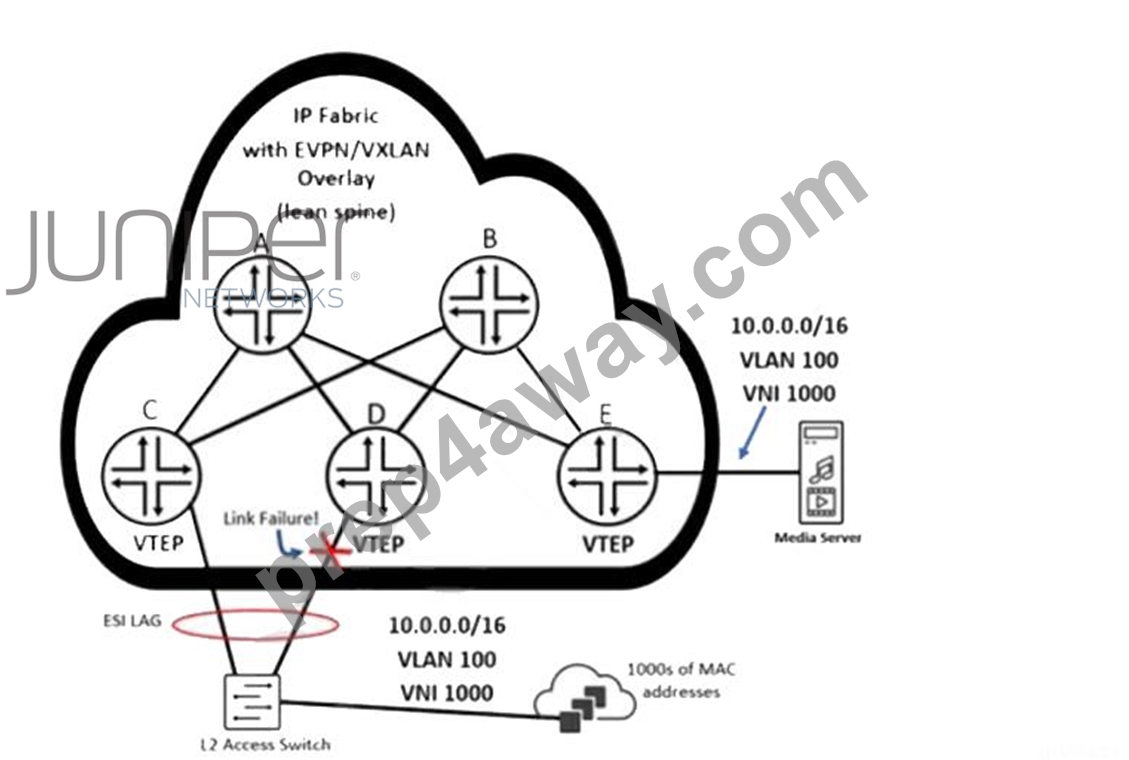
- A. Router E receives Type 1 withdrawal messages from router C.
- B. Router E receives Type 1 withdrawal messages from router D.
- C. Router E receives Type 2 withdrawal messages from router D.
- D. Router E receives Type 2 withdrawal messages from router C.
Answer: B
NEW QUESTION # 23
The connection between DC1 and DC2 is routed as shown in the exhibit.
In this scenario, which statement is correct?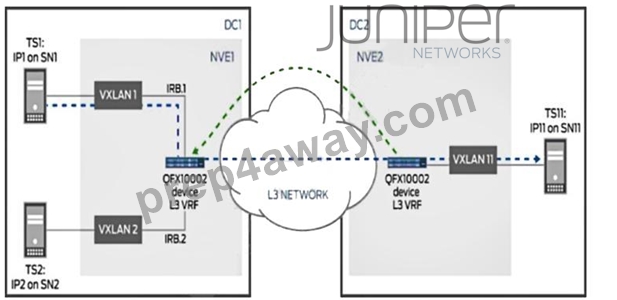
- A. L3VPN must be enabled to advertise reachability.
- B. Type 2 and Type 5 routes will be exchanged between DC1 and DC2.
- C. The border devices must be able to perform Layer 3 routing and provide IRB functionality.
- D. An IP prefix route provides encoding for intra-subnet forwarding.
Answer: C
Explanation:
In the given scenario, the connection between DC1 and DC2 is routed through a Layer 3 network. This indicates that the devices connecting the two data centers must be capable of performing Layer 3 routing to ensure that traffic can be properly forwarded across the network. Additionally, the use of VXLAN suggests that Integrated Routing and Bridging (IRB) functionality is required to enable communication between Layer
2 networks over the Layer 3 infrastructure.
* The border devices (QFX10002) must handle Layer 3 routing to manage IP traffic between the data centers.
* IRB functionality is necessary for routing between VLANs, allowing VXLAN to carry Layer 2 traffic across the Layer 3 network.
References:
* The diagrams indicate the use of VXLAN for Layer 2 extension over a Layer 3 network.
* The need for IRB is suggested by the presence of routed interfaces (IRB1 and IRB2) in the data center diagrams.
* The "Tech Ops Managed Router Juniper Install Guide" provides insights into the Layer 3 routing capabilities and configurations necessary for such setups.
NEW QUESTION # 24
You are troubleshooting an EVPN-VXLAN IP fabric and observe the loop shown in the exhibit.
Which two steps would you take to further troubleshoot this problem? (Choose two.)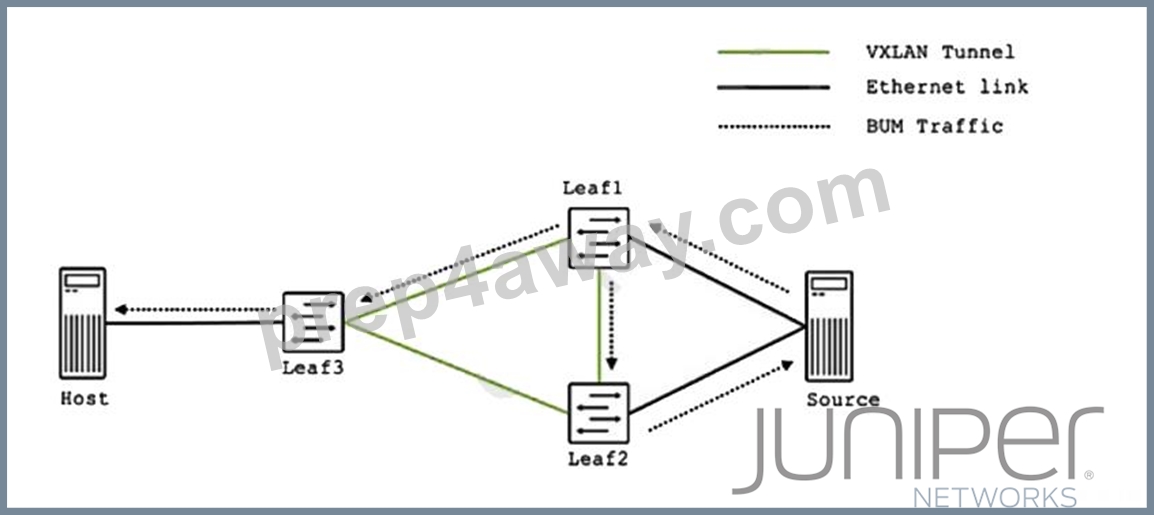
- A. Verify that the same ESI is configured on the link from the host and that it matches the source.
- B. Issue the show route table bgp.evpn.0 command on Leaf2 and verify that Type 4 routes are present.
- C. Verify that the same ESI is configured on the two links from the source.
- D. Issue the show route table bgp.evpn.0 command on Leaf2 and verify that Type 3 routes are present.
Answer: B,D
Explanation:
Type 2 route, MAC with IP advertisement route-Type 2 routes are per-VLAN routes, so only PEs that are part of a VNI need these routes. EVPN allows an end host's IP and MAC addresses to be advertised within the EVPN Network Layer reachability information (NLRI). This allows for control plane learning of ESI MAC addresses. Because there are many Type 2 routes, a separate route-target auto-derived per VNI helps to confine their propagation. This route type is supported by all EVPN switches and routers. Type 5 route, IP prefix Route-An IP prefix route provides encoding for inter-subnet forwarding. In the control plane, EVPN Type 5 routes are used to advertise IP prefixes for inter-subnet connectivity across data centers. To reach a tenant using connectivity provided by the EVPN Type 5 IP prefix route, data packets are sent as Layer 2 Ethernet frames encapsulated in the VXLAN header over the IP network across the data centers.
NEW QUESTION # 25
You recently committed a change to a router to reject OSPF routes sourced from area 10.
However, you are still seeing area 10 routes in the routing table. Referring to the exhibit, which statement is correct?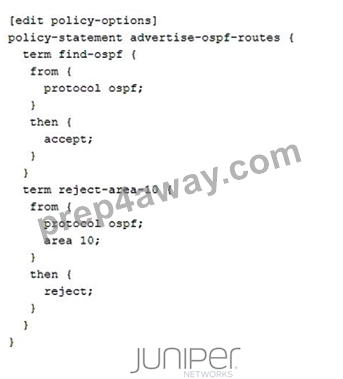
- A. The routes remain in the table until the routing daemon is restarted.
- B. The routes remain in the table until the device is rebooted.
- C. The OSPF protocol is first matched by find-ospf and accepted.
- D. The routes only timeout after 24 hours.
Answer: C
Explanation:
Once a route is accepted, no other terms in the routing policy are evaluated.
NEW QUESTION # 26
Which two multicast listener registration protocols are supported in the Junos operating system? (Choose two.)
- A. IGMP
- B. PIM
- C. MLD
- D. DVMRP
Answer: A,C
Explanation:
* Understanding Multicast Listener Registration Protocols:
* Multicast listener registration protocols are used to manage multicast group memberships on a network.
* They allow devices to join or leave multicast groups dynamically.
* Protocols Supported by Junos:
* MLD (Multicast Listener Discovery):
* Used for IPv6 multicast group management. It is the IPv6 equivalent of IGMP.
* MLD allows routers to discover multicast listeners on a network.
* IGMP (Internet Group Management Protocol):
* Used for IPv4 multicast group management.
* IGMP enables hosts to join and leave multicast groups and allows routers to manage multicast group memberships.
* Verification and Configuration in Junos:
* MLD and IGMP are supported on Juniper devices running the Junos operating system.
* Configuration examples:
* IGMP:
shell
Copy code
set protocols igmp interface ge-0/0/1.0
* MLD:
shell
Copy code
set protocols mld interface ge-0/0/1.0
References:
* Juniper IGMP Configuration Guide
* Juniper MLD Configuration Guide
NEW QUESTION # 27
Your network has an unmanaged switch between the hosts and your EX Series switch. After the traffic enters the EX Series switch, each host must be on a separate VLAN.
How would you accomplish this task?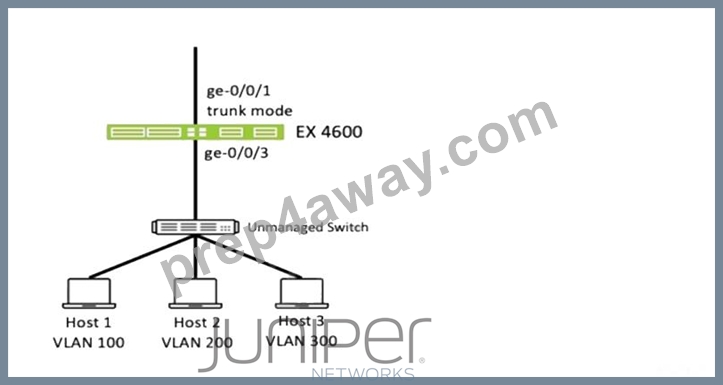
- A. Configure an output firewall filter on interface ge-0/0/1 to match the destination MAC or IP address of the hosts to assign the VLANs.
- B. Configure VSTP on interface ge-0/0/1 to assign the VLANs.
- C. Configure interface ge-0/0/3 to a mode trunk to assign the VLANs.
- D. Configure an input firewall filter on interface ge-0/0/3 to match the source MAC or IP address of the hosts to assign the VLANs.
Answer: C
NEW QUESTION # 28
A Layer 2 connection does not expend across data centers. The IP subnet in a Layer 2 domain is confined within a single data center.
Which EVPN route type is used to communicate prefixes between the data centers?
- A. Type 5
- B. Type 2
- C. Type 1
- D. Type 4
Answer: A
NEW QUESTION # 29
What are two similarities between OSPFv2 and OSPFv3? (Choose two.)
- A. protocol processing per link, not per subnet
- B. virtual links
- C. 32-bit router ID
- D. support for multiple instances per link
Answer: B,C
NEW QUESTION # 30
You are deploying an 802.1X solution and must determine what would happen if clients are unable to re-authenticate to the RADIUS server.
In this scenario, which configuration would provide access to the network if the supplicant is already authenticated?
- A. permit
- B. deny
- C. sustain
- D. move
Answer: C
NEW QUESTION # 31
You are asked to configure 802.1X on your access ports to allow only a single device to authenticate. In this scenario, which configuration would you use?
- A. multiple supplicant mode
- B. single supplicant mode
- C. single-secure supplicant mode
- D. MAC authentication mode
Answer: B
NEW QUESTION # 32
A user is attempting to watch a high-definition video being streamed from the media server over the network. However, the user complains that the experienced video quality is poor. While logged on to router B, a Juniper Networks device, you notice that video packets are being dropped.
In this scenario, what would solve this problem?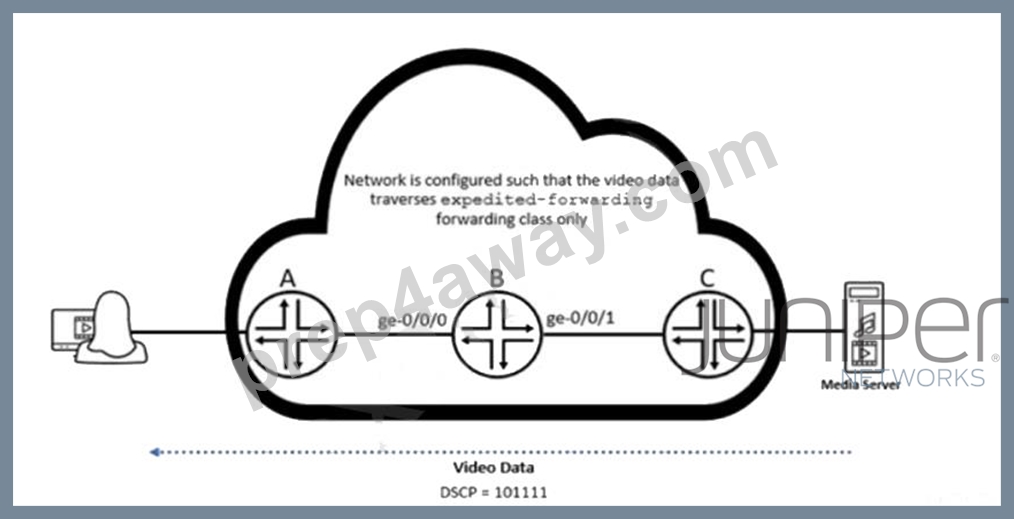
- A. Adjust the scheduler for the expedited-forwarding forwarding class to support a higher transmit rate.
- B. Adjust the scheduler-map to support a higher transmit rate.
- C. Adjust the expedited-forwarding BA classifier on router B's ge-0/0/1 interface to support a higher transmit rate.
- D. Adjust the expedited-forwarding BA classifier to router B's ge-0/0/0 interface to support a higher transmit rate.
Answer: A
Explanation:
transmit rate is set on the scheduler, BA and classifier do not have transmit rate. scheduler-map=maps schedulers to fwd classes
NEW QUESTION # 33
A modified deficit round-robin scheduler is defined by which three variables? (Choose three.)
- A. Layer 3 fields
- B. buffer size
- C. transmit rate
- D. WRED
- E. priority
Answer: B,C,E
Explanation:
A modified deficit round-robin (MDRR) scheduler is defined by the following three variables:
* Priority (A):
* Priority determines the importance of the queue, influencing the order in which packets are serviced. Higher priority queues are serviced before lower priority queues.
* Transmit rate (C):
* The transmit rate controls the amount of bandwidth allocated to each queue. It determines how quickly packets from a queue can be transmitted.
* Buffer size (E):
* Buffer size defines the amount of memory allocated to each queue for storing packets before they are transmitted. Larger buffer sizes can accommodate more packets but may introduce more latency.
References:
* Detailed information on MDRR and its variables can be found in Juniper's QoS configuration guides and related networking documents.
NEW QUESTION # 34
You are running OSPF as your IGP. The interfaces connecting two routers are in the ExStart state. You notice that something is incorrect with the configuration. Referring to the exhibit, which statement is correct?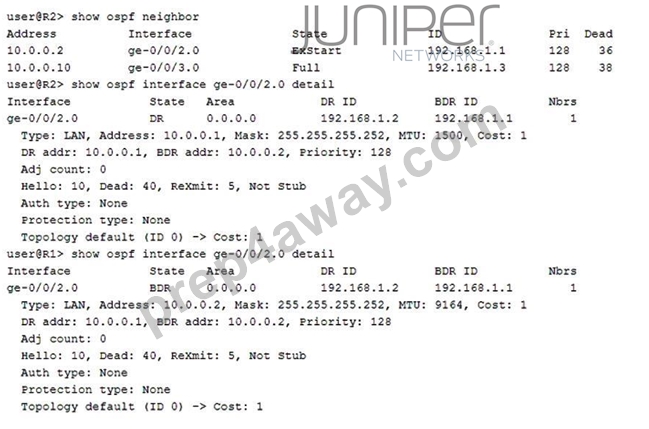
- A. The interface type is incorrect.
- B. The MTU setting are incorrect.
- C. The subnet mask is incorrect.
- D. The IP addresses are incorrect.
Answer: B
NEW QUESTION # 35
You are deploying IP phones in your enterprise network that must receive their power through their Ethernet connection. You are using your EX Series switch's PoE ports that support IEEE 802.3af.
In this scenario, what is the maximum amount of power allocated to each interface?
- A. 15.4 W
- B. 30 W
- C. 10.2 W
- D. 50 W
Answer: A
NEW QUESTION # 36
You have applied the CoS configuration shown in the exhibit to an EX4300 switch.
Which two statements are true? (Choose two.)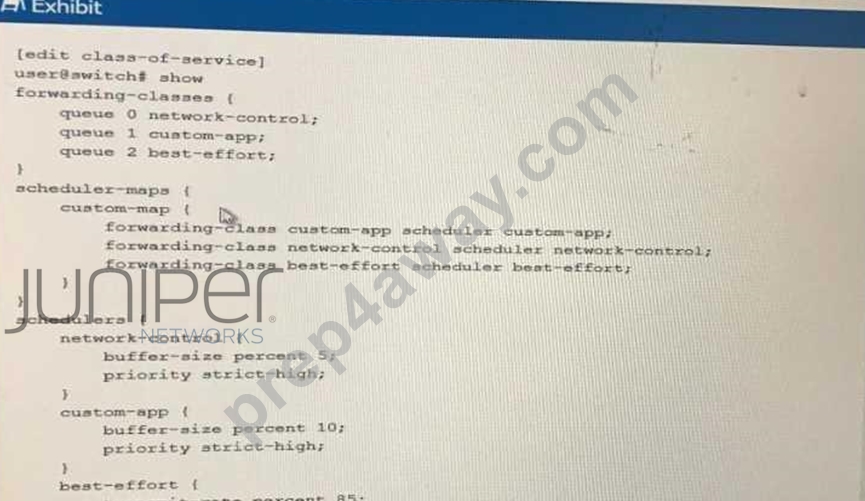
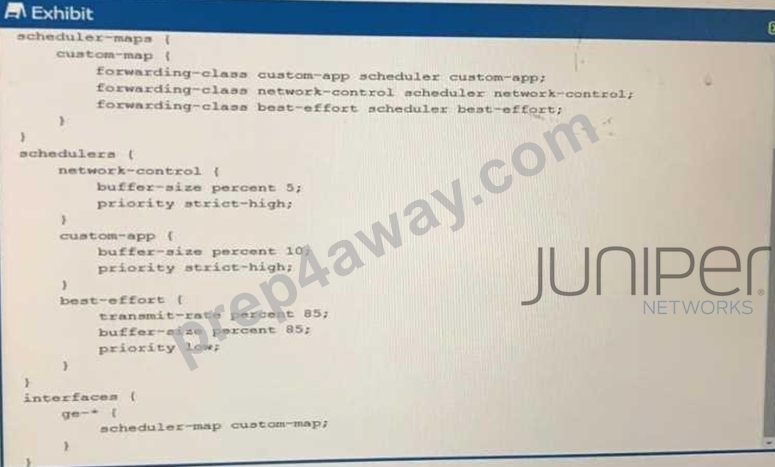
- A. Packets in low priority queues are serviced when strict-high priority queues have no available credits
- B. All strict-high priority queues are serviced in a round-robin fashion regardless of available credits.
- C. All strict-high priority queues are serviced in a round-robin fashion as long as they have remaining credits
- D. Packets in low priority queues transmit only when start-high priority queues are empty
Answer: C,D
NEW QUESTION # 37
......
Exam Questions for JN0-649 Updated Versions With Test Engine: https://www.prep4away.com/Juniper-certification/braindumps.JN0-649.ete.file.html
Test Engine to Practice Test for JN0-649 Valid and Updated Dumps: https://drive.google.com/open?id=1PvS1j5IMXbordCAwGqJ1fhm6VB1I-jk1