

100% PASS RATE JNCIP-ENT JN0-649 Certified Exam DUMP with 195 Questions
Updates For the Latest JN0-649 Free Exam Study Guide!
Juniper JN0-649 Enterprise Routing and Switching, Professional (JNCIP-ENT) Exam is a certification exam that is designed for IT professionals who specialize in enterprise routing and switching technologies. JN0-649 exam tests the knowledge and skills of candidates in the areas of routing technologies, switching technologies, security technologies, troubleshooting, and Junos OS fundamentals. It is a comprehensive exam that requires a thorough understanding of enterprise networking and routing protocols.
NEW QUESTION # 89
A BGP network has been designed to provide resiliency and redundancy to a multihomed customer network.
Which two statements are correct in this scenario? (Choose two.)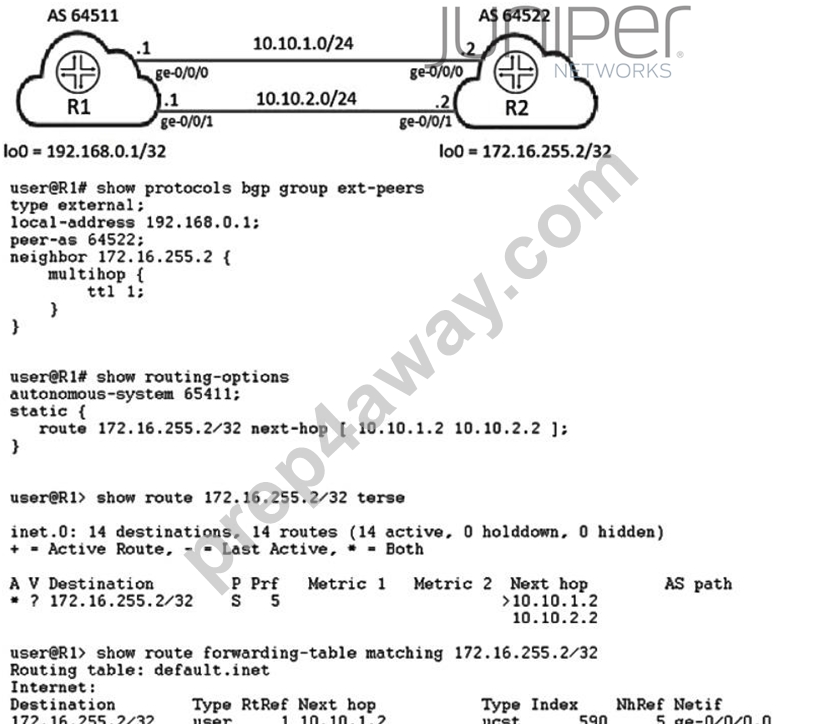
- A. The TTL value of 1 is set to limit the scope of the EBGP session.
- B. Both the next hops will be used to forward traffic to R2.
- C. The ttl statement must be configured to accommodate peering to a loopback address of a directly connected peer.
- D. A routing policy will be required to forward traffic to both next hops.
Answer: A,D
Explanation:
B - Because only one next hop in forwarding table.
C- Becuse TTL=1 limiting bgp connection to be established only over loopbacks interface.
https://www.juniper.net/documentation/us/en/software/junos/bgp/topics/topic-map/multihop- sessions.html Use the multihop statement to alter the default use of the neighbor's physical address. In addition, you can also specify a time-to-live (TTL) value in the BGP packets to control how far they propagate. We use a TTL value of 1 to ensure that the session cannot be established across any other backdoor links in the network.
NEW QUESTION # 90
You are using 802.1X authentication in your network to secure all ports. You have a printer that does not support 802.1X and you must ensure that traffic is allowed to and from this printer without authentication.
In this scenario, what will satisfy the requirement?
- A. MAC RADIUS
- B. static MAC bypass
- C. MAC filtering
- D. MACsec
Answer: B
Explanation:
For devices like printers that do not support 802.1X authentication, you can configure static MAC bypass. This allows traffic from devices with specific MAC addresses to bypass 802.1X authentication and gain network access directly.
References:
* From the Juniper documentation, you can implement static MAC bypass for devices that do not support
802.1X by configuring their MAC addresses to be statically permitted on the network.
* Useful Juniper Commands.txt
* Tech Ops Managed Router Juniper Install Guide
shell
Copy code
# Example configuration for static MAC bypass
set protocols dot1x authenticator interface ge-0/0/1.0 mac-radius static-mac 00:11:22:33:44:55 commit These configurations and explanations should address the questions accurately based on the provided information and referenced documents.
NEW QUESTION # 91
You ate deploying P|M source-specific multicast (SSM) for a new multicast messaging service You have configured the multicast source to use 236.44.123.100 as the multicast address. You are not able to join the PIM SSM multicast teed Which two solutions would resolve this problem? (Choose two )
- A. Reconfigure the multicast source to use an address in the range of 224.0.0 0 through
224.255.255.255. - B. Add the multicast address to the [edit routing-options multicast ssm-groups] stanza.
- C. Add the multicast address to the (edit routing-options multicast ssm-map) stanza.
- D. Reconfigure the multicast source to use an address in the range of 232 0.0 0 through
232.255.255.255
Answer: C,D
NEW QUESTION # 92
Referring to the exhibit, which LSA type is used to advertise 192.168.1.0/24 to R5?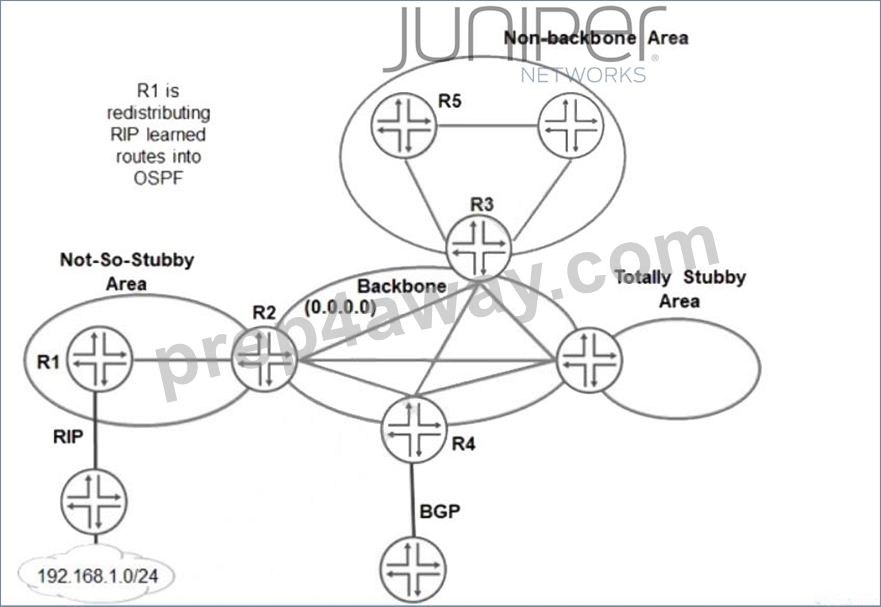
- A. Type 5
- B. Type 3
- C. Type 4
- D. Type 7
Answer: A
Explanation:
Area-1 has no external connections. However, Area-1 has static route (172.16.31.0/24) that are not internal OSPF route. You can limit the external route advertisements to the area and advertise the static routes by designating the area an NSSA. In an NSSA, the ASBR (vMX1) generates NSSA external (Type 7) LSAs and floods them into the NSSA, where they are contained.
Type-7 LSAs allow an NSSA to support the presence of ASBR and their corresponding external routing information. The ABR (vMX2) converts Type-7 LSAs into Type-5 External LSAs and leaks them to the other areas, but external routes from other areas are not advertised within the NSSA.
An admin should check this and change it
https://www.packetswitch.co.uk/configuring-junos-ospf-stub-and-nssa-areas/
https://www.juniper.net/documentation/us/en/software/junos/ospf/topics/ref/statement/nssa-edit-protocols-ospf.html
NEW QUESTION # 93
You are asked to enforce user authentication using a captive portal before users access the corporate network.
Which statement is correct in this scenario?
- A. HTTPS is the default protocol for a captive portal.
- B. A captive portal can be bypassed using an allowlist command containing a device's IP address.
- C. All Web browser requests are redirected to the captive portal until authentication is successful.
- D. When enabled, a captive portal must be applied to each individual interface.
Answer: C
NEW QUESTION # 94
Referring to the log shown in the exhibit, what is the problem with the OSPF adjacency establishment?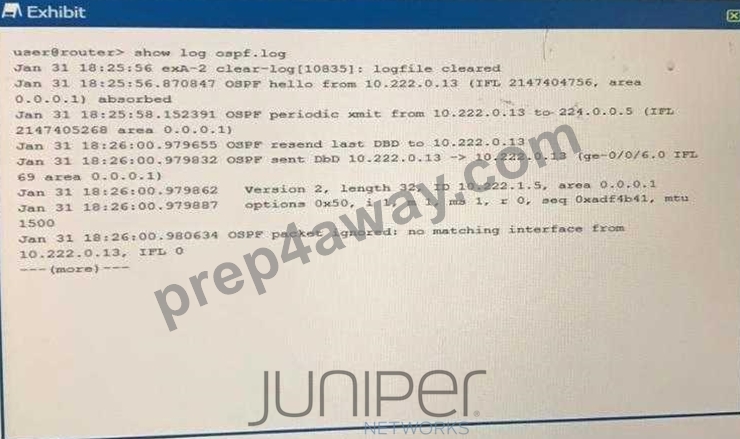
- A. The OSPF database description packet is malformed.
- B. There is an MDS authentication mismatch.
- C. The interface IP addresses on the subnet are duplicates.
- D. The referenced IP address does not exist on the network segment.
Answer: C
NEW QUESTION # 95
The connection between DC1 and DC2 is routed as shown in the exhibit.
In this scenario, which statement is correct?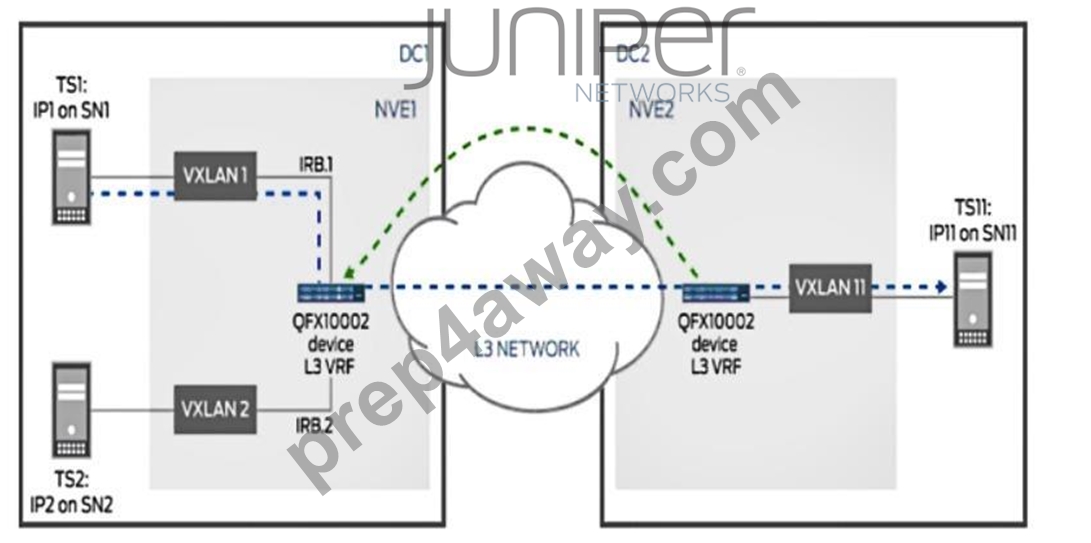
- A. An IP prefix route provides encoding for intra-subnet forwarding.
- B. Type 2 and Type 5 routes will be exchanged between DC1 and DC2.
- C. L3VPN must be enabled to advertise reachability.
- D. The border devices must be able to perform Layer 3 routing and provide IRB functionality.
Answer: D
Explanation:
https://www.juniper.net/documentation/us/en/software/junos/evpn-vxlan/topics/concept/evpn- route-type5-understanding.html
NEW QUESTION # 96
A customer needs to pass Layer 2 protocols between sites.
Which protocol or standard would be required to implement connectivity on EX4300, EX3400, and EX2300 devices?
- A. OSPF
- B. IGMP
- C. Q-in-Q
- D. VPLS
Answer: C
NEW QUESTION # 97
BGP multipath or multihop are not configured in your network. In this scenario, what is the correct sequence for BGP active route selection?
- A. higher local preference
shortest AS path
lowest router ID
lowest peer address
lower origin code - B. higher local preference
lowest router ID
lowest peer address
lower origin code
shortest AS path - C. higher local preference
shortest AS path
lower origin code
lowest router ID
lowest peer address - D. higher local preference
shortest AS path
lowest peer address
lowest router ID
lower origin code
Answer: C
Explanation:
BGP Path Selection process follows this order
1.Weight (Bigger is better)
2. Local preference (Bigger is better)
3. Self originated (Locally injected is better than iBGP/eBGP learned)
4. AS-Path (Smaller is better)
5. Origin
6. MED (Smaller is better)
7. External (Prefer eBGP over iBGP)
8. IGP cost (Smaller is better)
9. EBGP Peering (Older is better)
10. Router- ID
http://www.next-itsolutions.co.uk/wp-content/uploads/2015/09/CCIE-BGP-Best-Path- Selection1.png
https://www.juniper.net/documentation/us/en/software/junos/vpn-l2/bgp/topics/concept/routing- protocols-address-representation.html
NEW QUESTION # 98
Which type of BGP is used to peer with a different autonomous system?
- A. static
- B. external
- C. classless
- D. dynamic
Answer: B
NEW QUESTION # 99
Referring to the exhibit, which two statements are correct? (Choose two.)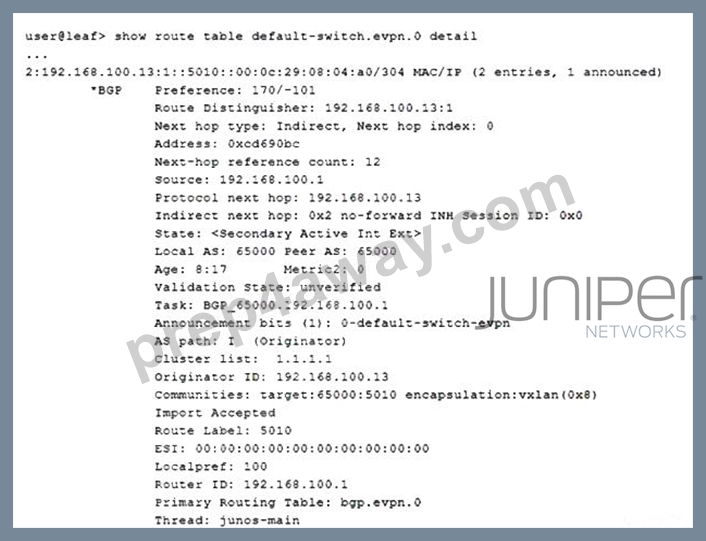
- A. The route is a Type 2 EVPN route.
- B. The route is a Type 1 EVPN route.
- C. The host that the route is associated with is multihomed to two leaf nodes.
- D. The host that the route is associated with is single-homed to one leaf node.
Answer: A,D
NEW QUESTION # 100
You have an IPv4 multicast network configured as PIM-SM. What must be done before replacing your static RP with auto-RP?
- A. Enable sparse-dense mode on each of the routers in the network.
- B. Configure each router in the network as a candidate BSR.
- C. Configure auto-RP domains on each router in the network.
- D. Enable each router in the network to forward multicast packets.
Answer: A
Explanation:
https://www.juniper.net/documentation/en_US/junos/topics/task/configuration/mcast-pim-auto- rp.html
"Because PIM dense mode is necessary to enable auto-RP to work, which in turns enables PIM sparse mode to work, you must configure PIM sparse-dense mode in the PIM domains that use auto-RP."
NEW QUESTION # 101
You must ensure that all routes in the 10.0.0/8 address range are not advertised outside of your AS.
Which well-known BGP community should be assigned to these addresses to accomplish this task?
- A. no-peer
- B. internet
- C. no-advertise
- D. no-export
Answer: D
Explanation:
For specifying the BGP community attribute only, you also can specify community-ids as one of the following well-known community names defined in RFC 1997:
no-advertise-Routes containing this community name are not advertised to other BGP peers.
no-export-Routes containing this community name are not advertised outside a BGP confederation boundary.
no-export-subconfed-Routes containing this community are advertised to IBGP peers with the same AS number, but not to members of other confederations.
llgr-stale-Adds a community to a long-lived stale route when it is readvertised.
no-llgr-Marks routes which a BGP speaker does not want to be retained by LLGR. The Notification message feature does not have any associated configuration parameters.
https://www.juniper.net/documentation/us/en/software/junos/bgp/topics/ref/statement/community-edit-routing-options.html
NEW QUESTION # 102
Which three types of ports are used for Junos Fusion Enterprise? (Choose three. )
- A. cascade port
- B. authenticated port
- C. extended port
- D. designated port
- E. uplink port
Answer: A,C,E
NEW QUESTION # 103
You are troubleshooting connectivity between an EVPN spine switch configured as a route reflector and a leaf node with an IP address of 10.30.100.6.
Referring to the exhibit, what is the problem?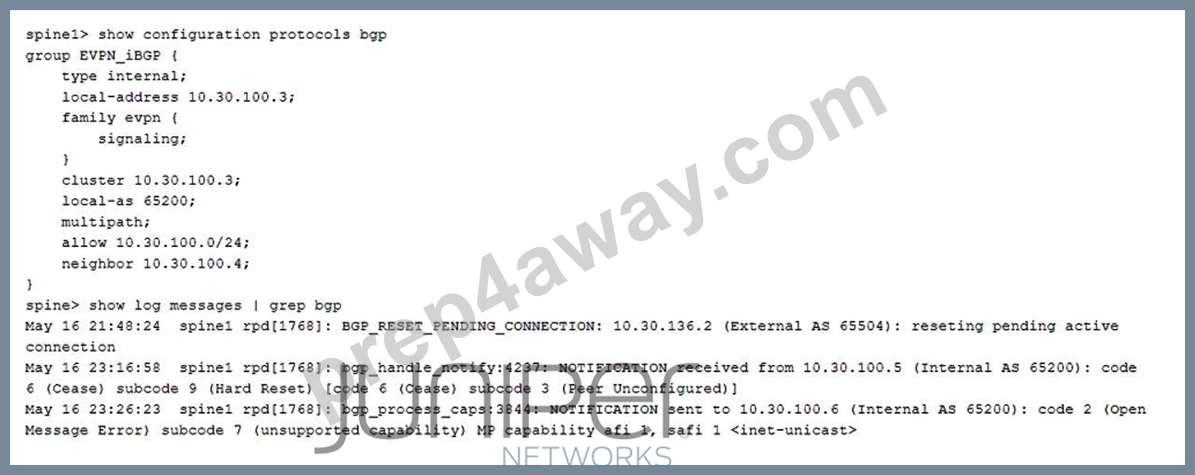
- A. The spine node is not configured for the family inet NLRI.
- B. The neighbor 10.30.100.6 statement is missing from spine1's configuration.
- C. The neighbor 10.30.100.3 statement is missing from leaf1's configuration.
- D. The leaf node is not configured for the family evpn NLRI.
Answer: A
NEW QUESTION # 104
Click the Exhibit button.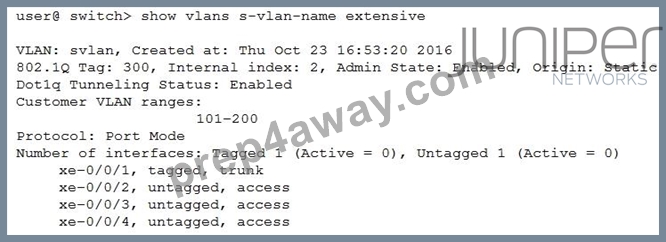
During an outage, you review the status of the Q-in-Q implementation on VLAN 300.
Referring to the exhibit, what would be the cause of the outage?
- A. There are no active ports.
- B. The S-VLAN is disabled.
- C. The VLAN range overlaps.
- D. The C-VLANs are disabled.
Answer: A
NEW QUESTION # 105
Which two statements are correct about a functional ESI LAG interface? (Choose two )
- A. The LACP system ID must be the same
- B. The ESI values must be the same
- C. The LACP system ID must be different
- D. The ESI values must be different
Answer: A,B
NEW QUESTION # 106
Click the Exhibit button.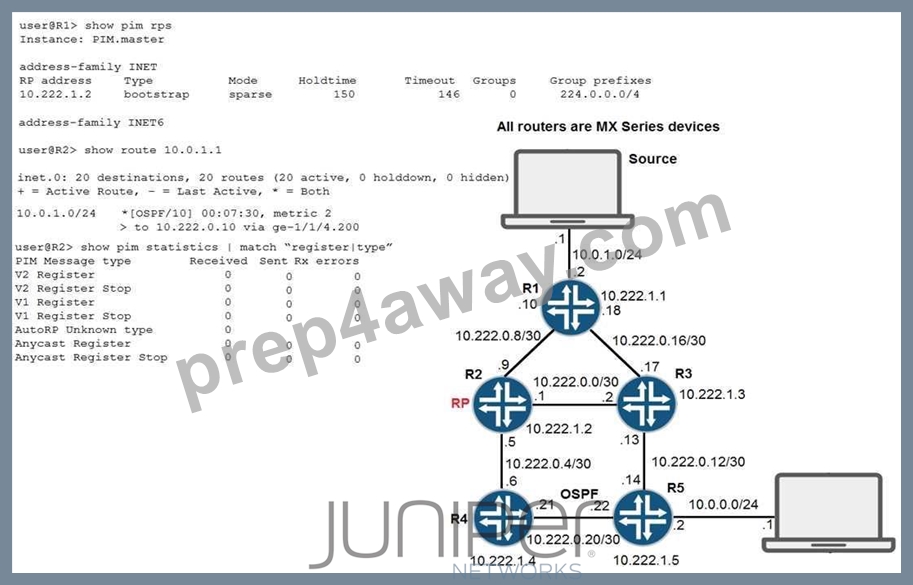
Referring to the exhibit, the source is currently sending multicast traffic using group 224.1.1.1, which is being received by R1. R2 is not receiving PIM register messages.
What would be the cause of this problem?
- A. Tunnel services have not been enabled on R1.
- B. A(*,G) tree has not been built yet.
- C. R5 has not received an IGMP report of 224.1.1.1.
- D. All routers have not been configured with the same Auto-RP discovery group.
Answer: A
Explanation:
The multicast traffic being sent by the source must be encapsulated into a PIM register packet. If the tunneling services under the chassis stanza is not configured, a PE (PIM Encapsulation interface) will not be present in the multicast first hop router. Anyway long story short, tunneling services must be turned on or else you will not get PIM register messages sent to the RP.
https://kb.juniper.net/InfoCenter/index?page=content&id=KB13329
NEW QUESTION # 107
You are troubleshooting an EVPN-VXLAN IP fabric and observe the loop shown in the exhibit.
Which two steps would you take to further troubleshoot this problem? (Choose two.)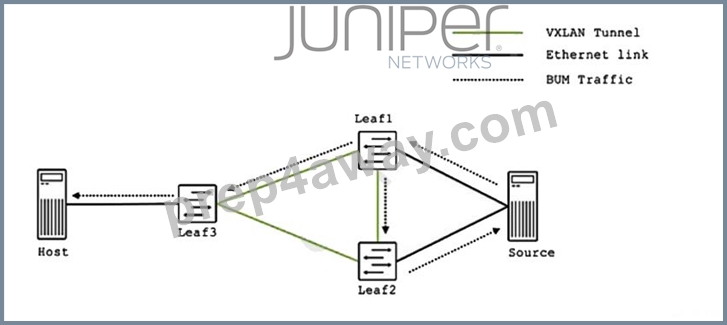
- A. Verify that the same ESI is configured on the link from the host and that it matches the source.
- B. Issue the show route table bgp.evpn.0 command on Leaf2 and verify that Type 3 routes are present.
- C. Verify that the same ESI is configured on the two links from the source.
- D. Issue the show route table bgp.evpn.0 command on Leaf2 and verify that Type 4 routes are present.
Answer: B,D
Explanation:
When troubleshooting an EVPN-VXLAN IP fabric loop, the following steps are crucial:
* Issue the show route table bgp.evpn.0 command on Leaf2 and verify that Type 4 routes are present: Type 4 routes indicate EVPN Ethernet Segment routes, which are essential for detecting and
* mitigating loops.
* Issue the show route table bgp.evpn.0 command on Leaf2 and verify that Type 3 routes are present: Type 3 routes (Inclusive Multicast Ethernet Tag routes) ensure that multicast and broadcast traffic is properly handled, helping identify and troubleshoot loop issues.
References:
* The commands for verifying BGP EVPN routes are standard in troubleshooting EVPN-VXLAN fabrics.
* Documentation from "Useful Juniper Commands.txt" and "Juniper Commands.pdf" which provide command references for verifying EVPN route types.
NEW QUESTION # 108
What information is contained in an OSPF LSA header? (Choose two.)
- A. subnet mask
- B. protocol
- C. options
- D. length
Answer: C,D
NEW QUESTION # 109
Your campus EX9200 core devices are highly oversubscribed on bandwidth ans reporting massive dropped packets.
To immediately address the issue, you decide to implement shaping on all interfaces.
Which action will accomplish?
- A. Apply the shape-rate 5G parameter to all interfaces under the [edit class-of service] hierarchy.
- B. Apply the input-shape-rate 5G parameter to all interfaces under the [edit class-of service] hierarchy.
- C. Define a CoS input traffic control profile with the shape-rate 5G parameter and apply it to all interfaces.
- D. Define a CoS output traffic control profile with the shape-rate 5G parameter and apply it to all interfaces.
Answer: D
Explanation:
https://www.juniper.net/documentation/en_US/junos/topics/task/configuration/cos-shaping-rate- on-physical-interfaces-configuring.html
NEW QUESTION # 110
You are asked to troubleshoot voice quality issues on your newly implement VoIP network. You notice that the voice packets are being dropped. You have verified that the packets are correctly marked for expedited forwarding queue.
Referring to the exhibit, what must you configure to solve the problem?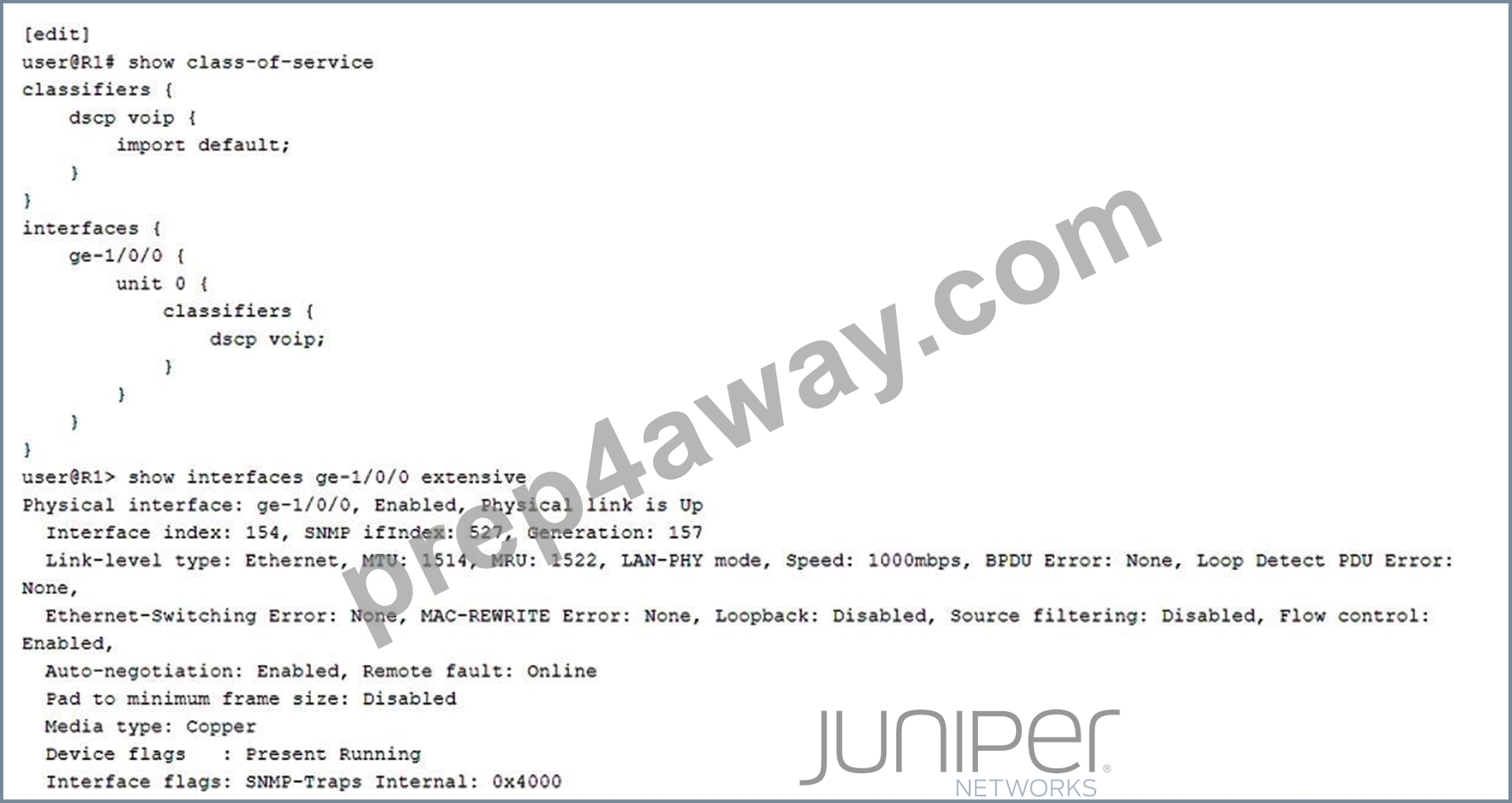
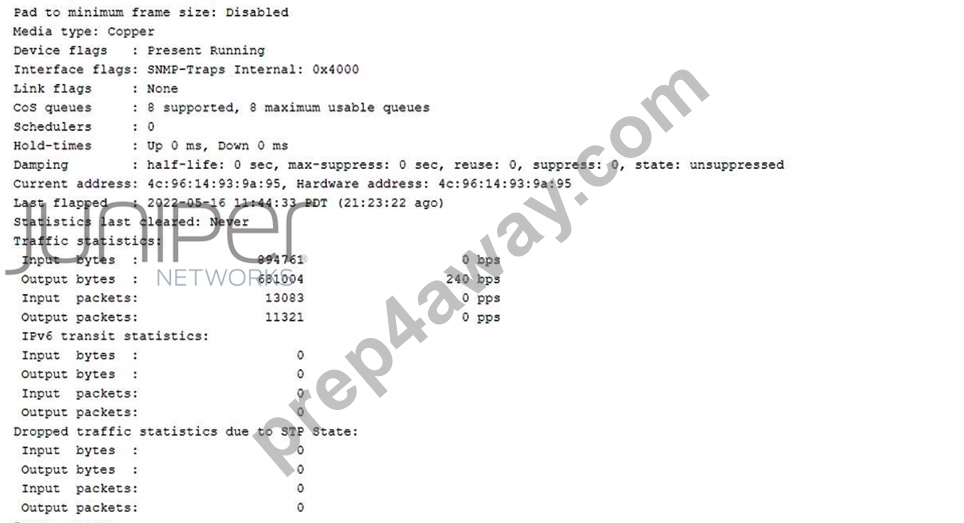
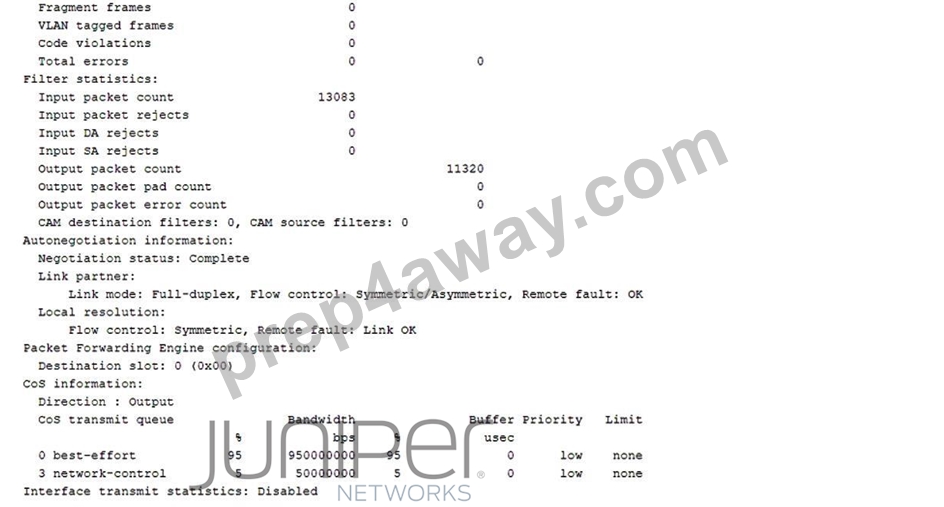
- A. You must configure a scheduler to allocate bandwidth to the expedited forwarding queue.
- B. You must configure a rewrite rule to ensure that the traffic is scheduled properly in the device.
- C. You must configure a multifield classifier to put the VoIP traffic in the correct queue.
- D. You must configure a policer to ensure that the queue is not being starved.
Answer: A
NEW QUESTION # 111
You have configured CoS on a Junos device. A packet is classified as best effort by a behavior aggregate (BA) classifier, and as expedited forwarding by a multifield (MF) classifier.
Which statement is true in this scenario?
- A. The packet will be placed into the queue which is least congested.
- B. The packet will be placed into the queue that has the most bandwidth assigned to it.
- C. The packet will be placed in a queue associated with the BA classifier.
- D. The packet will be placed in a queue associated with the MF classifier.
Answer: D
Explanation:
https://www.juniper.net/documentation/en_US/junos/topics/task/configuration/cos-configuring- multifield-classifiers.html
>> "If you configure both a behavior aggregate (BA) classifier and a multifield classifier, BA classification is performed first; then multifield classification is performed. If they conflict, any BA classification result is overridden by the multifield classifier."
NEW QUESTION # 112
......
Best JN0-649 Exam Preparation Material with New Dumps Questions https://www.prep4away.com/Juniper-certification/braindumps.JN0-649.ete.file.html
Fast Exam Updates JN0-649 dumps with PDF Test Engine Practice https://drive.google.com/open?id=1_xFChiBYLsfxHIOm1qnz4LUcedK8c3rn