

First Attempt Guaranteed Success in FCSS_LED_AR-7.6 Exam 2026
Real FCSS_LED_AR-7.6 Exam Questions are the Best Preparation Material
NEW QUESTION # 22
Which two actions must be completed before a FortiGate can be provisioned using ZTP?
(Choose two)
Response:
- A. Manually configure VLANs
- B. Assign a policy package to the device
- C. Set up DNS server for resolving FortiManager
- D. Configure local admin password
Answer: B,C
NEW QUESTION # 23
Refer to the exhibit.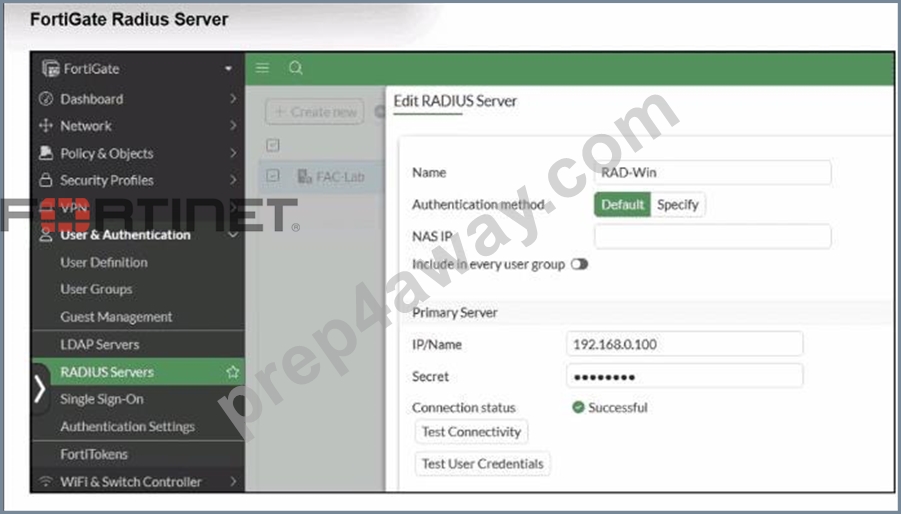

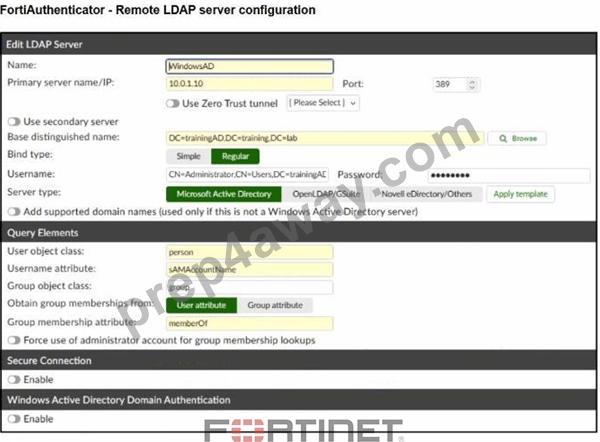
A RADIUS server has been successfully configured on FortiGate, which sends RADIUS authentication requests to FortiAuthenticator. FortiAuthenticator, in turn, relays the authentication using LDAP to a Windows Active Directory server.
It was reported that wireless users are unable to authenticate successfully.
The FortiGate configuration confirms that it can connect to the RADIUS server without issues.
While testing authentication on FortiGate using the command diagnose test authserver radius, it was observed that authentication succeeds with PAP but fails with MSCHAPv2.
Additionally, the Remote LDAP Server configuration on FortiAuthenticator was reviewed.
Which configuration change might resolve this issue?
- A. Change the RADIUS authentication protocol to CHAP
- B. Use RADIUS attributes under the FortiGate configuration.
- C. Enable Windows Active Directory Domain Authentication.
- D. Manually add user credentials to the FortiAuthenticator local database
Answer: C
Explanation:
From the exhibits and text:
* FortiGate #RADIUS# FortiAuthenticator
* FortiAuthenticator #LDAP# Windows AD
* diagnose test authserver radius ... papsucceeds
* diagnose test authserver radius ... mschap2fails
This behavior matches a classic limitation documented in FortiOS:
When usingLDAPas the back-end, the RADIUS server must usePAP. CHAP/MS-CHAPv2 arenot supported with plain LDAP because the server cannot validate the challenge-response without access to password hashes.
In the Remote LDAP server config on FortiAuthenticator, the option"Windows Active Directory Domain Authentication" is disabled.When this feature isenabled, FortiAuthenticator can talk to AD usingKerberos
/NTLMinstead of a simple LDAP bind, whichdoes support MS-CHAPv2for incoming RADIUS authentications.
So to allow MS-CHAPv2 all the way from FortiGate to AD, you must:
* Keep FortiGate using RADIUS with MS-CHAPv2 # FortiAuthenticator
* EnableWindows Active Directory Domain Authenticationso FortiAuthenticator can properly validate MS-CHAPv2 against AD.
Why the other options are wrong:
* A. Change to CHAP- CHAP still cannot be validated over LDAP; docs say LDAP back-ends must use PAP.
* C. Manually add users to local DB- That would allow local-DB auth but does not fix MS-CHAPv2 against AD.
* D. Use RADIUS attributes on FortiGate- Attributes do not influence the EAP inner method; they don't fix MS-CHAPv2 failures.
Therefore the configuration change that can realistically fix the MS-CHAPv2 problem isenabling Windows Active Directory Domain Authentication on FortiAuthenticator (B).
NEW QUESTION # 24
Which actions can FortiGate take when it places a device in quarantine?
(Choose two)
Response:
- A. Remove the device's IP from DHCP lease pool
- B. Apply security profile restrictions dynamically
- C. Add the device's MAC to a quarantine address group
- D. Disable the switch port directly
Answer: B,C
NEW QUESTION # 25
Which command enables dynamic VLAN assignment under a FortiSwitch interface policy?
Response:
- A. set dynamic-vlan enable
- B. set auth-mode radius
- C. set vlan-policy dynamic
- D. config switch-controller port-policy
Answer: C
NEW QUESTION # 26
Which steps can help restore communication between FortiGate and a FortiSwitch?
(Choose two)
Response:
- A. Restart FortiSwitch's SNMP agent
- B. Verify DHCP Option 138
- C. Check FortiLink interface status
- D. Set switch role to "Root Bridge"
Answer: B,C
NEW QUESTION # 27
What is the main benefit of VLAN pooling in wireless deployments?
Response:
- A. Forces clients to connect via MAC address
- B. Reduces DHCP exhaustion and improves load distribution
- C. Enables NAT between VLANs
- D. Disables rogue AP detection
Answer: B
NEW QUESTION # 28
Which FortiGuard licenses are required for FortiLink device detection to enable device identification and vulnerability detection?
- A. FortiGuard Attack Surface Security and FortiGuard loT Detection
- B. FortiGuard Vulnerability Management and FortiGuard Endpoit Protection
- C. FortiGuard Threat Intelligence and FortiGuard loT Detection
- D. FortiGuard Threat Intelligence and FortiGuard Endpoint Protection
Answer: A
Explanation:
FortiLink device detection relies on FortiGate'sDevice IdentificationandIoT Detectioncapabilities to classify devices connected to FortiSwitch ports.
To enabledevice identificationandvulnerability detectionfor IoT/endpoint devices in LAN Edge deployments, FortiGate must subscribe to the correct FortiGuard services.
1. Required FortiGuard License for Device Identification (IoT Detection) The FortiOS documentation clearly states:
"IoT detection service... requires anAttack Surface Security Rating service licenseto download the IoT signature package." Additionally:
"The following settings are required for IoT device detection:
A validAttack Surface Security Rating service licenseto download the IoT signature package." This service provides:
* IoT signature package
* IoT device classification
* Device behavior profiling
This makesAttack Surface Securitymandatory for FortiLink device detection.
2. Required FortiGuard License for Device Vulnerability Detection
FortiOS further clarifies that IoT vulnerabilities require theIoT Detection license, which is included under the same Attack Surface service entitlement:
"To detect IoT vulnerabilities the FortiGate must have a validIoT Definitions license..." The IoT Definitions license comeswith the Attack Surface Security Rating serviceand is used for:
* Scanning connected devices
* Identifying IoT/endpoint vulnerabilities
* Reporting vulnerability severity
* Enabling NAC-based remediation (VLAN steering, port isolation)
In LAN Edge Architect, this license combination is emphasized as a foundational requirement for:
* FortiSwitch NAC
* FortiLink device profiling
* Automated quarantine actions
* IoT device classification
* Vulnerability-based segmentation
3. Why the Correct Answer Is Option D
OptionDlists:
#FortiGuard Attack Surface Security
#FortiGuard IoT Detection
These are exactly the services required per FortiOS 7.4.1:
* Attack Surface Security Rating# provides IoT signature package + vulnerability data
* IoT Detection (Definitions)# enables actual device-type and vulnerability identification Together they powerFortiLink Device DetectionandIoT Vulnerability Detection, which are essential LAN Edge security functions.
4. Why Other Options Are Incorrect
A). Vulnerability Management + Endpoint Protection
Not used for FortiLink device detection; Endpoint detection relies on IoT service, not FortiClient.
B). Threat Intelligence + IoT Detection
Threat Intelligence (ThreatIntel DB) is used for FAZ IOC, not LAN Edge device detection.
C). Threat Intelligence + Endpoint Protection
Same issue-does not provide IoT device classification or vulnerability scanning.
LAN Edge 7.6 Architect Context Summary
In LAN Edge designs:
* FortiGate acts as the controller for FortiSwitch via FortiLink.
* Device detection is done at the FortiGate level using NAC/IoT signature capabilities.
* Vulnerability detection enables dynamic segmentation decisions (e.g., move device to quarantine VLAN).
To support this, two licenses aremandatory:
* Attack Surface Security(includes Security Rating + IoT Detection DB)
* IoT Detection(part of the same entitlement, but explicitly required for vulnerability detection) Thus the verified answer aligns perfectly with LAN Edge operational requirements and Fortinet documentation.
NEW QUESTION # 29
Which data sources does FortiAIOps use for correlation and anomaly detection?
(Choose three)
Response:
- A. FortiAnalyzer logs
- B. FortiGate performance metrics
- C. FortiSwitch and FortiAP telemetry
- D. DNS zone files
- E. FortiManager change history
Answer: A,B,C
NEW QUESTION # 30
In a Zero-Touch Provisioning (ZTP) deployment, which device typically initiates the connection to FortiManager?
Response:
- A. FortiGate
- B. FortiSwitch
- C. FortiAuthenticator
- D. FortiAP
Answer: A
NEW QUESTION # 31
In addition to requiring a FortiAnalyzer device to configure the Security Fabric, which license must be added to FortiAnalyzer to use Indicators of Compromise (IOC) rules?
- A. IOC detection is included on FAZ-Basic license
- B. loT Security Add-on license
- C. Threat Detection Service license
- D. IOC Subscription license
Answer: C
Explanation:
FortiAnalyzer requires a specific license to evaluateIndicators of Compromise (IOC).
From theFortiAnalyzer 7.4.1 Administration Guide:
IOC identification requires theThreat Detection Servicelicense on FortiAnalyzer.
This license enables:
* IOC database updates
* Compromised host detection
* Event correlation based on FortiGuard threat intelligence
* Fabric-wide IOC automation triggers
Why the other answers are incorrect:
* A: IoT Security add-on is unrelated to IOC rules.
* B: There isnoIOC subscription license type for FortiAnalyzer.
* C: FAZ-Basic license doesNOTinclude IOC detection.
NEW QUESTION # 32
To manually quarantine a MAC address in FortiGate CLI, which command is correct?
Response:
- A. diagnose firewall mac blacklist <mac-address>
- B. config system quarantine → edit <mac>
- C. config user quarantine → set mac <mac-address>
- D. diagnose quarantine mac add <mac-address>
Answer: D
NEW QUESTION # 33
A network administrator wants a newly deployed FortiGate to automatically discover its FortiManager without manual configuration. Which of the following must be correctly configured for this process to work?
Response:
- A. The FortiGate interface must be set to receive an IP address over DHCP.
- B. The DHCP server must provide a valid default gateway to reach FortiManager.
- C. FortiGate interface administrative access must have enabled Security Fabric Connection.
- D. The DHCP server must include Option 240 or Option 241 in its lease offers.
Answer: D
NEW QUESTION # 34
In a Windows environment using AD machine authentication, how does FortiAuthenticator ensure that a previously authenticated device is maintaining its network access once the device resumes operating after sleep or hibernation?
- A. It sends a wake-on-LAN packet to trigger reauthentication.
- B. It uses machine authentication based on the device IP address.
- C. It temporarily assigns the device to a guest VLAN until full reauthentication is completed.
- D. It caches the MAC address of authenticated devices for a configurable period of time.
Answer: D
Explanation:
WithAD machine authenticationvia FortiAuthenticator:
* When a machine successfully authenticates, FortiAuthenticator records:
* Machine account / identity
* MAC addressof the device
* Associated IP and session info
To handle sleep/hibernation:
* FortiAuthenticator keeps acache of authenticated MAC addressesfor a configured timeout.
* When the device wakes up and sends traffic again, FortiAuthenticator/FSSO can still treat it as authenticated as long as its MAC is in cache, so access is maintained without forcing a full machine re- auth immediately.
This matches optionD.
* A(guest VLAN) is not the standard behavior here.
* B(WoL) is unrelated.
* C(IP-based) would break as IPs can change; MAC-based caching is what's used.
NEW QUESTION # 35
APs have been manually configured to connect to FortiGate over an IPsec network, and FortiGate successfully detects and authorizes them. However, the APs remain unmanaged because FortiGate is unable to establish a CAPWAP tunnel with them.
What configuration change can resolve this issue and enable FortiGate to establish the CAPWAP tunnel over the IPsec connection?
- A. Decrease the CAPWAP tunnel MTU size for APs to prevent fragmentation.
- B. Configure a static route on FortiGate to reach the APs over the IPsec tunnel.
- C. Upgrade the FortiAP firmware image to ensure compatibility with the FortiOS version.
- D. Assign a custom AP profile for the remote APs with the set mpls-connection option enabled.
Answer: D
Explanation:
When FortiAPs connect to FortiGate overIPsec tunnels, this is treated similarly to WAN/MPLS deployments.
In these scenarios, FortiGate must know that CAPWAP must traverse anon-L2transport.
FortiAP profiles include:
set mpls-connection enable
This setting is required so that:
* FortiGate can encapsulate CAPWAP inside the transport tunnel
* Remote FortiAPs can establish CAPWAP even when behind routed/IPsec networks Without this option, the FortiGate detects the AP butcannot bring CAPWAP UP, leaving the AP in
"discovered/unauthorized" or "offline" state.
Why others are wrong
* A. Static route# Discovery already succeeds, so routing is not the issue.
* C. Reduce MTU# Sometimes useful for IPsec, but not required for CAPWAP establishment.
* D. Firmware upgrade# Firmware mismatch would show "Managed (upgrade required)," not CAPWAP tunnel failure.
Therefore,set mpls-connection enableis the required fix.
NEW QUESTION # 36
Refer to the exhibits which show the FortiSwitch and FortiGate interface configurations.
FortiSwitch VLAN configuration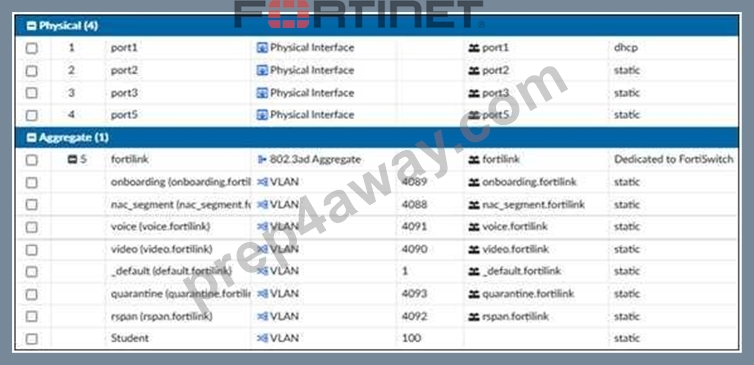
Port2 interface configuration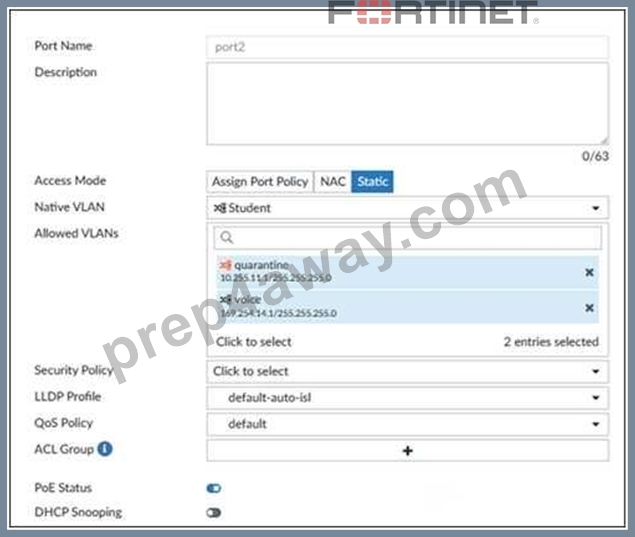
Which two statements describe how port2 handles tagged and untagged traffic? (Choose two.) Response:
- A. Port2 accepts ingress untagged traffic for VLAN IDs 100, 4091, and 4093 only.
- B. Port2 assigns ingress untagged traffic to VLAN 100.
- C. Port2 accepts ingress tagged traffic for VLAN IDs 4091 and 4093 only.
- D. Port2 tags egress traffic for VLAN 100.
Answer: B,C
NEW QUESTION # 37
You are setting up FortiAuthenticator to query users from Active Directory. Which bind method must be used for secure authentication?
Response:
- A. Anonymous Bind
- B. Simple Bind over SSL
- C. Local User Bind
- D. NTLM
Answer: B
NEW QUESTION # 38
......
Fortinet FCSS_LED_AR-7.6 Exam Syllabus Topics:
| Topic | Details |
|---|---|
| Topic 1 |
|
| Topic 2 |
|
| Topic 3 |
|
| Topic 4 |
|
Practice LATEST FCSS_LED_AR-7.6 Exam Updated 127 Questions: https://www.prep4away.com/Fortinet-certification/braindumps.FCSS_LED_AR-7.6.ete.file.html
Download Latest FCSS_LED_AR-7.6 Dumps with Authentic Real Exam QA's: https://drive.google.com/open?id=1MwS5pWzSbLzTJvH1kdnxUg3ut3IxiuMC