

[Nov-2021] Microsoft AZ-104 DUMPS WITH REAL EXAM QUESTIONS
2021 New Prep4away AZ-104 PDF Recently Updated Questions
Final Thoughts
If you want to achieve a high score after taking the Microsoft AZ-104 exam, you need to know a lot about it and learn all its topics. This guide and the hints for your preparation will make a significant difference during your preparation process. So, follow them to succeed, and good luck!
Who should take the AZ-104:Microsoft Azure Administrator Exam
The AZ-104 Exam certification is an internationally-recognized certification which help to have validation for those professionals who are knowledgeable in the Azure administration process. Candidates should have extensive experience and knowledge of using PowerShell, the Command Line Interface, Azure Portal, and ARM templates. It is good for these candidates:
- Azure administrator
- Fresher
NEW QUESTION 181
You need to meet the connection requirements for the New York office.
What should you do? To answer, select the appropriate options in the answer area.
NOTE: Each correct selection is worth one point.
Answer:
Explanation:
Explanation
Box 1: Create a virtual network gateway and a local network gateway.
Azure VPN gateway. The VPN gateway service enables you to connect the VNet to the on-premises network through a VPN appliance. For more information, see Connect an on-premises network to a Microsoft Azure virtual network. The VPN gateway includes the following elements:
* Virtual network gateway. A resource that provides a virtual VPN appliance for the VNet. It is responsible for routing traffic from the on-premises network to the VNet.
* Local network gateway. An abstraction of the on-premises VPN appliance. Network traffic from the cloud application to the on-premises network is routed through this gateway.
* Connection. The connection has properties that specify the connection type (IPSec) and the key shared with the on-premises VPN appliance to encrypt traffic.
* Gateway subnet. The virtual network gateway is held in its own subnet, which is subject to various requirements, described in the Recommendations section below.
Box 2: Configure a site-to-site VPN connection
On premises create a site-to-site connection for the virtual network gateway and the local network gateway.
Scenario: Connect the New York office to VNet1 over the Internet by using an encrypted connection.
Topic 1, Humongous Insurance
Overview
Existing Environment
Huongous Insurance is an insurance company that has three offices in Miami, Tokoyo, and Bankok. Each has
5000 users.
Active Directory Environment
Humongous Insurance has a single-domain Active Directory forest named humongousinsurance.com. The functional level of the forest is Windows Server 2012.
You recently provisioned an Azure Active Directory (Azure AD) tenant.
Network Infrastructure
Each office has a local data center that contains all the servers for that office. Each office has a dedicated connection to the Internet.
Each office has several link load balancers that provide access to the servers.
Active Directory Issue
Several users in humongousinsurance.com have UPNs that contain special characters.
You suspect that some of the characters are unsupported in Azure AD.
Licensing Issue
You attempt to assign a license in Azure to several users and receive the following error message: "Licenses not assigned. License agreement failed for one user." You verify that the Azure subscription has the available licenses.
Requirements
Planned Changes
Humongous Insurance plans to open a new office in Paris. The Paris office will contain 1,000 users who will be hired during the next 12 months. All the resources used by the Paris office users will be hosted in Azure.
Planned Azure AD Infrastructure
The on-premises Active Directory domain will be synchronized to Azure AD.
All client computers in the Paris office will be joined to an Azure AD domain.
Planned Azure Networking Infrastructure
You plan to create the following networking resources in a resource group named All_Resources:
* Default Azure system routes that will be the only routes used to route traffic
* A virtual network named Paris-VNet that will contain two subnets named Subnet1 and Subnet2
* A virtual network named ClientResources-VNet that will contain one subnet named ClientSubnet
* A virtual network named AllOffices-VNet that will contain two subnets named Subnet3 and Subnet4 You plan to enable peering between Paris-VNet and AllOffices-VNet. You will enable the Use remote gateways setting for the Paris-VNet peerings.
You plan to create a private DNS zone named humongousinsurance.local and set the registration network to the ClientResources-VNet virtual network.
Planned Azure Computer Infrastructure
Each subnet will contain several virtual machines that will run either Windows Server 2012 R2, Windows Server 2016, or Red Hat Linux.
Department Requirements
Humongous Insurance identifies the following requirements for the company's departments:
* Web administrators will deploy Azure web apps for the marketing department. Each web app will be added to a separate resource group. The initial configuration of the web apps will be identical. The web administrators have permission to deploy web apps to resource groups.
* During the testing phase, auditors in the finance department must be able to review all Azure costs from the past week.
Authentication Requirements
Users in the Miami office must use Azure Active Directory Seamless Single Sign-on (Azure AD Seamless SSO) when accessing resources in Azure.
NEW QUESTION 182
You have an Azure subscription.
You plan to use Azure Resource Manager templates to deploy 50 Azure virtual machines that will be part of the same availability set.
You need to ensure that as many virtual machines as possible are available if the fabric fails or during servicing.
How should you configure the template? To answer, select the appropriate options in the answer area.
NOTE: Each correct selection is worth one point.
Answer:
Explanation:
Explanation:
Use max for platformFaultDomainCount
2 or 3 is max value, depending on which region you are in.
Use 20 for platformUpdateDomainCount
Increasing the update domain (platformUpdateDomainCount) helps with capacity and availability planning when the platform reboots nodes. A higher number for the pool (20 is max) means that fewer of their nodes in any given availability set would be rebooted at once.
References:
https://www.itprotoday.com/microsoft-azure/check-if-azure-region-supports-2-or-3-fault-domains-managed-disks
https://github.com/Azure/acs-engine/issues/1030
NEW QUESTION 183
You have Azure subscriptions named Subscription1 and Subscription2.
Subscription1 has following resource groups:
RG1 includes a web app named App1 in the West Europe location.
Subscription2 contains the following resource groups:
For each of the following statements, select Yes if the statement is true. Otherwise, select No.
NOTE: Each correct selection is worth one point.
Answer:
Explanation:
Explanation
Reference:
https://docs.microsoft.com/en-us/azure/azure-resource-manager/management/move-limitations/app-service-move
NEW QUESTION 184
Your company has serval departments. Each department has a number of virtual machines (VMs).
The company has an Azure subscription that contains a resource group named RG1.
All VMs are located in RG1.
You want to associate each VM with its respective department.
What should you do?
- A. Create Azure Management Groups for each department.
- B. Assign tags to the virtual machines.
- C. Modify the settings of the virtual machines.
- D. Create a resource group for each department.
Answer: B
Explanation:
Reference:
https://docs.microsoft.com/en-us/azure/azure-resource-manager/resource-group-using-tags
NEW QUESTION 185
You have an Azure subscription. The subscription contains virtual machines that run Windows Server 2016 and are configured as shown in the following table.

Answer:
Explanation:
NEW QUESTION 186
You enable password reset for contoso.onmicrosoft.com as shown in the Password Reset exhibit (Click the Password Reset tab.)
You configure the authentication methods for password reset as shown in the Authentication Methods exhibit. (Click the Authentication Methods tab.)
For each of the following statements, select Yes if the statement is true. Otherwise, select No.
NOTE: Each correct selection is worth one point.
You enable password reset for contoso.onmicrosoft.com as shown in the Password Reset exhibit (Click the Password Reset tab.)
You configure the authentication methods for password reset as shown in the Authentication Methods exhibit. (Click the Authentication Methods tab.)
For each of the following statements, select Yes if the statement is true. Otherwise, select No.
NOTE: Each correct selection is worth one point.

Answer:
Explanation:
Explanation:
Box 1: No
Two methods are required.
Box 2: No
Self-service password reset is only enabled for Group2, and User1 is not a member of Group2.
Box 3: Yes
As a User Administrator User3 can add security questions to the reset process.
References:
https://docs.microsoft.com/en-us/azure/active-directory/authentication/quickstart-sspr
https://docs.microsoft.com/en-us/azure/active-directory/authentication/active-directory-passwords-faq
NEW QUESTION 187
You have an Azure subscription that contains the Azure virtual machines shown in the following table.
You add inbound security rules to a network security group (NSG) named NSG1 as shown in the following table.
You run Azure Network Watcher as shown in the following exhibit.
You run Network Watcher again as shown in the following exhibit.
For each of the following statements, select Yes if the statement is true. Otherwise, select No.
NOTE: Each correct selection is worth one point.
Answer:
Explanation:
NEW QUESTION 188
You have a virtual network named VNET1 that contains the subnets shown in the following table:
You have two Azure virtual machines that have the network configurations shown in the following table:
For NSG1, you create the inbound security rule shown in the following table:
For NSG2, you create the inbound security rule shown in the following table:
For each of the following statements, select Yes if the statement is true. Otherwise, select No.
NOTE: Each correct selection is worth one point.
Answer:
Explanation:
Explanation
Box 1: Yes
The inbound security rule for NSG1 allows TCP port 1433 from 10.10.2.0/24 (or Subnet2 where VM2 and VM3 are located) to 10.10.1.0/24 (or Subnet1 where VM1 is located) while the inbound security rule for NSG2 blocks TCP port 1433 from 10.10.2.5 (or VM2) to 10.10.1.5 (or VM1). However, the NSG1 rule has a higher priority (or lower value) than the NSG2 rule.
Box 2: Yes
No rule explicitly blocks communication from VM1. The default rules, which allow communication, are thus applied.
Box 3: Yes
No rule explicitly blocks communication between VM2 and VM3 which are both on Subnet2. The default rules, which allow communication, are thus applied.
Reference:
https://docs.microsoft.com/en-us/azure/virtual-network/security-overview
NEW QUESTION 189
You have an Azure virtual machine named VM1 and a Recovery Services vault named Vault1.
You create a backup Policy1 as shown in the exhibit. (Click the Exhibit tab.)
You configure the backup of VM1 to use Policy1 on Thursday, January 1.
You need to identify the number of available recovery points for VM1.
How many recovery points are available on January 8 and on January 15? To answer, select the appropriate options in the answer area.
NOTE: Each correct selection is worth one point.
Answer:
Explanation:
Explanation
Box 1: 6
4 daily + 1 weekly + monthly
Box 2: 8
4 daily + 2 weekly + monthly + yearly
NEW QUESTION 190
You have an Azure subscription that contains an Azure file share.
You have an on-premises server named Server1 that runs Windows Server 2016.
You plan to set up Azure File Sync between Server1 and the Azure file share.
You need to prepare the subscription for the planned Azure File Sync.
Which two actions should you perform in the Azure subscription? To answer, drag the appropriate actions to the correct targets. Each action may be used once, more than once, or not at all. You may need to drag the split bar between panes or scroll to view content.
Answer:
Explanation:
Explanation:
As per the official MS doc:
The recommended steps to onboard on Azure File Sync for the first with zero downtime while preserving full file fidelity and access control list (ACL) are as follows:
1. Deploy a Storage Sync Service. --> This needs to be done on Azure .
2. Create a sync group. --> This needs to be done on Azure
3. Install Azure File Sync agent on the server with the full data set. --> This needs to be done on server1.
4. Register that server and create a server endpoint on the share. --> This needs to be done on server1.
5. Let sync do the full upload to the Azure file share (cloud endpoint).
6. After the initial upload is complete, install Azure File Sync agent on each of the remaining servers.
7. Create new file shares on each of the remaining servers.
8. Create server endpoints on new file shares with cloud tiering policy, if desired. (This step requires additional storage to be available for the initial setup.)
9. Let Azure File Sync agent do a rapid restore of the full namespace without the actual data transfer. After the full namespace sync, sync engine will fill the local disk space based on the cloud tiering policy for the server endpoint.
10. Ensure sync completes and test your topology as desired.
11. Redirect users and applications to this new share.
12. You can optionally delete any duplicate shares on the servers.
First action: Create a Storage Sync Service
The deployment of Azure File Sync starts with placing a Storage Sync Service resource into a resource group of your selected subscription.
Second action: Create a sync group
A sync group defines the sync topology for a set of files. Endpoints within a sync group are kept in sync with each other. A sync group must contain one cloud endpoint, which represents an Azure file share and one or more server endpoints. A server endpoint represents a path on a registered server. A server can have server endpoints in multiple sync groups. You can create as many sync groups as you need to appropriately describe your desired sync topology.
Third action: Run Server Registration
Registering your Windows Server with a Storage Sync Service establishes a trust relationship between your server (or cluster) and the Storage Sync Service. A server can only be registered to one Storage Sync Service and can sync with other servers and Azure file shares associated with the same Storage Sync Service. ) Reference:
https://docs.microsoft.com/en-us/azure/storage/files/storage-sync-files-deployment-guide?tabs=azure-portal
NEW QUESTION 191
You have an Azure subscription that contains the Azure virtual machines shown in the following table.
You configure the network interfaces of the virtual machines to use the settings shown in the following table
From the settings of VNET1, you configure the DNS servers shown in the following exhibit.
The virtual machines can successfully connect to the DNS server that has an IP address of 192.168.10.15 and the DNS server that has an IP address of 193.77.134.10.
For each of the following statements, select Yes if the statement is true. Otherwise, select No.
Answer:
Explanation:
Explanation
Box 1: Yes
You can specify DNS server IP addresses in the VNet settings. The setting is applied as the default DNS server(s) for all VMs in the VNet.
Box 2: No
You can set DNS servers per VM or cloud service to override the default network settings.
Box 3: Yes
You can set DNS servers per VM or cloud service to override the default network settings.
Reference:
https://docs.microsoft.com/en-us/azure/virtual-network/virtual-networks-faq#name-resolution-dns
NEW QUESTION 192
You have an Azure subscription named Subscription1. Subscription1 contains the virtual networks in the following table.
Subscription1 contains the virtual machines in the following table:
The firewalls on all the virtual machines are configured to allow all ICMP traffic.
You add the peerings in the following table.
For each of the following statements, select Yest if the statement is true. Otherwise, select No.
NOTE: Each correct selection is worth one point.
Answer:
Explanation:
Explanation
Statement 1: Yes
Vnet1 and Vnet3 are peers.
Statement 2: No
Statement 3: No
Peering connections are non-transitive.
References:
https://docs.microsoft.com/en-us/azure/architecture/reference-architectures/hybrid-networking/hub-spoke
NEW QUESTION 193
You are developing an Azure web app named WebApp1. WebApp1 uses an Azure App Service plan named Plan1 that uses the B1 pricing tier.
You need to configure WebApp1 to add additional instances of the app when CPU usage exceeds 70 percent for 10 minutes.
Which three actions should you perform in sequence? To answer, move the appropriate actions from the list of actions to the answer area and arrange them in the correct order.
Answer:
Explanation:
References:
https://azure.microsoft.com/en-us/pricing/details/app-service/windows/
https://blogs.msdn.microsoft.com/hsirtl/2017/07/03/autoscaling-azure-web-apps/
NEW QUESTION 194
You have an Azure subscription.
You create the Azure Storage account shown in the following exhibit.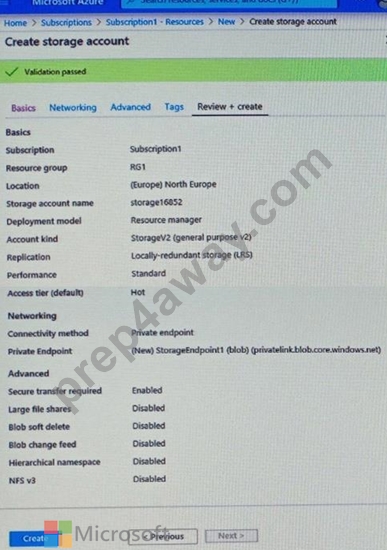
Use the drop-down menus to select the answer choice that completes each statement based on the information presented in the graphic.
NOTE: Each correct selection is worth one point.
Answer:
Explanation:
Explanation:
Box1: LRS will keep minimum three copies.
Box2: Changing the access tier from hot to cool will reduce the cost. In performance, standard is cheap.
In the Account kind, GPV2 is giving best price. Can be checked yourself using the pricing calculator on below link.
Reference:
https://azure.microsoft.com/en-in/pricing/calculator/?service=storage
NEW QUESTION 195
Note: This question is part of a series of questions that present the same scenario. Each question in the series contains a unique solution that might meet the stated goals. Some question sets might have more than one correct solution, while others might not have a correct solution.
After you answer a question in this section, you will NOT be able to return to it. As a result, these questions will not appear in the review screen.
You have an Azure subscription that contains the virtual machines shown in the following table.
You deploy a load balancer that has the following configurations:
* Name: LB1
* Type: Internal
* SKU: Standard
* Virtual network: VNET1
You need to ensure that you can add VM1 and VM2 to the backend pool of LB1.
Solution: You create two Standard public IP addresses and associate a Standard SKU public IP address to the network interface of each virtual machine.
Does this meet the goal?
- A. No
- B. Yes
Answer: A
Explanation:
Explanation
A Backend Pool configured by IP address has the following limitations:
* Standard load balancer only
Reference:
https://docs.microsoft.com/en-us/azure/load-balancer/backend-pool-management
NEW QUESTION 196
You have an Azure subscription named Subscription1 that contains the quotas shown in the following table.
You deploy virtual machine to Subscription1 as shown in the following table.
You plan to deploy the virtual machines shown in the following table.
For each of the following statements, select Yes if the statement is true. Otherwise, select No.
Answer:
Explanation:
Explanation
The total regional vCPUs is 20 so that means a maximum total of 20 vCPUs across all the different VM sizes.
The deallocated VM with 16 vCPUs counts towards the total. VM20 and VM1 are using 18 of the maximum
20 vCPUs leaving only two vCPUs available.
Reference:
https://docs.microsoft.com/en-us/azure/virtual-machines/windows/quotas
NEW QUESTION 197
You have an Azure subscription named Subscription1.
In Subscription1, you create an Azure web app named WebApp1. WebApp1 will access an external service that requires certificate authentication.
You plan to require the use of HTTPS to access WebApp1.
You need to upload certificates to WebApp1.
In which formats should you upload the certificate? To answer, select the appropriate options in the answer area.
NOTE: Each correct selection is worth one point.
Answer:
Explanation:
Explanation:
A PFX file contains the public key file (SSL Certificate) and its unique private key file. This is required for HTTPS access. The web app will distribute the public key (in a CER file) to clients that connect to the web app.
The CER file is an SSL Certificate which has the public key of the external service. The external service will have the private key associated with the public key contained in the CER file.
NEW QUESTION 198
You have an Azure subscription named Subscription1.
In Subscription1, you create an Azure file share named share1.
You create a shared access signature (SAS) named SAS1 as shown in the following exhibit.
To answer, select the appropriate options in the answer area.
NOTE: Each correct selection is worth one point.
Answer:
Explanation:
Explanation
Box 1: will have no access
The IP 193.77.134.1 does not have access on the SAS since this IP falls outside of the allowed IP address range for SAS. Hence "will have no access" is correct.
Box 2: will be prompted for credentials
The net use command is used to connect to file shares.To mount an Azure file share, you will need the primary (or secondary) storage key. SAS keys are not currently supported for mounting. Based on the provided SAS exhibit, IP address is an allowed IP and also on given date SAS is active, but account storage key is must to have to run the "net use" command , which is not provided in the question. Hence "will be prompted for credentials" is correct option for this.
net use R: \rebelsa1.file.core.windows.net\rebelshare <storage key> /user:Azure\rebelsa1 References:
https://docs.microsoft.com/en-us/azure/vs-azure-tools-storage-manage-with-storage-explorer?tabs=windows
https://feedback.azure.com/forums/217298-storage/suggestions/14498352-allow-azure-files-shares-to-be-mounted-using-sas-s
https://docs.microsoft.com/en-us/azure/storage/common/storage-sas-overview
https://docs.microsoft.com/en-us/azure/storage/files/storage-how-to-use-files-windows
http://www.rebeladmin.com/2018/03/step-step-guide-create-azure-file-share-map-windows-10/
NEW QUESTION 199
You have a sync group named Sync1 that has a cloud endpoint. The cloud endpoint includes a file named File1.txt.
You on-premises network contains servers that run Windows Server 2016. The servers are configured as shown in the following table.
You add Share1 as an endpoint for Sync1. One hour later, you add Share2 as an endpoint for Sync1.
For each of the following statements, select Yes if the statement is true. Otherwise, select No.
NOTE: Each correct selection is worth one point.
Answer:
Explanation:
Explanation
Statement 1: Yes
If you add an Azure file share that has an existing set of files as a cloud endpoint to a sync group, the existing files are merged with any other files that are already on other endpoints in the sync group.
Statement 2: No
Files present in any server endpoint will not be overwritten by the files present in cloud endpoint. Hence this statement is false.
If you add a server location with an existing set of files as a server endpoint to a sync group, those files will be merged with any other files already on other endpoints in the sync group but not vice versa.
Statement 3: Yes
Azure File Sync has a simple architecture : cloud endpoints, which is the Azure File Sync service and server endpoints, which are the registered servers with the service. On top of that, we have Sync Groups, which combine one cloud endpoint with one or more server endpoints. All members of this group will receive the replicated data where the central location will be the cloud endpoint.
References:
https://docs.microsoft.com/en-us/azure/storage/files/storage-sync-files-planning
http://techgenix.com/azure-file-sync-replicating-data/
NEW QUESTION 200
......
Microsoft AZ-104 Practice Test Questions, Microsoft AZ-104 Exam Practice Test Questions
Microsoft Azure is one of the leading Cloud computing platforms around the globe that offers a slew of useful features. Azure is being used by a lot of large-scale companies and this has created many job openings. However, to apply for these positions, the professionals need to get certified. Microsoft offers many certificates related to its Azure technology and the most popular one among them is known as Microsoft Certified: Azure Administrator Associate. To obtain this certification, you will have to pass the Microsoft AZ-104 exam.
Latest AZ-104 Pass Guaranteed Exam Dumps Certification Sample Questions: https://www.prep4away.com/Microsoft-certification/braindumps.AZ-104.ete.file.html
AZ-104 Exam with Guarantee Updated 465 Questions: https://drive.google.com/open?id=1smlTAcuEVw498dyi5k8njfUU18YFxrpQ