

PCNSA Free Update With 100% Exam Passing Guarantee [2021]
[Oct-2021] Verified Palo Alto Networks Exam Dumps with PCNSA Exam Study Guide
What Areas PCNSA Assesses You on?
There are six different domains covered under this certification exam. These areas and their details are as follows:
- Traffic Visibility
Traffic visibility concerns rules for security and this covers application shifts, dependent applications, and implicit applications as well as determining them. Such a topic is also about application filters or groups, application characteristics, properties, timeouts, and tools for optimizing security policies. The last part concerns features for streamlining policy creation for App-ID such as application tags and dependencies and explicit app dependency resolution targeting workflows.
- Simply Passing Traffic
To start is the subsection on identifying and configuring management interfaces for the firewall. It covers access to the firewalls for Palo Alto Networks, steps to gaining access to firewall, methods for managing firewall, services for firewall, etc. Managing firewall features is next with a focus on configurations for candidates, running, last saved, saved name configuration snapshot, export and import device states, and more. There is also configuring internal as well as external services targeting account administration, administrative roles, authentication sequence, configuration logs, etc. What follows further is the domain of firewall interfaces that include Ethernet, Virtual, Layer 2, Tap, Layer 3, and aggregate. Some parts cover security zones and virtual routers while others focus on the function of specific types of security, followed by identifying and configuring conditions, logging options, security policies. Also, implicit in addition to explicit rules and security rule hit count are to be covered by the PCNSA test. Finally, are the matters of NAT solution implementation covering NAT types, configuring source NAT, and more.
- Securing Traffic
This objective covers risk scenarios and how the appropriate profile can be applied. Included here are threat logs, security profiles, and customization for antivirus, anti-spyware, vulnerability protection, URL filtering, and file blocking. Also, there is a safe search and HTTP header logging. The next part is about firewall protection against packet & protocol attacks. Included within this topic are protections like Denial-of-Service, zone, flood attack, SYN cookies, UDP, ICMP, reconnaissance attack, packet-based attack, etc. What comes after is how cloud DNS security can be used by the firewall in controlling domains based on traffic and how the PAN-DB database can be used by the firewall for controlling websites based on traffic. At last, in this section, candidates will get equipped with the knowledge of URL filtering components and how to monitor access to them.
- Identifying Users
The PCNSA exam also looks at user identification and maps different IP addresses for them. Additionally, it considers controlling access to particular URLs by utilizing custom filtering categories for URL and identifying the proper user ID agent to be deployed. Also, it connects to how the mapping of firewalls to user groups is done and the ID configuration options for users.
- Deployment Optimization
This topic engages the advantages as well as differences occurring between the PBA reports and Heatmap. In particular, it includes the Heatmap component that analyzes the deployment of Palo Alto Networks and filters the data by making use of various group devices. To know more, this area also covers the feature section for Zone mapping, which helps you identify the best traffic to use by choosing the appropriate zone.
- Palo Alto Networks Cybersecurity Portfolio Core
First, this topic is concerned with identifying the components alongside operations targeting the architecture of Single-Pass Parallel Processing. In addition, candidates will learn more about Strata Security for organizations, Prismas Security for the Cloud, and Cortex Security Operational procedures. The next area to be covered here is centered on the stages of the lifecycle of a cyberattack as well as the firewall mitigations which are capable of preventing attacks. To finalize, this domain describes the Zero Trust model as well as traffic moving via networks.
NEW QUESTION 38
An administrator needs to allow users to use their own office applications. How should the administrator configure the firewall to allow multiple applications in a dynamic environment?
- A. Create an Application Filter and name it Office Programs, then filter it on the business-systems category
- B. Create an Application Group and add business-systems to it
- C. Create an Application Group and add Office 365, Evernote, Google Docs, and Libre Office
- D. Create an Application Filter and name it Office Programs, then filter it on the business-systems category, office-programs subcategory
Answer: B
NEW QUESTION 39
Which definition describes the guiding principle of the zero-trust architecture?
- A. never trust, always verify
- B. always connect and verify
- C. never trust, never connect
- D. trust, but verify
Answer: A
Explanation:
Explanation/Reference: https://www.paloaltonetworks.com/cyberpedia/what-is-a-zero-trust-architecture
NEW QUESTION 40
When creating a Source NAT policy, which entry in the Translated Packet tab will display the options Dynamic IP and Port, Dynamic, Static IP, and None?
- A. Translation Type
- B. Address Type
- C. Interface
- D. IP Address
Answer: A
NEW QUESTION 41
Arrange the correct order that the URL classifications are processed within the system.
Answer:
Explanation:
NEW QUESTION 42
All users from the internal zone must be allowed only Telnet access to a server in the DMZ zone. Complete the two empty fields in the Security Policy rules that permits only this type of access.
Choose two.
- A. Service = "any"
- B. Application = "any"
- C. Application = "Telnet"
- D. Service - "application-default"
Answer: C,D
NEW QUESTION 43
All users from the internal zone must be allowed only Telnet access to a server in the DMZ zone. Complete the two empty fields in the Security Policy rules that permits only this type of access.
Choose two.
- A. Service = "any"
- B. Application = "any"
- C. Application = "Telnet"
- D. Service - "application-default"
Answer: C,D
NEW QUESTION 44
Match the Palo Alto Networks Security Operating Platform architecture to its description.
Answer:
Explanation: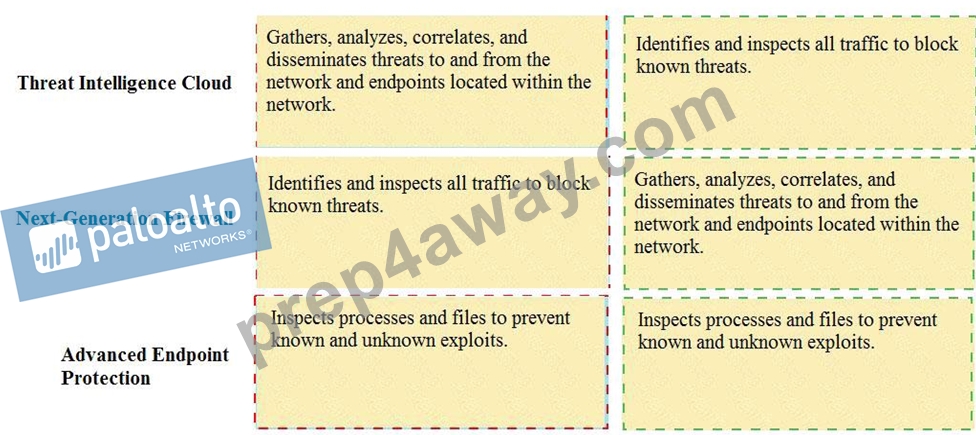
Explanation
Threat Intelligence Cloud - Gathers, analyzes, correlates, and disseminates threats to and from the network and endpoints located within the network.
Next-Generation Firewall - Identifies and inspects all traffic to block known threats Advanced Endpoint Protection - Inspects processes and files to prevent known and unknown exploits
NEW QUESTION 45
When creating a Source NAT policy, which entry in the Translated Packet tab will display the options Dynamic IP and Port, Dynamic, Static IP, and None?
- A. Translation Type
- B. Address Type
- C. Interface
- D. IP Address
Answer: A
NEW QUESTION 46
What must be configured for the firewall to access multiple authentication profiles for external services to authenticate a non-local account?
- A. LDAP server profile
- B. authentication server list
- C. authentication sequence
- D. authentication list profile
Answer: C
Explanation:
References:
NEW QUESTION 47
What in the minimum frequency for which you can configure the firewall too check for new wildfire antivirus signatures?
- A. every 24 hours
- B. every 30 minutes
- C. every 5 minutes
- D. every 1 minute
Answer: D
Explanation:
NEW QUESTION 48
How often does WildFire release dynamic updates?
- A. every 30 minutes
- B. every 15 minutes
- C. every 60 minutes
- D. every 5 minutes
Answer: D
Explanation:
Explanation/Reference: https://docs.paloaltonetworks.com/pan-os/7-1/pan-os-new-features/wildfire-features/five-minute- wildfire-updates
NEW QUESTION 49
Which two statements are true for the DNS security service introduced in PAN-OS version 10.0?
- A. It removes the 100K limit for DNS entries for the downloaded DNS updates.
- B. It functions like PAN-DB and requires activation through the app portal.
- C. IT eliminates the need for dynamic DNS updates.
- D. IT is automatically enabled and configured.
Answer: A,B
NEW QUESTION 50
Based on the show security policy rule would match all FTP traffic from the inside zone to the outside zone?
- A. intercone-default
- B. inside-portal
- C. engress outside
- D. internal-inside-dmz
Answer: C
NEW QUESTION 51
How frequently can wildfire updates be made available to firewalls?
- A. every 30 minutes
- B. every 15 minutes
- C. every 60 minutes
- D. every 5 minutes
Answer: D
NEW QUESTION 52
An administrator needs to allow users to use their own office applications. How should the administrator configure the firewall to allow multiple applications in a dynamic environment?
- A. Create an Application Filter and name it Office Programs, then filter it on the business-systems category
- B. Create an Application Filter and name it Office Programs, the filter it on the business-systems category, office-programs subcategory
- C. Create an Application Group and add business-systems to it
- D. Create an Application Group and add Office 365, Evernote, Google Docs, and Libre Office
Answer: C
NEW QUESTION 53
Which the app-ID application will you need to allow in your security policy to use facebook-chat?
- A. facebook-chat
- B. facebook-email
- C. facebook-base
- D. facebook
Answer: A,C
NEW QUESTION 54
How is the hit count reset on a rule?
- A. with a dataplane reboot
- B. Device > Setup > Logging and Reporting Settings > Reset Hit Count
- C. in the CLI, type command reset hitcount <POLICY-NAME>
- D. select a security policy rule, right click Hit Count > Reset
Answer: D
NEW QUESTION 55
A server-admin in the USERS-zone requires SSH-access to all possible servers in all current and future Public Cloud environments. All other required connections have already been enabled between the USERS- and the OUTSIDE-zone. What configuration-changes should the Firewall-admin make?
- A. In addition to option a, a custom-service-object called SERVICE-SSH-RETURN that contains source-port-TCP-22 should be created. A second security-rule is required that allows traffic from zone OUTSIDE to USERS for SERVICE-SSH-RETURN for any source-IP-address to any destination-Ip-address
- B. Create a security-rule that allows traffic from zone USERS to OUTSIDE to allow traffic from any source IP-address to any destination IP-address for application SSH
- C. Create a custom-service-object called SERVICE-SSH for destination-port-TCP-22. Create a security-rule between zone USERS and OUTSIDE to allow traffic from any source IP-address to any destination IP-address for SERVICE-SSH
- D. In addition to option c, an additional rule from zone OUTSIDE to USERS for application SSH from any source-IP-address to any destination-IP-address is required to allow the return-traffic from the SSH-servers to reach the server-admin
Answer: B
NEW QUESTION 56
An administrator receives a global notification for a new malware that infects hosts. The infection will result in the infected host attempting to contact a command-and-control (C2) server. Which two security profile components will detect and prevent this threat after the firewall's signature database has been updated?
(Choose two.)
- A. URL filtering profile applied to outbound security policies
- B. vulnerability protection profile applied to outbound security policies
- C. antivirus profile applied to outbound security policies
- D. anti-spyware profile applied to outbound security policies
Answer: A,D
Explanation:
Explanation/Reference:
Reference: https://docs.paloaltonetworks.com/pan-os/7-1/pan-os-admin/policy/create-best-practice- security-profiles
NEW QUESTION 57
......
How to book the PCNSA Exam
These are following steps for registering the Palo Alto Networks PCNSA exam. Step 1: Visit to Pearson VUE Exam Registration Step 2: Signup/Login to Pearson VUE account Step 3: Search for Palo Alto Networks PCNSA Exam Certifications Exam Step 4: Select Date, time and confirm with payment method
How much PCNSA Exam Cost
The price of PCNSA exam is $160 USD.
Authentic Best resources for PCNSA Online Practice Exam: https://www.prep4away.com/Palo-Alto-Networks-certification/braindumps.PCNSA.ete.file.html
PCNSA Test Engine Practice Exam: https://drive.google.com/open?id=1D9sq0T_Ibnv-TyJavhcJ2QaEfcfTxSZ4